






Breaking News






Belgium to boost mobile air defense capabilities with acquisition of German-made Skyranger systems.
On June 24, 2025, Belgian Defense Minister Theo Francken confirmed that Belgium will proceed with the acquisition of Skyranger air defense systems. The announcement was made in the context of a broader military restructuring under the Strategic Vision 2025 framework, which sets procurement and capability goals for the period 2026 to 2034. This acquisition is intended to address NATO-mandated capability targets and to reintroduce a short-range ground-based air defense capacity that had been dismantled following post-Cold War defense reductions.
Follow Army Recognition on Google News at this link
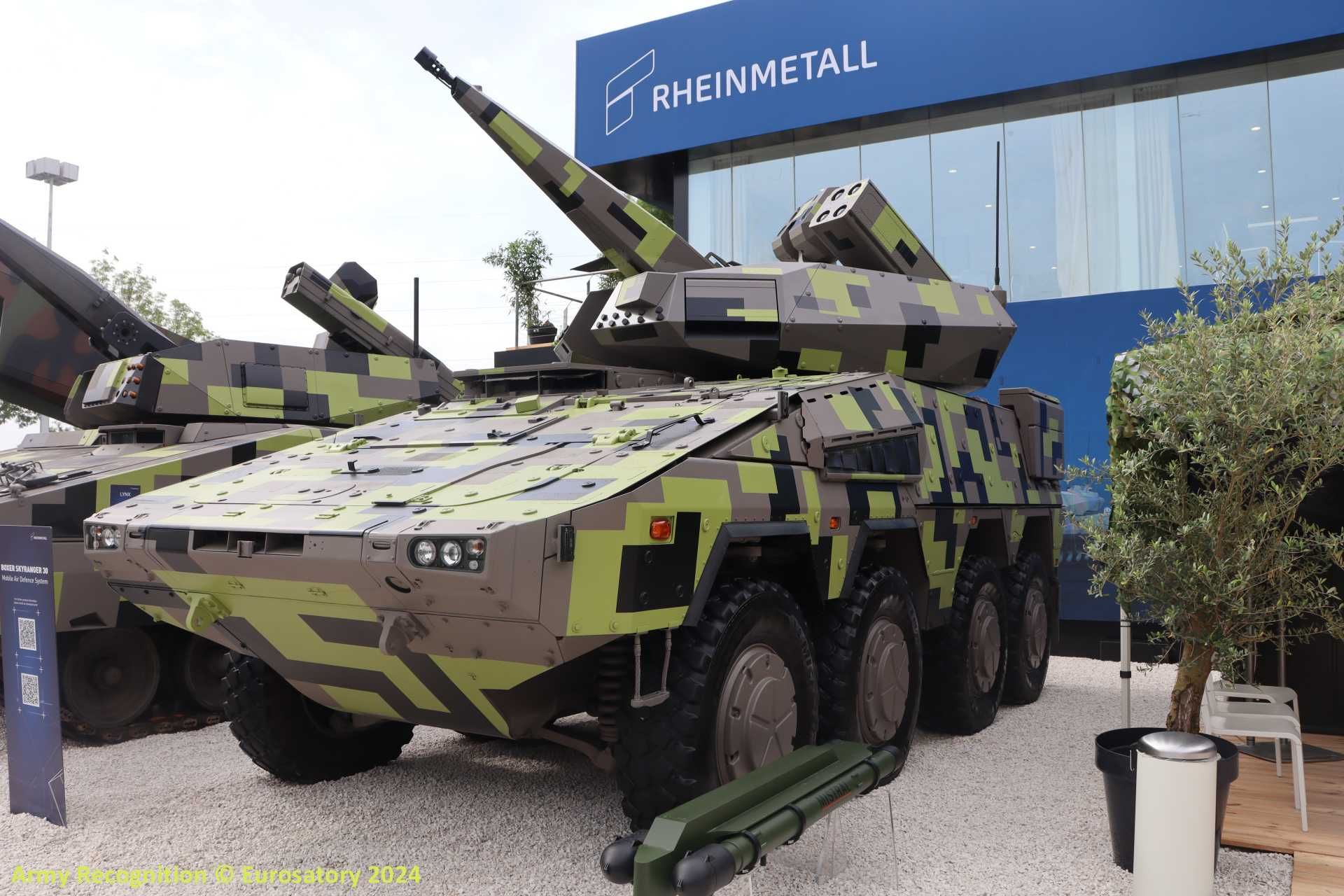
The main Skyranger variant currently in production is the Skyranger 30, which is equipped with a 30×173 mm Oerlikon KCE revolver cannon capable of a nominal rate of fire of 1,200 rounds per minute, effective at ranges of up to 3 km. (Picture source: Army Recognition)
While Francken did not specify the variant or vehicle chassis to be used, Belgian media De Morgen subsequently reported that 20 Skyranger systems are included in the plan. The Skyranger is a family of very short-range air defense systems produced by the German company Rheinmetall Air Defence AG. The main turret variant currently in production is the Skyranger 30, which is equipped with a 30×173 mm Oerlikon KCE revolver cannon capable of a nominal rate of fire of 1,200 rounds per minute. The gun has an effective range of 3 km and uses airburst munitions such as the PMC308 and PMC455, which release tungsten sub-projectiles to increase effectiveness against small aerial targets. The turret is compatible with short-range missile systems, including Stinger, Mistral-3, and the MBDA SADM/DefendAir, providing missile engagement ranges between 5 and 9 km. Integrated sensors include the Hensoldt Spexer 2000M 3D MkIII radar for 360° coverage and the FIRST infrared search and track system. The design allows for both standalone and networked operation. The final Belgian configuration has not yet been disclosed, and it remains uncertain whether Belgium will adopt the Skyranger 30, the heavier Skyranger 35 variant, or another configuration, and whether it will be integrated onto wheeled or tracked vehicles.
Different versions of the Skyranger have been selected by various NATO member states, each integrated with national vehicle platforms. Germany ordered 19 Skyranger 30 turrets to be mounted on Boxer 8x8 vehicles, under a €595 million contract signed in 2024. Austria ordered 36 systems on Pandur EVO 6×6 chassis, with an option for nine additional units, to be delivered starting in 2026. Denmark chose 16 Skyranger 30 units to be integrated with Piranha V platforms, while the Netherlands has selected the ACSV tracked platform for 22 systems, to be delivered by 2028. Hungary is developing a variant mounted on the KF41 Lynx, in cooperation with Rheinmetall. Other chassis have been explored for potential integration, including the M5 Ripsaw UGV and Indonesia's Badak 6x6. To date, no Belgian industrial partner or integration platform has been confirmed. Rheinmetall has proposed production and assembly options in several European countries. A €5 million contract signed in May 2025 with Lumibird Photonics Sweden AB covers the delivery of Vidar laser rangefinders for the Skyranger 30 through 2028, which may be relevant to future Belgian systems if aligned with standard NATO configurations.
The Skyranger order is part of the wider Strategic Vision 2025 plan, which outlines long-term objectives for the Belgian Armed Forces from 2026 to 2034. The plan includes €50 billion for personnel-related expenses, including pensions, €7 billion for infrastructure upgrades, and €34.2 billion in defense investments, of which €27 billion is earmarked for new equipment. Alongside the Skyrangers, major procurement items include a third naval frigate, a logistics support vessel, additional MQ-9B SkyGuardian drones, heavy and search and rescue helicopters, and over 3,000 vehicles for combat and logistics use. Specifically, the land forces will receive over 1,000 armored combat vehicles, including Serval, Griffon, and Jaguar types, and approximately 2,100 logistic vehicles such as trucks and trailers. A second motorized brigade composed of 3,000 troops will be formed. Personnel targets include a total force of 34,500 military personnel, 8,500 civilian staff, and 12,800 reservists, the latter to be structured into a fully equipped operational and territorial reserve. The plan also establishes a new medical hub at the military hospital site in Neder-Over-Heembeek and allocates a portion of funds to improving service conditions.
Air defense is one of the core elements of the Strategic Vision 2025. The plan includes the procurement of ten NASAMS batteries from Norway via the Netherlands and outlines future acquisition of long-range systems, either the Patriot or SAMP/T, through joint procurement with the Netherlands. Belgium also intends to acquire 200 to 300 Polish-made Piorun MANPADS and participate in a multinational purchase of Mistral-3 missiles with France, Estonia, Cyprus, and Hungary. The Skyranger systems are intended to form the short-range mobile layer of this air defense structure. According to Belgian and NATO assessments, the lack of ground-based air defense systems in Belgium since the early 2010s has left critical infrastructure such as ports, industrial zones, and communication hubs vulnerable. Generals and specialists have identified the inability to intercept low-flying threats as a strategic gap. The reintroduction of a layered air defense network is therefore considered necessary to meet NATO capability targets and restore operational readiness.
Belgium’s Strategic Vision was adopted shortly before the June 2025 NATO summit in The Hague, where members are expected to address long-term spending and force structure. Prime Minister Bart De Wever and Minister Francken have framed the plan as a response to current and projected capability demands. Belgium’s defense spending will rise gradually, reaching 2.5% of GDP by 2034. The Alliance’s current target of 3.5% by 2035 is not yet matched by Belgium’s plan, and discussions on the implementation of a capital gains tax, required by coalition partners before additional F-35 purchases, remain unresolved. NATO has requested a fleet of 55 fighter aircraft, while Belgium has ordered 34 F-35A since 2018, and debates continue over the possible addition of 11 or 21 more. Internal coalition disagreement has delayed decisions on follow-on orders. Some parties, including Vooruit and Les Engagés, argue that further commitments must be financially justified before proceeding. Defense officials maintain that F-35 acquisition is one element in a broader modernization framework and not an isolated priority.
The inclusion of Skyranger systems in Belgium’s new defense posture reflects a shift toward restoring and modernizing national air defense capabilities. The combination of NASAMS, Skyranger, Patriot or SAMP/T, and MANPADS is intended to form a multi-layered structure capable of intercepting threats ranging from drones to cruise and ballistic missiles. Belgium’s participation in NATO’s Integrated Air and Missile Defense and the European Sky Shield Initiative supports the interoperability of these systems with neighboring countries. However, final platform selection, industrial participation, and delivery timelines for the Skyranger systems remain pending. The Strategic Vision states that all investments must enhance operational readiness in the short term and enable scalable deployments within NATO structures. According to the defense ministry, the full package, including personnel, equipment, and munitions, will improve Belgium’s ability to respond to conventional and hybrid threats and contribute to collective deterrence.