






Breaking News






Australia Fires HIMARS MLRS for the First Time to Strengthen Indo-Pacific Deterrence.
The Australian Army has conducted its first-ever firing of HIMARS missiles on national territory, marking a significant step in Canberra's military build-up within the tense security environment of the Indo-Pacific. The event took place on July 14, 2025, at the Shoalwater Bay Training Area in Queensland, as part of the multinational Talisman Sabre exercise, the largest ever held in Australia. This historic launch was carried out alongside US and Singaporean forces, which also operate these truck-mounted long-range artillery systems.
Follow Army Recognition on Google News at this link
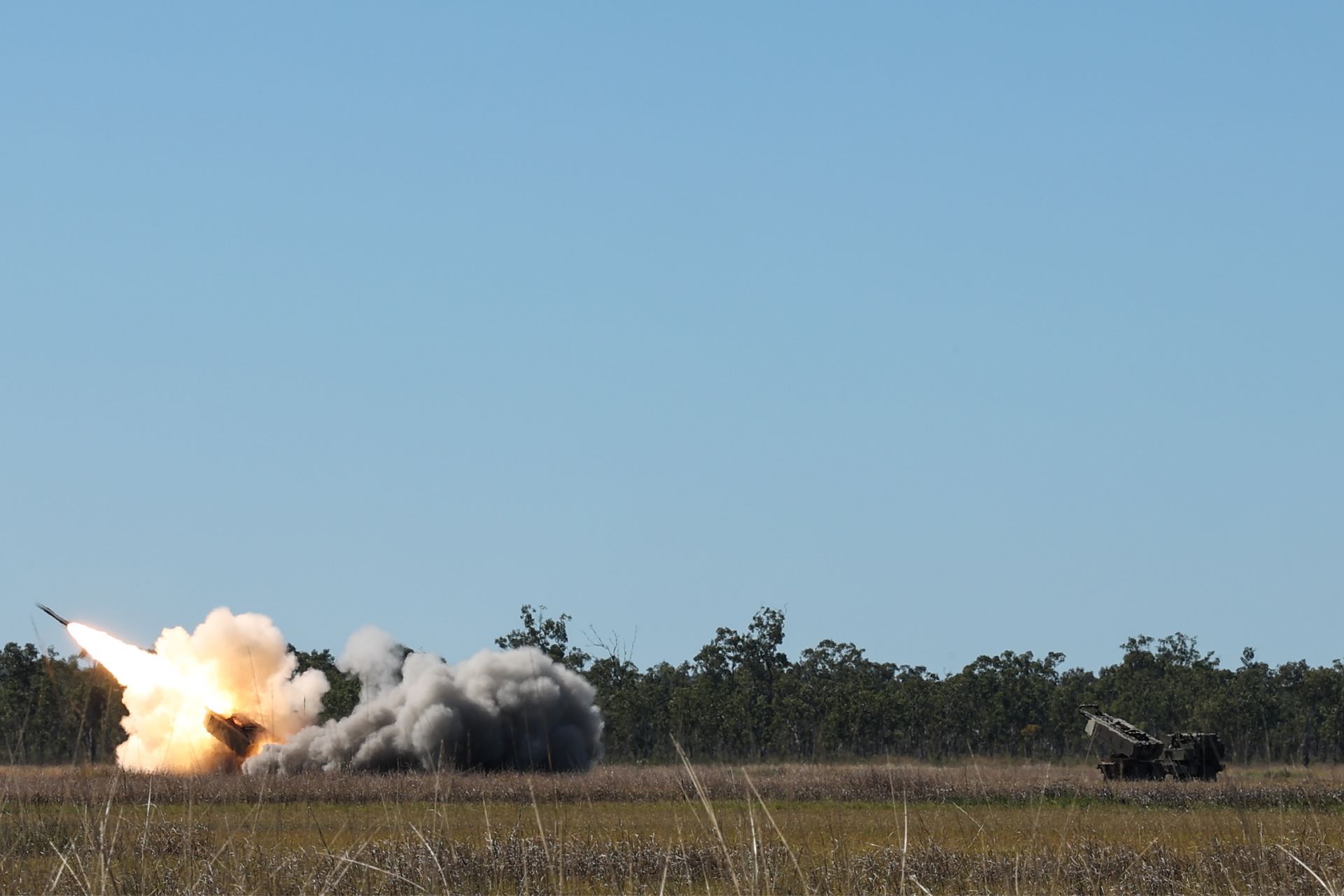
An Australian Army High Mobility Artillery Rocket System (HIMARS) is fired during a live fire exercise at Shoalwater Bay Training Area during Talisman Sabre 2025. (Picture source: Australian MoD)
The HIMARS, or High Mobility Artillery Rocket System, has become a key strategic asset, capable of striking targets up to 400 kilometers away. Its effectiveness has been demonstrated in recent operational theaters, particularly in Ukraine. In the Indo-Pacific, where regional tensions are increasing, several US allies have opted for this system. Australia, having begun receiving the first of 42 units ordered from Lockheed Martin, is thus enhancing its access denial and rapid projection capabilities.
The M142 HIMARS is an artillery system mounted on a 6x6 FMTV 5-ton military truck chassis. Developed by Lockheed Martin in 1996, it combines firepower with rapid deployment capabilities, able to fire six MLRS rockets or a single ATACMS tactical missile with a maximum range of 300 km. The armored cabin protects a crew of three against small arms fire and shell fragments, while the launcher can rotate 360 degrees, allowing for swift and precise firing. HIMARS is air-transportable by C-130 aircraft, enabling deployment to distant operational theaters.
Powered by a Caterpillar C7 engine and an Allison 7-speed automatic transmission, the HIMARS reaches a top speed of 85 km/h on roads, with a range of 480 km. It is equipped with NBC protection, an autonomous loading system, and control equipment including video interfaces and GPS. Capable of firing the full suite of MLRS munitions, including the GPS-guided GMLRS rockets with a range of 70 km, it provides a long-range strike solution suitable for modern operational requirements. Already in service with multiple countries, it combines mobility, accuracy, and firepower.
Talisman Sabre 2025 opened with a combined live-fire exercise featuring long-range land strikes, missile launches, and the engagement of US F-35B fighter jets. The show of force in northern Queensland gathered up to 40,000 military personnel from 19 nations, including the US, Japan, France, South Korea, Singapore, and European partners such as the United Kingdom and Germany. This year’s edition covers a vast area from Christmas Island in the Indian Ocean to the Coral Sea on Australia's east coast, and for the first time, exercises are also being held in Papua New Guinea, a strategic neighbor of Australia.
Brigadier Nick Wilson, director general of the combined firing exercise, highlighted that "this is the first time the Australian Army has conducted a live fire of its long-range, multi-domain strike platforms, notably the HIMARS, making it a significant day." He explained that the system is integrated into a broader strategy combining various weapons to ensure regional security and stability. Australia plans to rapidly deploy its HIMARS regiments to neighboring island states under defense agreements, to secure its northern approaches.
The exercise was attended by senior officials including Australia's Governor-General Sam Mostyn and Chief of the Defence Force Admiral David Johnston. US Army Lieutenant General Joel Vowell stated that Talisman Sabre serves as a deterrent mechanism aimed at maintaining peace: "Our ultimate goal is no war." On the diplomatic front, the maneuvers coincide with Australian Prime Minister Anthony Albanese's six-day official visit to China, which includes a meeting with President Xi Jinping. Albanese indicated that the routine surveillance of these exercises by Chinese spy ships, observed since 2017, would not be raised with Xi. Defense Industry Minister Pat Conroy confirmed that while Chinese vessels had not yet been sighted, their presence was expected and allied forces are preparing accordingly.
First launched in 2005, Talisman Sabre has established itself as a major biennial event between Australia and the United States, now expanded to include numerous partners and international observers, such as Malaysia and Vietnam this year. It aligns with Australia's rearmament policy, which includes an investment of 74 billion Australian dollars over the next decade to develop and produce missiles domestically.
The inaugural HIMARS firing and the scale of Talisman Sabre reflect Canberra’s intention to strengthen its defensive posture amid the Sino-American rivalry. This military demonstration, conducted alongside active diplomacy with Beijing, illustrates the complexities of the Indo-Pacific security balance and Australia’s determination to play a central role in regional stability.
Australia initiated the acquisition of HIMARS in August 2023, following approval by the US Department of State for a sale valued at 975 million USD. The contract includes 42 launchers with associated equipment and munitions. In April 2025, Lockheed Martin delivered the first two units to Canberra, enhancing long-range artillery capabilities in response to China’s military growth. This acquisition is part of a broader strategy involving significant investments in missile systems and the establishment of domestic industrial capacity.
The HIMARS are intended to replace or complement Australia’s existing indirect fire capabilities, previously limited to 155 mm M777 towed howitzers and lighter mobile systems. While effective, these assets lacked the range and tactical mobility provided by HIMARS. This capability upgrade gives Australia a means of deep strike from land, essential for protecting its northern approaches and ensuring deterrence in an increasingly contested geopolitical environment.