






Breaking News





AUSA 2025: RTX boosts Patriot air defense missile system with next-gen LTAMDS radar.
At the AUSA 2025 meeting in Washington, RTX introduced the latest generation of its Lower Tier Air and Missile Defense Sensor (LTAMDS). The system delivers a major upgrade to the U.S. Army’s Patriot units, expanding their reach and resilience against advanced missile and hypersonic threats.
Washington D.C., United States, October 13, 2025 - RTX unveiled its newest Lower Tier Air and Missile Defense Sensor, or LTAMDS, at the Association of the United States Army (AUSA) Annual Meeting 2025, presenting a radar designed to transform Patriot air defense performance. Developed under the U.S. Army’s modernization portfolio, the LTAMDS delivers 360-degree coverage using an advanced gallium nitride (GaN) active electronically scanned array, enabling Patriot batteries to detect, track, and engage next-generation threats such as low-flying cruise missiles and hypersonic glide vehicles.
Follow Army Recognition on Google News at this link
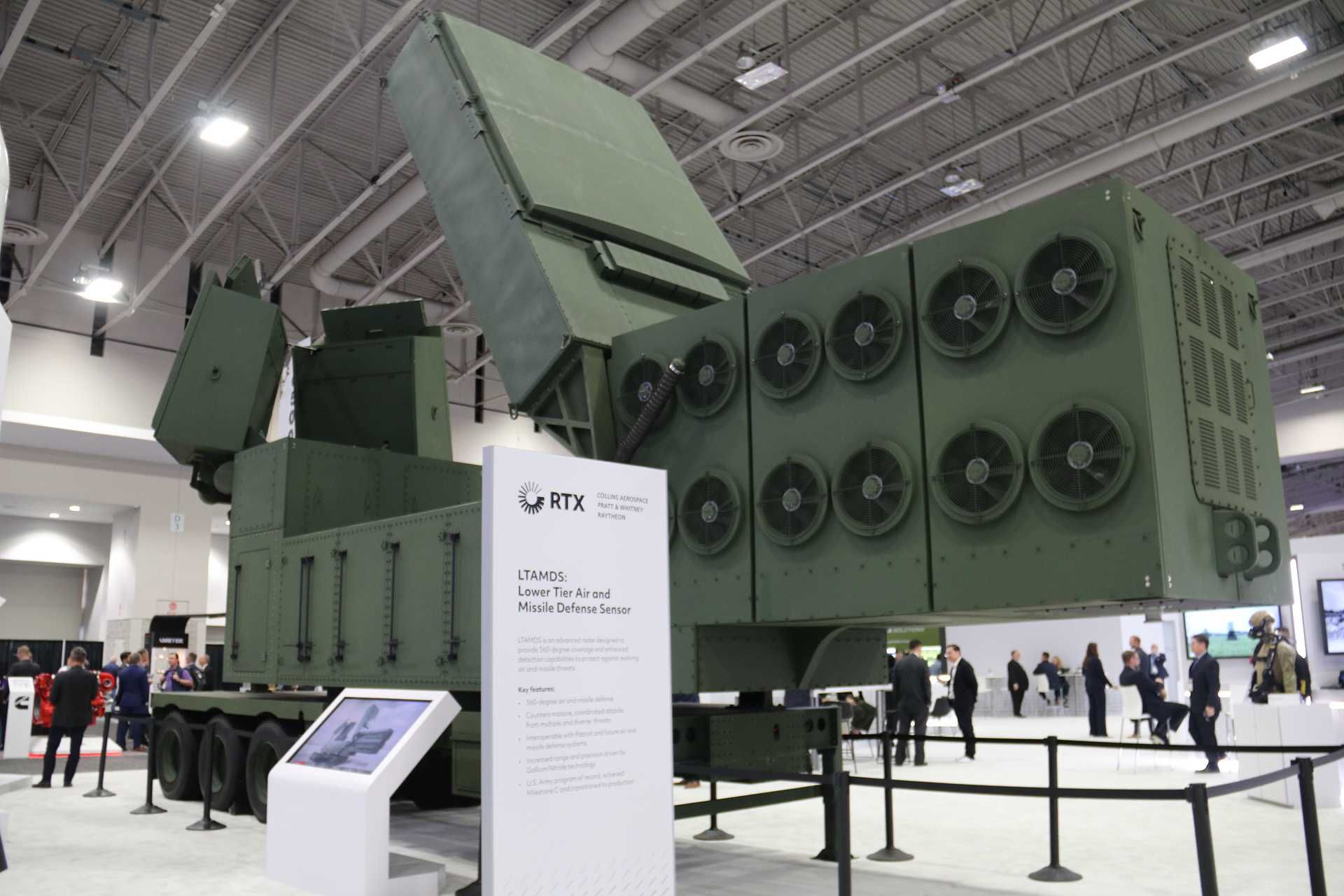
RTX’s latest generation LTAMDS radar system displayed at AUSA 2025 in Washington D.C., showcasing enhanced 360-degree coverage and advanced GaN technology for the Patriot air defense system. (Picture source: Army Recognition Group)
Displayed at the RTX pavilion, the LTAMDS (Lower Tier Air and Missile Defense Sensor) radar showcased a refined modular design that integrates seamlessly into the Army’s Integrated Air and Missile Defense (IAMD) command network. Engineers from RTX emphasized that this radar represents not just an incremental improvement, but a transformative advance toward a fully networked, 360-degree sensor capable of managing simultaneous multi-domain engagements. The company highlighted advancements in gallium nitride (GaN) technology, allowing for higher power efficiency, increased sensitivity, and longer-range target detection with a smaller maintenance footprint.
At AUSA 2025, RTX also detailed several new features integrated into the latest LTAMDS configuration. The most striking addition is its Adaptive Multi-Mode Processing Suite (AMPS), a software-driven enhancement that enables real-time reconfiguration of radar modes depending on threat type and engagement priority. This means the LTAMDS can dynamically switch between tracking high-altitude ballistic targets and low-flying cruise missiles without operator intervention. RTX further introduced Spectral Fusion Algorithms, a proprietary data processing method that merges radar returns from multiple bands, improving discrimination between genuine threats and electronic countermeasures.
Another major innovation is the Distributed Aperture Network Interface, which allows LTAMDS units to operate cooperatively across dispersed positions. When networked, multiple LTAMDS radars can act as a single integrated sensor grid, dramatically increasing detection accuracy and expanding coverage against low-observable threats such as stealth aircraft or long-range drones. The radar also includes an improved Resilient Power and Cooling Module (RPCM), designed for continuous operation in degraded power environments, a key demand for expeditionary and forward-deployed forces.
Inside technical briefings during AUSA, RTX engineers explained that the radar’s next-generation processing architecture enables faster and more intelligent signal interpretation, improving the system’s ability to distinguish between decoys, low-observable aircraft, and high-speed hypersonic vehicles. The system’s new digital control interface, compatible with the Army’s Integrated Battle Command System (IBCS), allows real-time coordination between sensors and interceptors, reducing engagement timelines by up to 30 percent.
Defense analysts attending the show described RTX’s updated LTAMDS as the backbone of future Patriot formations, emphasizing its scalability for both fixed-site and mobile operations. Discussions with U.S. Army officials confirmed that the system will serve as the foundation for future modernization phases of the Patriot force structure, complementing IBCS and providing a unified radar picture across air and missile defense assets.
RTX is currently under a 1.7 billion dollar U.S. Army contract to produce nine LTAMDS units for early fielding, with initial operational capability expected in 2026. Poland has been identified as the first international customer, with additional European and Indo-Pacific partners reportedly in discussions for follow-on acquisitions.
Company representatives stated that the next generation LTAMDS, displayed at AUSA 2025, reflects lessons learned from early testing at White Sands Missile Range and ongoing soldier evaluations. The radar’s development roadmap includes expanded integration with counter-UAS systems and emerging directed-energy interceptors, ensuring long-term adaptability as the air defense environment evolves.
RTX’s presentation at AUSA 2025 underscores its central role in reshaping layered air defense for the next decade, linking proven Patriot capabilities with future multi-domain sensor networks that will define how the U.S. and its allies defend against tomorrow’s aerial threats.
Written by Alain Servaes – Chief Editor, Army Recognition Group
Alain Servaes is a former infantry non-commissioned officer and the founder of Army Recognition. With over 20 years in defense journalism, he provides expert analysis on military equipment, NATO operations, and the global defense industry.