







Breaking News




Aselsan’s ALP 100-G Radar System Completes First Test in Türkiye’s Air Defense Push.
As reported by the Turkish company Aselsan on April 4, 2025, its new ALP 100-G low altitude radar system successfully completed the first acceptance phase, proving its high-performance detection, tracking, and mobility capabilities after months of rigorous testing and evaluation. Developed as part of Türkiye’s strategic push for a fully integrated and autonomous air defense architecture, the ALP 100-G marks a turning point in national radar technology, enabling three-dimensional detection and classification of modern aerial threats across diverse terrains.
Follow Army Recognition on Google News at this link
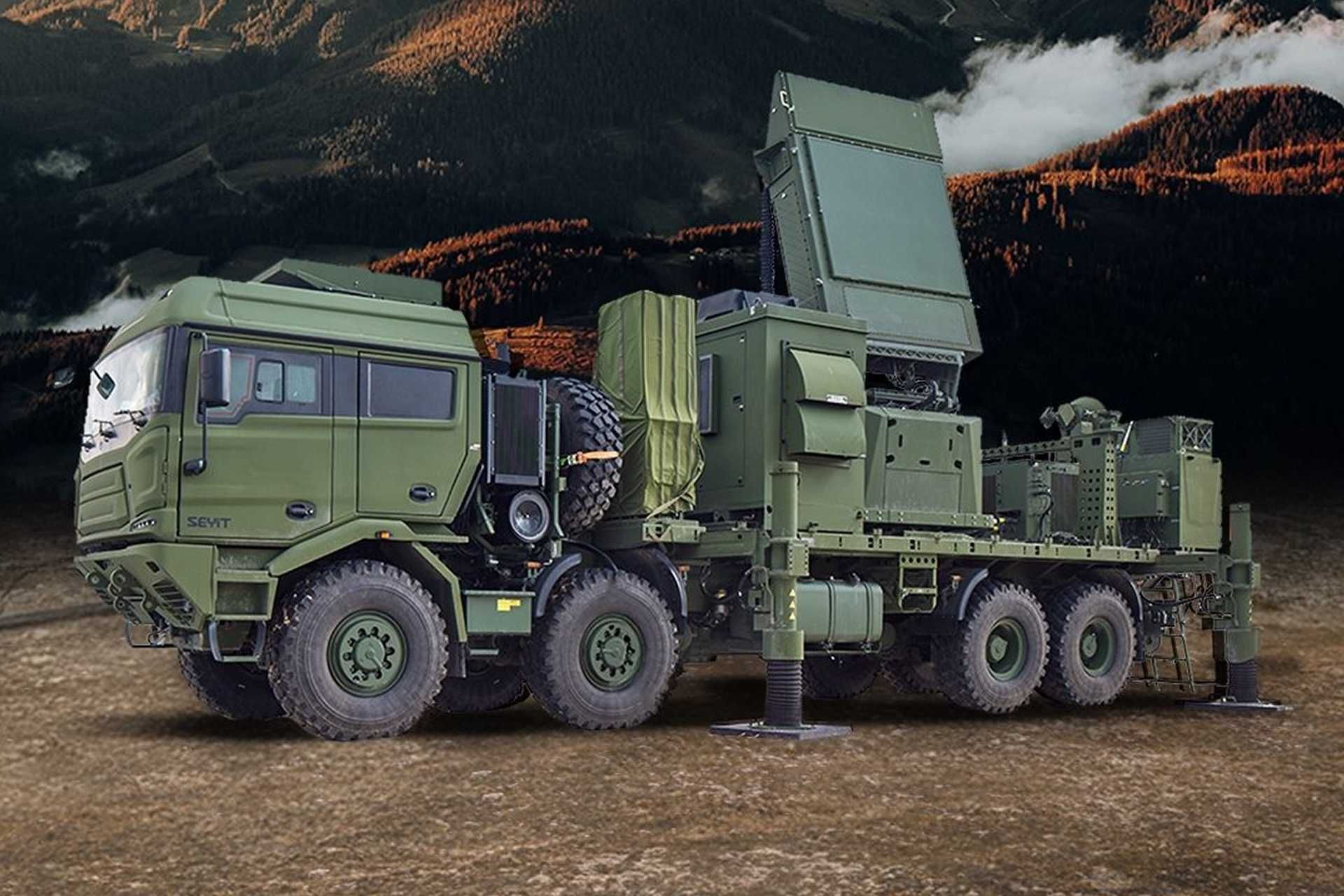
Initiated in 2019, the ALP 100-G program responds to Türkiye’s growing need for indigenous air defense solutions following the strategic and political limitations observed during the procurement of foreign systems such as the Russian S-400. (Picture source: Aselsan)
This domestically produced multifunction AESA radar is now set to play a vital role in Türkiye’s low-altitude surveillance and target engagement strategy, offering rapid deployment, modularity, and resilience in contested environments. As Türkiye reshapes its airspace defense in response to evolving geopolitical challenges and shifting alliances, the integration of the ALP 100-G signals both operational maturity and strategic independence.
The ALP 100-G, mounted on an 8x8 tactical wheeled vehicle and fully designed by Aselsan, is part of the company's scalable S-band radar family. It features active electronically scanned array (AESA) technology and is capable of performing three-dimensional detection and tracking of a wide range of targets, including fighter jets, helicopters, hovering rotorcraft, unmanned aerial vehicles (UAVs), and cruise missiles. With a tracking capacity of over 1000 targets and full 360-degree azimuth coverage, it can operate at low, medium, and high altitudes. Elevation coverage ranges from -6° to +70°, ensuring effective surveillance in both flat and mountainous areas. The system’s integrated Mode-5/S IFF enables real-time identification of friendly and hostile platforms, while its classification and jammer direction finding functions provide advanced situational awareness. The ALP 100-G also includes a dedicated weapon locating mode, capable of identifying launch points and predicted impact areas of ballistic threats such as rockets and mortars, reinforcing its role in sense-and-warn and counter-fire operations.
Designed for tactical mobility and high autonomy, the ALP 100-G radar system is mounted on a mobile platform equipped with its own power supply and communication modules. It can be transported by an A400M aircraft and deployed or prepared for movement within 15 minutes by just two operators. This makes it particularly suitable for rapid reaction in dynamic operational environments. The system can also be operated remotely through a command-and-control network, enhancing its survivability and adaptability in distributed defense configurations.
Within Türkiye’s layered air defense architecture, the ALP 100-G operates either independently or as a networked node. It complements the Hisar and Siper platforms, which are indigenous surface-to-air missile systems developed by Aselsan and Roketsan, with support from TÜBİTAK Sage. Hisar provides short-to-medium range coverage, while Siper is designed for long-range air defense. Together, they form the backbone of Türkiye’s national airspace protection.
Initiated in 2019, the ALP 100-G program responds to Türkiye’s growing need for indigenous air defense solutions following the strategic and political limitations observed during the procurement of foreign systems such as the Russian S-400. While the S-400 provided high-altitude coverage, its limited integration into NATO architecture and operational constraints led Turkish defense planners to prioritize domestic alternatives. The successful development and testing of the ALP 100-G over six months, beginning in December 2024, reflect a concerted effort by Aselsan and its partners to deliver a reliable, high-performance solution tailored to national requirements. The acceptance phase concluded symbolically on the 110th anniversary of the Battle of Çanakkale, underlining the radar’s significance within the broader narrative of Türkiye’s defense sovereignty and technological resurgence.
In strategic terms, the ALP 100-G fills a critical operational gap by enabling early warning and target tracking at low altitudes, where threats such as cruise missiles and UAVs typically evade detection by conventional long-range systems. This capacity is increasingly essential given the proliferation of small, low-flying aerial platforms used in both state-level conflicts and asymmetric warfare. Compared to equivalent radar systems such as Germany’s TRML-4D or Israel’s EL/M-2084, which are integrated into systems like Iron Dome, the ALP 100-G offers similar technical capabilities with enhanced mobility and integration into Türkiye’s domestic production ecosystem. Its AESA-based architecture allows for agile beam steering and robust tracking under electronic warfare conditions, while its modular S-band configuration supports scalable deployment across varying threat environments.
While no international contracts have yet been announced, the radar’s export potential is significant. Its transportability, rapid deployment capability, and full-spectrum threat detection make it a compelling option for allied nations seeking flexible air surveillance systems without reliance on foreign suppliers. Though the budget associated with the ALP 100-G program remains undisclosed, its domestic development and production suggest substantial cost advantages compared to imported equivalents, particularly in terms of lifecycle support and strategic autonomy.
The acceptance of Aselsan’s ALP 100-G marks a decisive advancement in Türkiye’s air defense posture, demonstrating the country's growing capability to independently field high-tech, mobile radar solutions tailored to modern threat environments. By integrating cutting-edge AESA surveillance with rapid deployment and remote operation, the ALP 100-G will serve as both a tactical asset and a symbol of technological resilience. Its role in bolstering Türkiye’s layered air defense architecture not only enhances operational readiness, but also reinforces national sovereignty at a time when airspace control is more critical than ever.