






Breaking News






Turkish Drone Kizilelma PT-4 Validates Afterburner Take-Off Capability for Short-Runway Operations.
The Bayraktar Kizilelma PT-4 has reached a critical milestone by completing its afterburner-assisted take-off test. The announcement was made on May 24, 2025, by Baykar Chairman of the Board Selçuk Bayraktar through social media. The test, officially referred to as the "Afterburner Take-off Aerodynamic System Identification Test," was part of a broader validation process aimed at refining the aerodynamic and propulsion characteristics of the Kizilelma, which is expected to enter service with the Turkish Armed Forces by 2026.
Follow Army Recognition on Google News at this link
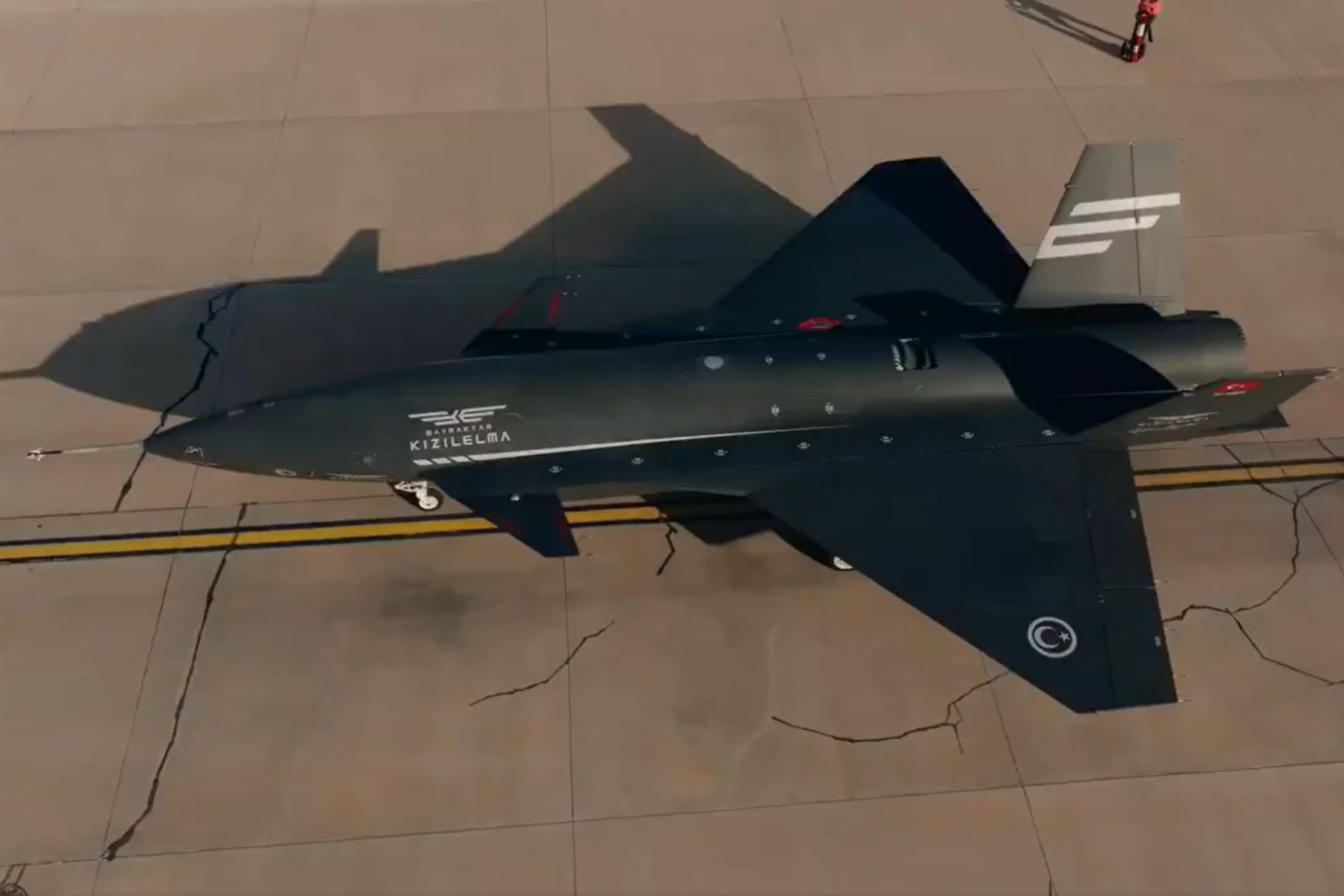
The successful afterburner take-off confirms the PT-4's ability to perform high-thrust, short-runway launches, essential for operations from restricted airstrips or ski-jump carriers (Picture source: Baykar)
The Bayraktar Kizilelma is a significant development in the field of unmanned combat aviation and aligns with Turkey's long-term vision of an air combat environment increasingly reliant on unmanned systems. Designed and developed entirely within Turkey, this aerial platform builds on Baykar’s extensive experience in tactical drones and UCAVs. It marks a transition toward more advanced combat systems that integrate automation, low observability, and enhanced mission capabilities.
In terms of performance, the Kizilelma supports a payload capacity of up to 1.5 tons and has a total weight of 8.5 tons. It is capable of cruising at Mach 0.6 and reaching a maximum speed of Mach 0.9. Its combat radius extends to 500 nautical miles, with an operational altitude of 25,000 feet and a service ceiling of 45,000 feet. The drone is designed to operate for over three hours, allowing for extended-range missions.
The aircraft measures 14.5 meters in length, with a wingspan of 10 meters and a height of 3.5 meters. Its structure is optimized for stealth and agility. Equipped with a turbofan engine, it can perform autonomously throughout all flight phases, including take-off, landing, taxiing, and cruising. These features enable effective operation in high-intensity environments.
The onboard systems include an electro-optical targeting unit, an infrared search and track system (IRST), and a multi-mode AESA radar. The drone is compatible with a variety of weapon types, including laser-guided munitions, conventional missiles, and long-range cruise missiles, allowing for operational flexibility across multiple mission types.
The successful afterburner take-off of the PT-4 represents a substantial technical advancement. It validates the drone’s ability to carry out short and rapid take-offs under high thrust, a critical requirement for deployment from limited-length runways or ski-jump-equipped aircraft carriers. This type of capability is typically associated with advanced manned fighter aircraft and indicates the operational intentions behind the Kizilelma program.
For Baykar, this achievement marks a move from producing tactical drones to developing more complex combat systems that can compete with established international programs. For Turkey, the Kizilelma is part of a broader industrial and strategic initiative. Over the past two decades, the country has evolved from a drone-importing nation to a major exporter.
Systems like the TB2 and Akinci have demonstrated operational effectiveness in conflicts in Libya, Syria, Nagorno-Karabakh, and Ukraine. The development of heavier and more autonomous drones such as the Kizilelma reinforces this trend, placing Turkey among the few countries capable of producing high-performance UCAVs while strengthening its strategic independence in a competitive global defense landscape.