






Breaking News






Is Egypt Considering the Chinese J-35 for Its Next-Generation Fighter Program?.
During the recent China-Egypt joint air drills, Eagles of Civilization 2025, held between April and May at Wadi Abu Rish Air Base, non-official sources reported that the Commander of the Egyptian Air Force, Lieutenant General Mahmoud Fuad Abdel Gawad, expressed a strong interest in China’s J-35 stealth fighter. While this information has not been officially confirmed by either Egyptian or Chinese authorities, it has sparked considerable speculation about a potential shift in Cairo’s military procurement strategy.
Follow Army Recognition on Google News at this link
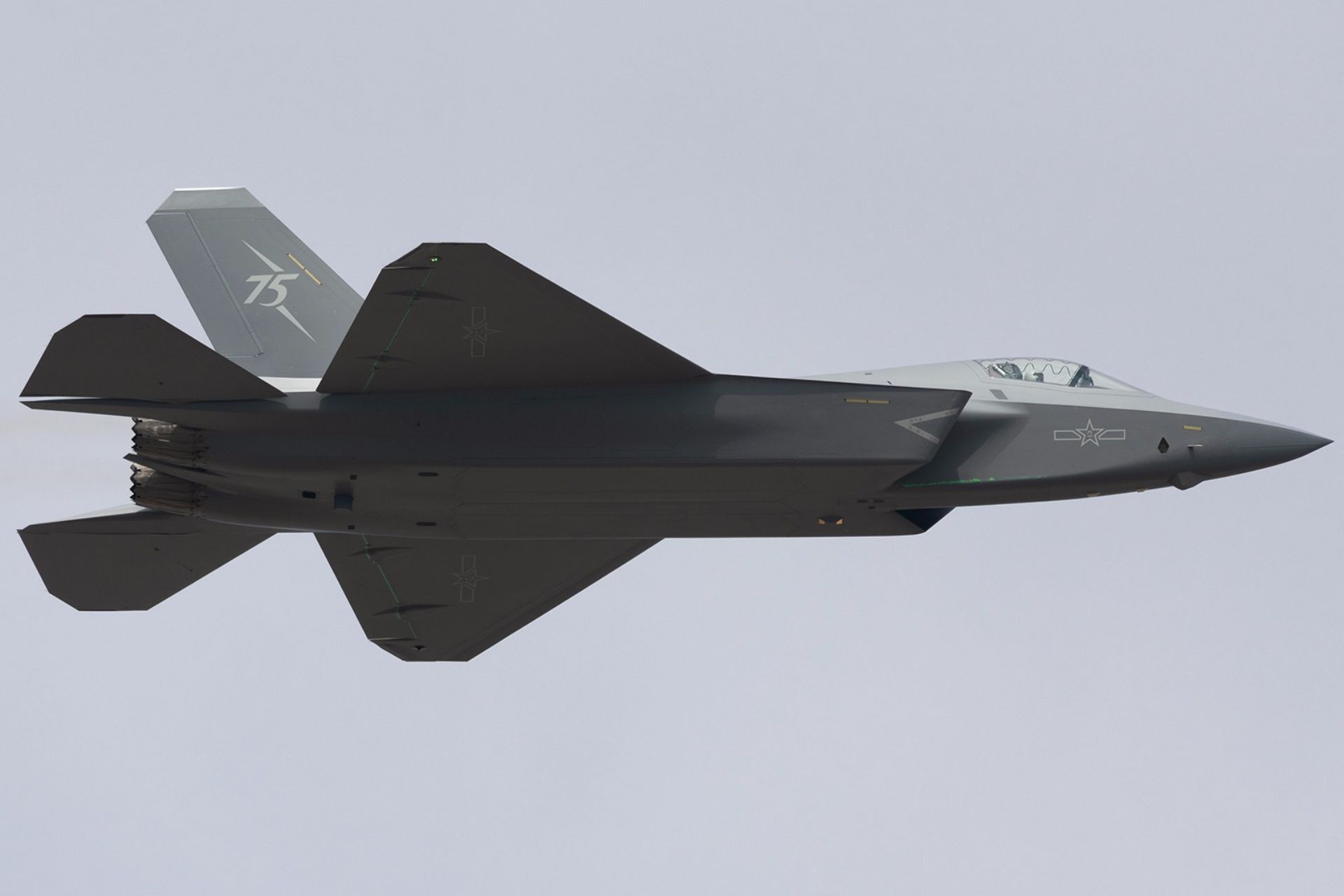
The J-35 features a low-observable twin-engine airframe, diverterless supersonic inlets (DSI), and internal weapons bays. (Picture source: @ZGGGRWY01)
This reported interest would have emerged during the general’s visit to the bilateral exercise, in which both countries deployed advanced aerial platforms. China brought in its J-10C fighters, the KJ-500 early warning aircraft, YU-20 tankers, and Y-20 strategic airlifters. Egypt fielded its Russian-built MiG-29M/M2 fighters. Although no official statement corroborates the general’s remarks, the setting provided a credible environment for technical exchanges and capability evaluations.
The J-35, developed by Shenyang Aircraft Corporation, is a fifth-generation fighter derived from the FC-31 demonstrator, designed for both air superiority and strike missions. It features a low-observable twin-engine airframe, diverterless supersonic inlets (DSI), and internal weapons bays. Two main variants exist: the naval J-35, designed for Chinese aircraft carriers with folding wings and a reinforced nose gear for catapult launches, and the J-35A, a lighter land-based version optimized for the Chinese Air Force. The aircraft is equipped with an active electronically scanned array (AESA) radar, an electro-optical targeting system (EOTS) under the nose, infrared search and track (IRST), and a heads-up display integrated with a digital control interface. The cockpit includes a 20-inch multifunction touchscreen and a helmet-mounted sighting system.
In terms of firepower, the J-35 can carry up to six missiles internally, such as the PL-10, PL-15, and PL-21, and additional ordnance on six external hardpoints. It can also deploy precision-guided bombs, cruise missiles, or anti-radiation weapons depending on the mission. With a maximum take-off weight estimated at 28 tons and a combat radius of 1,200 kilometers, it is designed for beyond-visual-range engagements and operations in heavily contested airspace. The WS-21 engine currently powers the aircraft, providing 93 kN of thrust, while the WS-19 engine, intended to enable supercruise, is still under development. Its modular structure, smooth surface, radar-absorbent materials, and serrated exhausts contribute to its reduced radar and infrared signatures.
If confirmed, Egypt’s interest in this platform would reflect a broader effort to diversify its defense suppliers. The Egyptian Air Force currently operates over 200 U.S.-made F-16s, French Rafales, Russian MiG-29s, and Chinese-made trainers and drones. However, U.S. restrictions on upgrading its F-16 fleet, particularly in terms of AESA radars and long-range missiles, limit Egypt’s modernization path. In 2018, a planned acquisition of Russian Su-35s was suspended under threat of U.S. sanctions, even though some units had already been built.
In this context, turning to Chinese systems like the J-35 could offer an intermediate solution for Cairo to enhance its airpower while bypassing political constraints. However, there are indications that this interest might be part of a diplomatic strategy commonly observed in defense circles, signaling alignment with an alternative supplier to gain better terms from traditional partners. This tactic was used in 2022 when talks about acquiring Su-35s prompted the U.S. to offer Egypt access to F-15s.
It is also important to note that the J-35 remains unproven in combat and is still in advanced testing stages. While commercial availability has not yet been formally declared, Pakistan may become its first customer. Integrating a platform of this complexity into Egypt’s already diverse fleet would require significant investments in infrastructure, training, maintenance, and doctrinal adjustments.
In parallel, Egypt is exploring other options, notably the South Korean FA-50 light fighter. According to open sources, discussions are underway for the potential acquisition of around 100 units, with the possibility of local production. The FA-50, compatible with Western standards, offers simpler logistics and a unit cost of around $30 million.
Still, a key question remains: Would China be willing to export such a sensitive asset as the J-35 to a country like Egypt? While the aircraft is officially intended for foreign markets, delivering a fifth-generation stealth fighter to a military historically aligned with the U.S. would mark a significant strategic shift. For Beijing, it could represent a way to break into a region traditionally dominated by Western influence. However, it also entails political and technological risks, especially given Egypt’s interoperability with NATO systems. Pakistan, a more closely aligned defense partner, appears to be a more plausible first recipient, casting doubt on China’s readiness to make Egypt its initial export customer.
The plausibility of a shift toward the J-35 is supported by several factors: Cairo’s dissatisfaction with U.S. restrictions, its ongoing effort to diversify military partners, its political alignment with Beijing, and the exposure to Chinese capabilities during joint drills. Additionally, the broader Sino-Egyptian strategic partnership, formalized in 2024 and supported by $1 billion in bilateral contracts, provides a political framework for deepening ties.
While the Eagles of Civilization 2025 exercise has given Egypt a close look at China’s advanced aerospace systems, a future acquisition of the J-35 remains speculative at this stage. It could mark a major strategic evolution, or simply serve as a calculated move to strengthen Egypt’s negotiating position with its Western allies. The coming years will reveal whether Cairo truly intends to pivot toward Chinese stealth capabilities or whether this interest is part of a broader effort to assert autonomy in an evolving geopolitical landscape.