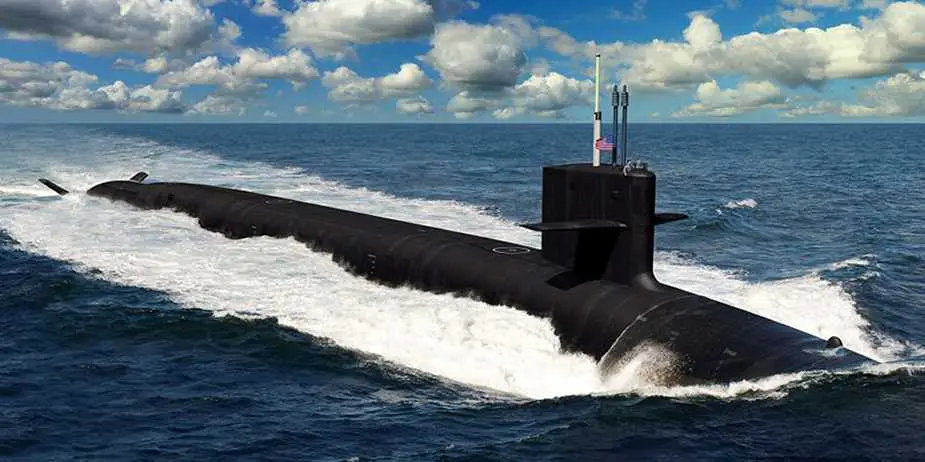
The Columbia-class is the U.S. Navy's next-generation of nuclear-powered ballistic missile submarines (SSBNs) developed to replace the fourteen Ohio-class SSBNs that have formed the sea-based component of the U.S. nuclear triad since the early 1980s. Originally known as the Ohio Replacement Program (ORP) and SSBN(X), the class consists of twelve planned submarines that will gradually enter service beginning in the early 2030s while Ohio-class retirements occur at a rate of one submarine per year. Representing the U.S. Navy's highest acquisition priority, the Columbia-class will become the United States' primary strategic nuclear deterrent at sea once fully operational, with each submarine designed for a 42-year service life without reactor refueling and expected to conduct up to 124 strategic deterrent patrols before retirement.
Country users: United States






Technical Data
-
Armament
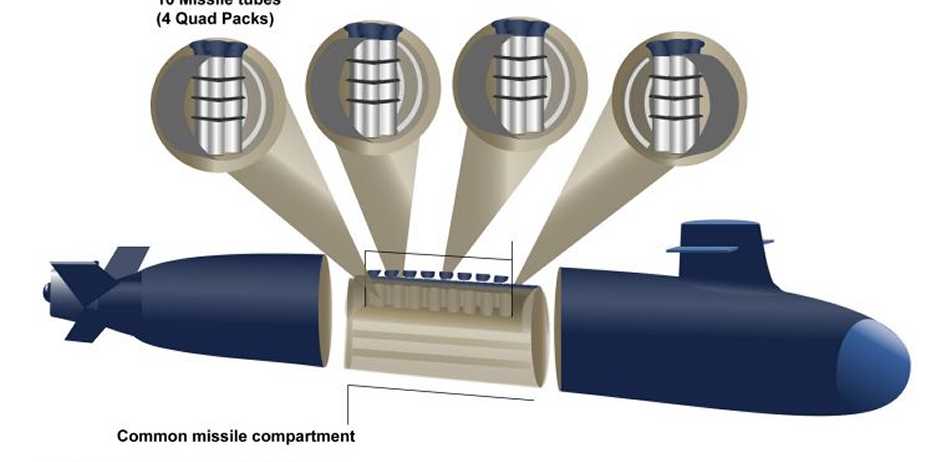
The Columbia-class is built around the Common Missile Compartment (CMC), which forms the primary structural section of the submarine and constitutes its principal combat capability. Developed jointly by the US and the UK, the CMC standardizes the missile launch architecture used by both the Columbia-class and the Royal Navy's Dreadnought-class. Instead of individual launch tube arrangements, the compartment is organized into four Quad-Pack modules, each containing four missile tubes, for a total of 16 launch tubes. The compartment incorporates not only the tubes themselves but also the associated launch control equipment, electrical distribution, cooling systems, gas venting systems, missile support equipment, and launch software required for ballistic missile operations. Responsibility for development of the CMC rests with the U.S. Navy Strategic Systems Programs office.
Each missile tube is dimensionally identical to those installed aboard the Ohio-class, with an internal diameter of 87 inches (2.2 m), allowing continued operation of the UGM-133 Trident II D5 Life Extension (D5LE) submarine-launched ballistic missile (SLBM). The launch system is also planned to accommodate the upgraded D5LE2 missile. The reduction from 24 launch tubes aboard the Ohio-class to 16 on the Columbia-class reflects a force-structure decision: the U.S. Navy concluded that improvements in submarine availability, extended service life, reduced maintenance periods, and continuous deployment schedules would maintain required strategic deterrence with fewer launchers while reducing acquisition and life-cycle costs.
Although the SLBMs represent the submarine's primary weapon system, the Columbia-class also retains 533 mm torpedo tubes located in the forward weapons compartment for self-defense and limited tactical engagements. The torpedo room occupies one of the major pressure hull modules manufactured by Newport News Shipbuilding before final assembly at Electric Boat. Unlike attack submarines, however, the torpedo armament represents a secondary capability intended primarily for force protection during deployment rather than offensive undersea warfare.
-
Design
The Columbia-class has a submerged displacement of 20,810 long tons (21,140 metric tons), an overall length of 171 meters (560 feet) and a beam of 13 meters (43 feet), making it the largest submarine ever constructed for the U.S. Navy. While overall length remains similar to the Ohio-class, hull diameter increased by approximately 30 cm (1 foot) to provide additional internal volume for the new propulsion architecture, electrical generation equipment, reactor compartment and updated missile compartment while preserving buoyancy and acoustic isolation requirements.
Unlike previous generations of American ballistic missile submarines, the Columbia-class was designed from the outset for a 42-year service life without nuclear refueling. The S1B reactor employs a life-of-the-ship nuclear fuel core that eliminates the two-year mid-life reactor overhaul required by the Ohio-class. Removing this overhaul significantly increases operational availability throughout each submarine's lifetime while reducing long-term maintenance demands across the twelve-boat fleet. The U.S. Navy estimates each Columbia-class submarine will complete 124 strategic deterrent patrols before retirement.
Hydrodynamic design incorporates several features previously introduced on the Virginia-class. The stern adopts X-shaped control surfaces instead of the conventional cruciform arrangement, improving maneuverability while reducing hydrodynamic drag and acoustic flow disturbances. Sail-mounted dive planes replace bow-mounted hydroplanes, reducing interference with the large bow sonar array and improving under-ice navigation. Extensive anechoic hull coatings reduce reflected active sonar signature while also attenuating machinery noise transmitted through the outer hull. Together with the pump-jet propulsor and electric-drive propulsion architecture, these measures substantially reduce the submarine's acoustic signature compared with previous U.S. ballistic missile submarines.
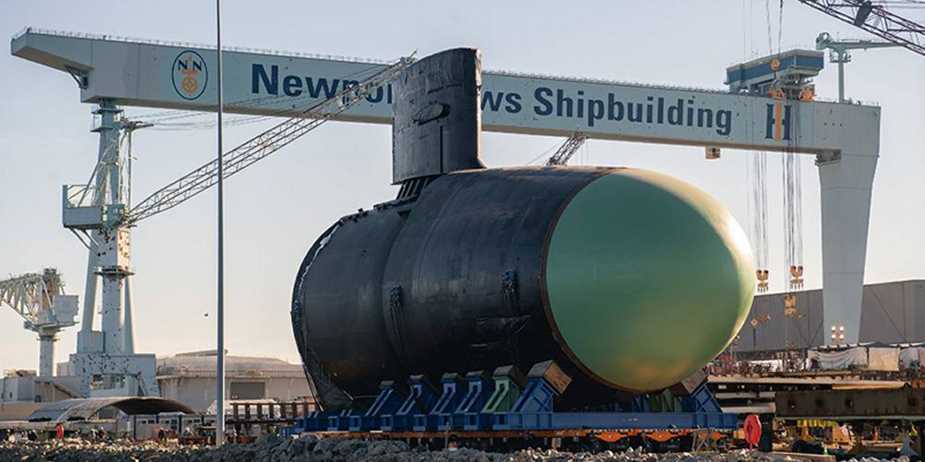
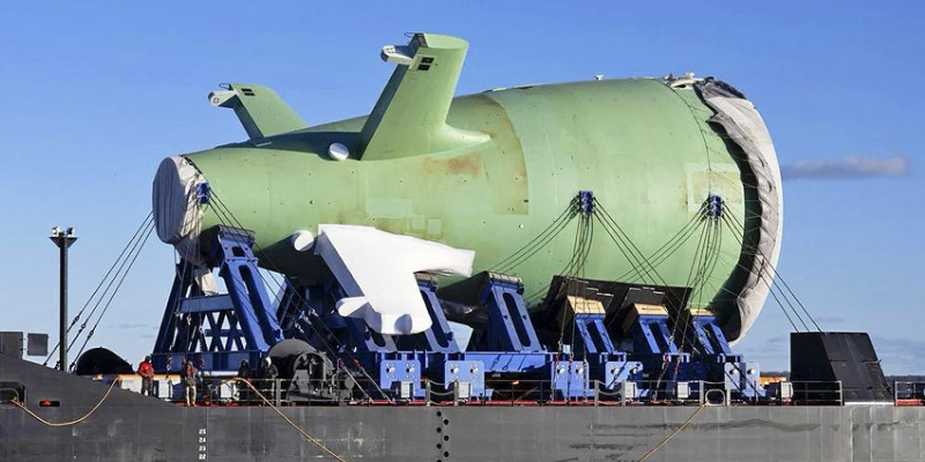
Construction relies on a fully modular manufacturing process distributed between the country's only two nuclear submarine shipyards. Newport News Shipbuilding manufactures the bow, weapons compartment, auxiliary machinery rooms, superstructure, sail and stern, while Electric Boat produces the largest and most technically demanding pressure hull sections, including the reactor compartment, missile compartment and central command spaces before conducting final assembly at Groton, Connecticut. Simultaneous fabrication of complete hull sections allows the Columbia-class production to continue alongside the Virginia-class construction while shortening overall assembly time and sustaining the submarine industrial base.
-
Propulsion
The Columbia-class introduces the first integrated turbo-electric propulsion system installed aboard a U.S. Navy ballistic missile submarine. Instead of transmitting mechanical power from steam turbines through reduction gears to the propulsor, the S1B nuclear reactor generates steam that drives turbine generators producing electrical power. That electrical energy supplies both the submarine's onboard systems and a high-power electric propulsion motor connected to the pump-jet propulsor. Eliminating the large mechanical reduction gear removes one of the principal sources of radiated machinery noise while providing greater flexibility in machinery arrangement inside the pressure hull. The exact thermal or electrical megawatt power output of this pressurized water reactor designed by Bechtel Marine Propulsion Corporation is classified by the U.S. Navy
Northrop Grumman was selected during 2014 to design and manufacture the turbine generator units, while Leonardo DRS became the supplier of the propulsion motor and associated drive system. The lead ship's propulsion motor was delivered to Electric Boat in 2022 as construction progressed. The U.S. Navy evaluated several electric motor technologies during development, including permanent-magnet motors and superconducting synchronous motors, before focusing development on advanced permanent-magnet electric propulsion solutions intended to maximize efficiency, reliability and acoustic performance.
Propulsion is completed by a pump-jet propulsor, a technology previously introduced on the Virginia-class attack submarine. Compared with conventional propellers, the pump-jet delays cavitation at higher speeds, lowers broadband underwater radiated noise and improves hydrodynamic efficiency during sustained submerged operations. Combined with the electric-drive architecture, the propulsion system is intended to maximize acoustic discretion throughout extended strategic patrols while supporting the submarine's unlimited operational range provided by its nuclear propulsion plant.
-
Sensors and detection systems
The Columbia-class employs a distributed acoustic surveillance architecture derived from the latest Virginia-class submarines rather than relying on a single large bow sonar. The core of the system is an enlarged Large Aperture Bow (LAB) array, a water-backed passive sonar that replaces the air-backed spherical bow array carried by earlier Los Angeles- and Ohio-class submarines. The LAB array uses commercial off-the-shelf hydrophone technology mounted directly within the bow structure, reducing maintenance requirements while increasing passive detection sensitivity over a broad frequency spectrum. Relocating the forward diving planes from the bow to the sail also allows a larger acoustic aperture while minimizing hydrodynamic turbulence around the sonar installation. The FY2026 Navy budget identifies the Columbia sonar suite as comprising the LAB array hydrophones, Low Cost Conformal Array (LCCA), AN/WSQ-9 acoustic signal analysis system, and TB-29 and TB-34 towed passive arrays used for long-range detection, tracking, and localization of submerged contacts.
Unlike previous U.S. ballistic missile submarines, the Columbia-class incorporates the Non-Propulsion Electronics System (NPES), an integrated architecture that combines sonar processing, tactical command-and-control, navigation, communications and crew information systems into a common digital environment. The combat system is based on the Submarine Warfare Federated Tactical System (SWFTS) open architecture already fielded across the Virginia-class fleet. Separating software applications from dedicated hardware allows computing equipment, acoustic processors and mission applications to be modernized independently throughout the submarine's projected service life, reducing upgrade complexity while facilitating the insertion of new sensors, processors and cybersecurity improvements without redesigning the complete combat system. Current operational testing also includes cybersecurity assessments covering the communications, combat control and command-and-control systems integrated within this architecture.
The sensor suite is complemented by non-hull-penetrating photonic masts, replacing conventional optical periscopes with the L3Harris Technologies Type 20 low-profile mast, electro-optical, infrared and digital imaging systems that transmit imagery electronically to multifunction displays within the control room. The Columbia program also incorporates modern electronic warfare support measures (ESM) from Lockheed Martin, communications, navigation and photonics technologies already matured across recent U.S. submarine programs, reducing development risk while improving reliability and maintainability. Publicly available Navy information confirms dedicated program offices supporting submarine electromagnetic systems, including the Photonics Mast and electronic warfare equipment, although detailed performance characteristics remain classified.
Acoustic survivability remains the defining characteristic of the Columbia-class. Rather than relying on a single quieting technology, the submarine combines the LAB array, conformal arrays, towed arrays, integrated electric-drive propulsion, pump-jet propulsor, extensive machinery isolation, resilient equipment foundations, and anechoic hull treatments into a single low-signature design. The elimination of reduction gears through turbo-electric propulsion substantially reduces machinery-generated vibration, while the pump-jet delays cavitation and lowers broadband radiated noise. These measures are intended to preserve the survivability required for strategic deterrent patrols against increasingly capable anti-submarine warfare forces throughout the class's projected service life into the 2080s.

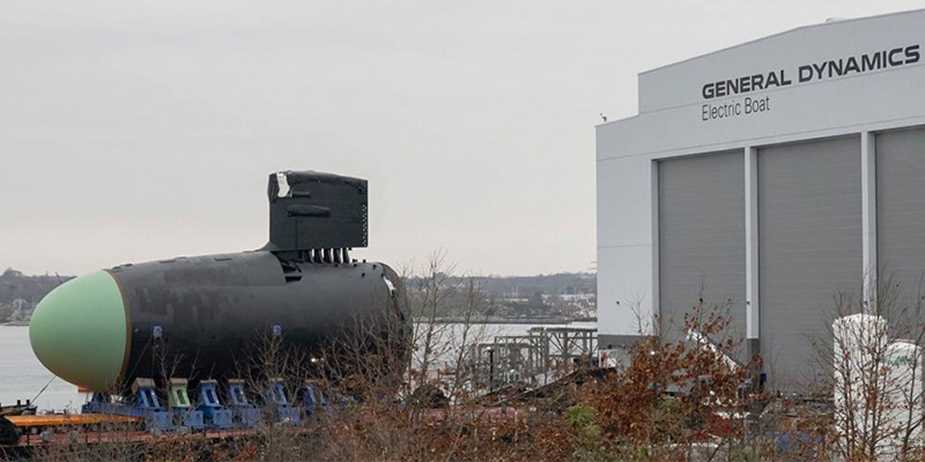
The bow section of the future District of Columbia (SSBN 826), built by HII, arrived at General Dynamics Electric Boat for final assembly and testing in November 2025.
Details View


Photo Gallery