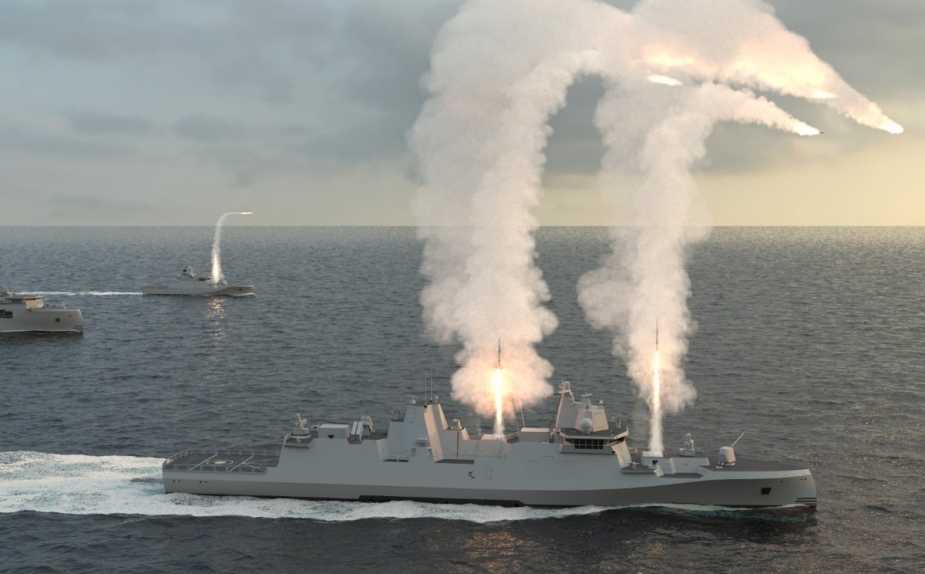
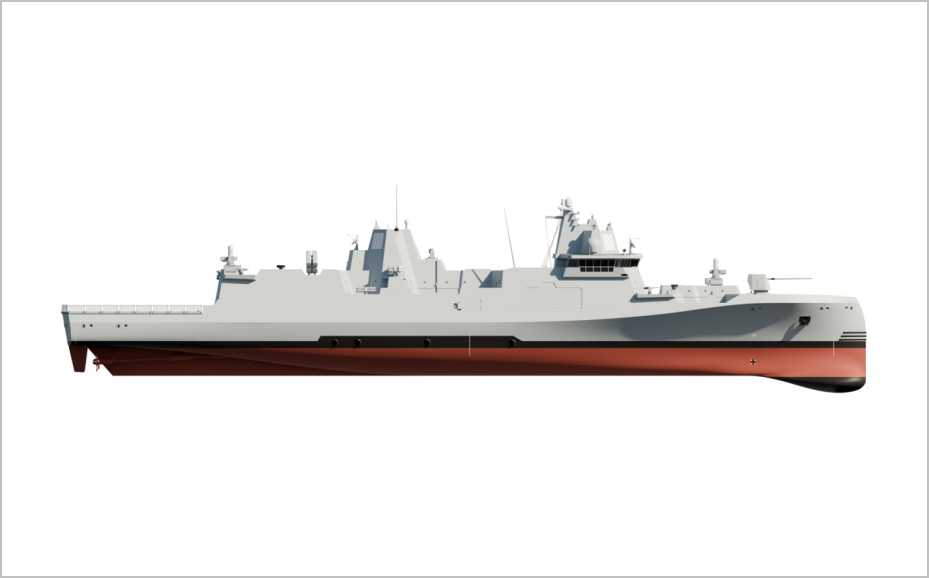
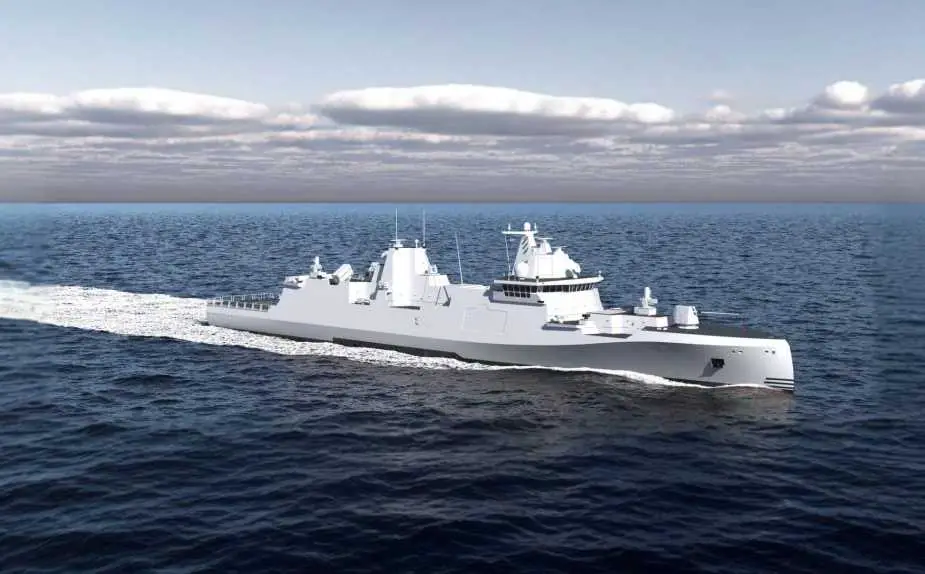
The GMF 140 is a 140 m guided missile frigate developed by the German company Rheinmetall for anti-air warfare, ballistic missile defense, anti-submarine warfare, and long-range precision strike missions. The ship displaces more than 6,000 tonnes, reaches a maximum speed of 30 knots, and is intended to operate with a core crew of 90 personnel, with accommodation for 35 additional personnel. Its principal missile battery consists of 64 Strike-Length vertical launch cells connected to an AEGIS-centered combat architecture and configurable U.S.-sourced primary radars. Rheinmetall developed the ship for NATO and allied navies requiring a frigate capable of tracking conventional aircraft, cruise missiles, hypersonic threats and ballistic missiles while retaining anti-submarine and land-attack capabilities.
Country users: Germany






Technical Data
-
Design
The GMF 140 has an overall length of 140 m and a displacement of more than 6,000 tonnes. Rheinmetall has not disclosed whether this figure represents standard, full-load or design displacement. Beam, draught, overall height, flight deck dimensions and internal volume have also not been released. The vessel uses a low-signature hull and superstructure arrangement intended to reduce detection, while integrated acoustic management is included to control machinery and hydrodynamic noise during anti-submarine operations.
The ship is designed around a minimum-manning concept, with a standard crew of 90 and accommodation for 35 additional personnel. The reduced complement likely indicates the extensive use of automated machinery monitoring, centralized combat-system management and automated ship control functions, although the level of automation and number of watch stations have not been specified. Rheinmetall has not provided separate figures for officers, enlisted personnel, aviation crews or mission specialists. The total stated accommodation capacity is 125 personnel when all additional berths are occupied.
The frigate supports blue-water operations, coastal missions, expeditionary deployments and multinational fleet operations. Aviation facilities are intended to accommodate maritime helicopters of U.S. or European origin together with unmanned systems. The number, dimensions and maximum takeoff weight of embarked aircraft have not been specified, and Rheinmetall has not stated whether the hangar is sized for one or more helicopters. Aviation fuel capacity, weapons magazines, maintenance spaces and flight deck handling equipment are likewise undisclosed.
Survivability features include a low-signature hull, reduced acoustic emissions, distributed sensors, defensive weapons, electronic warfare equipment and decoy systems. Rheinmetall describes the ship as highly survivable but provides no information on armor, compartmentation, shock standards, redundancy, nuclear-biological-chemical protection or damage-control zoning. The hull material and superstructure material are also not identified. No unit cost, construction duration, service life or upgrade margin has been published.
-
Armament
The main missile armament consists of 64 Strike-Length VLS cells. Strike-Length cells are intended to accept longer missiles than shorter self-defense launcher modules, allowing the ship to carry a mixed inventory of air defense interceptors, ballistic missile defense weapons, and land-attack missiles. Rheinmetall does not identify the missile models, and the available information does not confirm Standard Missile, Tomahawk, ESSM, or anti-submarine rocket integration by name. The actual magazine composition would consequently be determined by the selected combat system, national release approvals and the customer's mission priorities.
The 64-cell battery provides the ship with a comparatively large missile magazine for a frigate of more than 6,000 tonnes. However, 64 cells do not necessarily equal 64 missiles because some smaller interceptors can be carried in multiple-round canisters, while larger missiles occupy one full cell each. Rheinmetall has not released a standard wartime load, peacetime load, or division between air defense, ballistic missile defense, and land-attack weapons. No information is available concerning at-sea VLS reloading or the location and arrangement of the launcher modules.
Surface warfare armament includes deck-mounted anti-ship missiles, but Rheinmetall has not named a specific missile or stated the number of launch canisters. The anti-ship weapons are listed separately from the 64 VLS cells, indicating that dedicated deck launchers may be used, although the final arrangement would depend on customer selection. Range, warhead weight, guidance method and targeting equipment cannot be stated without identifying the missile. The ship's long-range strike role may also be supported by land-attack missiles carried in the VLS.
The main gun is identified only as a 5-inch weapon, corresponding to a nominal caliber of 127 mm. Rheinmetall has not named the gun model, ammunition family, magazine capacity, rate of fire or maximum range. The gun would provide surface engagement, warning fire and naval gunfire support, but its exact performance would depend on the selected weapon and ammunition. No secondary gun caliber, number of mounts or remote weapon station type is specified.
The close-range defensive fit includes a Close-In Weapon System, secondary armament and a laser weapon. Rheinmetall has not stated whether the CIWS uses guns, missiles or a combined configuration, nor has it identified the number or location of the mounts. The laser's output, engagement range, power supply and intended target set are not disclosed to date. It can therefore only be listed as a planned directed-energy weapon, without assigning it a confirmed capability against missiles, drones, boats or optical sensors.
Anti-submarine weapons include torpedo launchers, but their caliber, number and torpedo model are not provided. The torpedo launchers would work with the hull-mounted sonar, towed sonar and embarked aviation to prosecute submarine contacts. Rheinmetall has not confirmed vertical-launch anti-submarine missiles or the carriage of helicopter-launched torpedoes. No anti-torpedo hard-kill system is identified.
-
Sensors and electronics
The GMF 140's combat architecture is centered on the Aegis Combat System, a system that would connect the primary radar, missile battery, fire control functions, and tactical picture within a common command-and-engagement architecture. The current information does not identify the Aegis baseline, computer suite, fire control radar arrangement, or Cooperative Engagement Capability (CEC) integration. It also does not specify whether the ship would use a full U.S Navy configuration or a customer-specific export version.
The frigate can additionally integrate Lockheed Martin's CMS330 Combat Management System (CMS). The CMS330 would provide an open and scalable architecture for integrating European or national sensors and weapons alongside U.S.-origin equipment. This configuration could be relevant to navies that require national command functions or non-U.S. effectors while retaining the Aegis for air and missile engagements. Rheinmetall has not stated whether the CMS330 replaces part of the Aegis or operates as a complementary management layer.
The primary radar will be selected from U.S.-sourced air defense radars offered in several configurations. At the upper end, Rheinmetall states that the radar can provide full ballistic missile tracking capability in addition to detecting conventional aircraft and hypersonic weapons. No radar model, antenna size, frequency band, instrumented range, target capacity, or transmitter power has been provided. The ship's final surveillance and missile defense performance will therefore depend heavily on the radar selected by the customer.
Anti-submarine sensors consist of a hull-mounted sonar and a towed sonar system. The hull sonar would provide local and forward-sector underwater surveillance, while the towed system would operate behind the ship to reduce interference from hull and machinery noise. Rheinmetall does not identify whether the towed system is passive, active, variable-depth or a combined array. Detection range, operating frequency, tow depth and processing system are also not disclosed.
The electronic suite also includes electro-optical sensors, electronic warfare equipment and decoy systems. The electro-optical systems would support identification, surveillance and weapon cueing without requiring continuous radar transmission. Electronic warfare equipment would detect and classify hostile electromagnetic emissions, while decoys would provide a soft-kill response against radar-guided or infrared-guided threats. Rheinmetall has not named the electronic support measures, jammers, decoy launchers or expendable decoy types.
The ship is designed to operate manned maritime helicopters and unmanned aerial systems of either U.S. or European origin. These aircraft could extend radar, electro-optical and anti-submarine coverage beyond the range of the ship's hull-mounted systems. The supplied information does not identify aircraft models, datalinks, control stations or embarked mission packages. No unmanned surface vessel or unmanned underwater vehicle capacity is specifically confirmed.
-
Engine and propulsion
Rheinmetall has not disclosed the propulsion architecture of the GMF 140. The press release does not identify diesel engines, gas turbines, electric motors, reduction gears, propellers, shafts or waterjets. Installed power, electrical generation capacity and machinery arrangement are also absent. It is therefore not possible to determine whether the ship uses CODAD, CODAG, CODOG, CODLAG, integrated electric propulsion or another configuration.
The only confirmed performance figure is a maximum speed of 30 knots, equivalent to 55.6 km/h. No economical cruising speed, acceleration figure, or sustained high-speed endurance is provided. The number of shafts and propellers has not been officially specified. Fuel capacity and replenishment arrangements are likewise undisclosed.
Operational range and endurance have not been published. The supplied information does not state the distance achievable at a specified cruising speed, the number of days the ship can remain at sea, or the quantity of provisions carried. These omissions prevent a direct assessment of deployment persistence in the North Atlantic, Indo-Pacific or other distant operating areas. They also prevent comparison of propulsion efficiency with other frigates using the same displacement category.
Electrical output is particularly relevant because the GMF 140 is expected to support a large air-defense radar, Aegis equipment, electronic warfare systems and a laser weapon. However, Rheinmetall has not provided the number or output of ship-service generators, cooling capacity, or reserve electrical margin. The power class of the laser is also unknown, so its effect on the electrical and thermal architecture cannot be calculated. No information is available on acoustic isolation of engines, gears, or generators beyond the general reference to integrated acoustic management.

The GMF 140 is intended to conduct anti-air warfare (AAW), ballistic missile defence (BMD), anti-submarine warfare (ASW), and long-range strike missions.


Photo Gallery