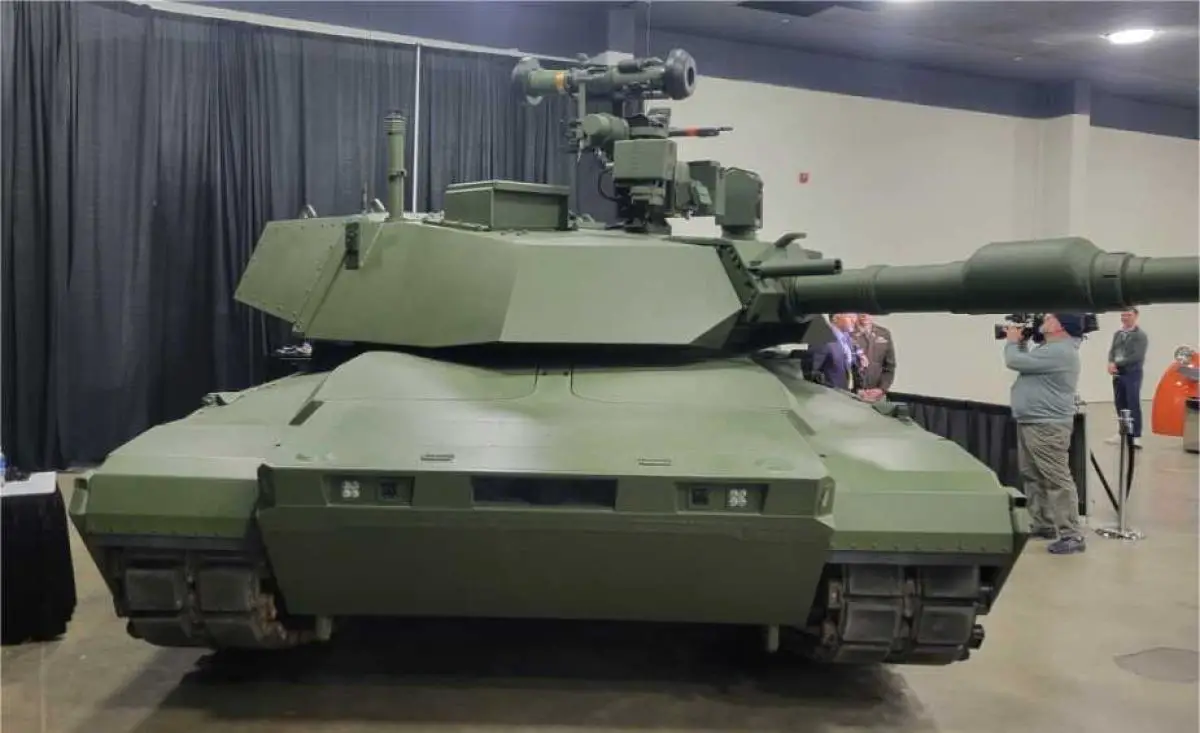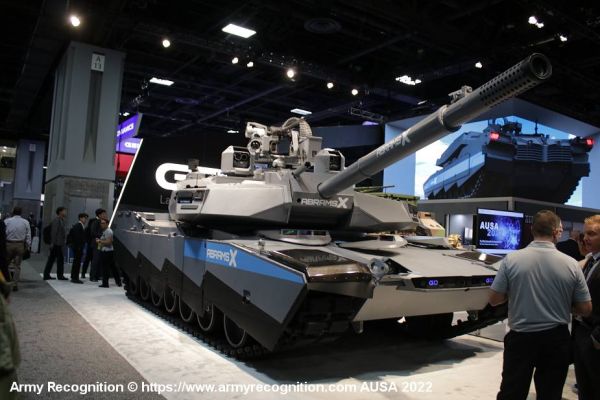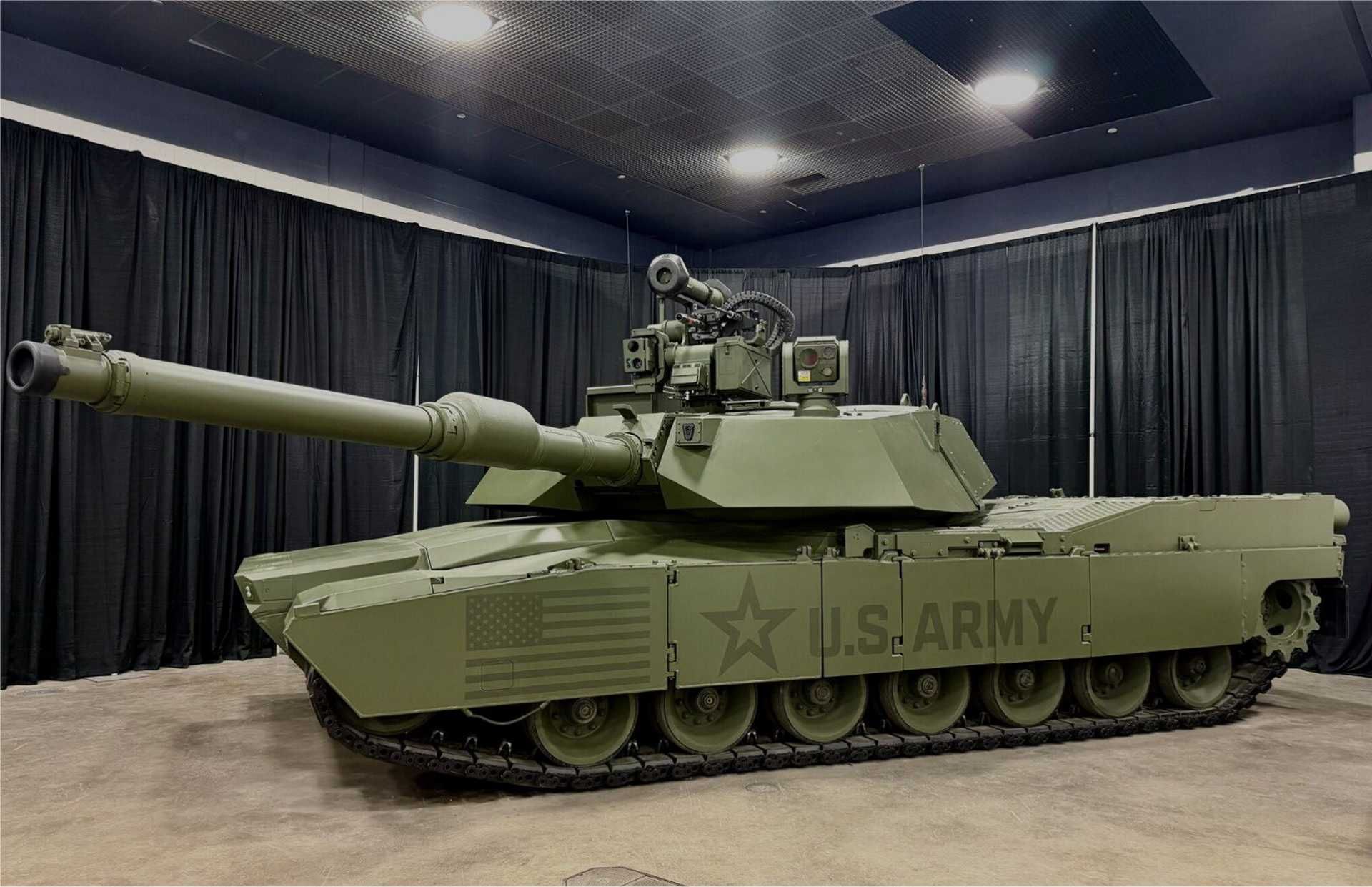
The M1E3 Abrams is the latest-generation U.S. main battle tank developed by General Dynamics Land Systems for the United States Army. It was first unveiled during the 2026 Detroit Auto Show and represents a significant departure from previous Abrams models by incorporating a fully unmanned turret, an autoloader, a three-person crew located in an armored hull compartment, and a digital-native systems architecture. Designed to counter future threats including drones, top-attack munitions, and precision-guided systems, the M1E3 is lighter, more survivable, and engineered for rapid upgrades as battlefield technologies evolve through the 2040s.
Country users: United States




Technical Data
-
Armament
The M1E3 Abrams is armed with a 120 mm smoothbore cannon derived from the M256 family, mounted inside a fully unmanned turret and operated via an automatic loading system. The autoloader eliminates the need for a human loader, reduces turret volume, and enables faster, more consistent rates of fire. The main gun is compatible with current and emerging U.S. ammunition types, including the M829A4 armor-piercing fin-stabilized discarding sabot (APFSDS) round and the XM1147 Advanced Multi-Purpose (AMP) programmable round capable of airburst, delay, and point-detonation functions.
The turret also houses an EOS R400 Mk2 Remote Weapon Station (RWS), visible on the M1E3 prototype, which, in its displayed configuration, includes a 40 mm Mk19 automatic grenade launcher, a 7.62 mm machine gun, and a single FGM-148 Javelin anti-tank missile launcher. The RWS is integrated with an EchoGuard radar system for 360-degree drone detection, target tracking, and cueing. The RWS layout is modular, allowing different weapons or sensor loads depending on the mission, including counter-unmanned aerial systems (C-UAS) and short-range defense roles.
-
Design and protection
The M1E3 design centers around a significant crew protection innovation. Unlike previous Abrams variants with manned turrets, the M1E3 relocates all three crew members (commander, gunner, and driver) into a heavily armored crew capsule located within the forward section of the hull. This configuration reduces crew vulnerability by removing them from the turret, which is the most exposed part of the tank.
Armor protection is modular and multi-layered. The base structure uses advanced composite materials, with optional integration of depleted uranium armor modules for added protection against kinetic threats. The hull features a V-shaped underbody designed to deflect mines and improvised explosive devices. Internal survivability is enhanced by spall liners, automatic fire suppression systems, and blast-attenuating seats.
The M1E3 is fully compatible with active protection systems (APS). It is expected to support both the Trophy VPS system and the U.S. Army’s Modular Active Protection System (MAPS) standard. These systems provide hard-kill and soft-kill defenses against anti-tank guided missiles, rocket-propelled grenades, and top-attack munitions. The modular design also enables rapid configuration changes for export or theater-specific requirements.
-
Mobility
The M1E3 Abrams is significantly lighter than its SEPv3 predecessor, with an estimated combat weight of approximately 66 metric tons. This reduction improves operational mobility, logistical efficiency, and strategic transport compatibility with military bridging and transport aircraft. The prototype retains the 1,500-horsepower AGT1500 gas turbine engine, but the production version is expected to incorporate a hybrid-electric drive. This hybrid system will support silent mobility, silent watch, reduced acoustic and thermal signatures, and higher onboard power generation for advanced electronics and directed energy systems.
The tank uses a torsion-bar suspension system supplemented by hydropneumatic damping, which improves ride quality, firing stability, and terrain adaptability. The M1E3 features seven dual rubber-coated road wheels on each side, double-pin steel tracks with replaceable rubber pads, and a ground clearance of approximately 500 mm. The drivetrain includes a hydrostatically controlled differential steering system, allowing pivot turns and precision maneuvering in confined environments.
The tank is expected to achieve a maximum road speed of approximately 68 km/h. Its projected operational range is between 450 and 500 km, depending on fuel configuration, terrain, and final propulsion system selection. These improvements ensure greater tactical mobility and reduce the need for frequent resupply under combat conditions.
-
Combat Equipment
The M1E3 Abrams is built with a fully digital combat architecture in accordance with the U.S. Army’s Modular Open Systems Architecture (MOSA) guidelines. This architecture enables rapid insertion of new technologies, sensors, weapons, and electronic warfare systems through standardized interfaces and software-defined subsystems.
Primary sighting systems include the DRS S3, which is available in both long-wave infrared (LWIR) and mid-wave infrared (MWIR) variants. This system is also deployed in the U.S. Army’s M-LIDS Increment 3 and has demonstrated high effectiveness in detecting and tracking small unmanned aerial systems. The commander’s sight is the Leonardo S3 stabilized panoramic optic, which replaces the Safran Paseo system used on the earlier AbramsX demonstrator. The S3 offers long-range target acquisition, stabilization, and digital fire control integration.
An EchoGuard radar system is integrated with the RWS to enable drone detection, tracking, and cueing for countermeasures. The vehicle is also equipped with a 360-degree day and night EO/IR camera suite, laser warning receivers, automated smoke grenade launchers, and AI-assisted fire control. These systems work together to provide full-spectrum battlefield awareness and autonomous engagement options.
The tank is fully compatible with JADC2 (Joint All-Domain Command and Control), allowing it to receive, process, and transmit targeting and situational data across platforms including UAVs, satellites, and robotic combat vehicles. The vehicle also incorporates predictive maintenance systems, system health monitoring, and cybersecurity features. Future upgrades are expected to include support for manned-unmanned teaming, electronic warfare modules, and AI-supported tactical decision tools.
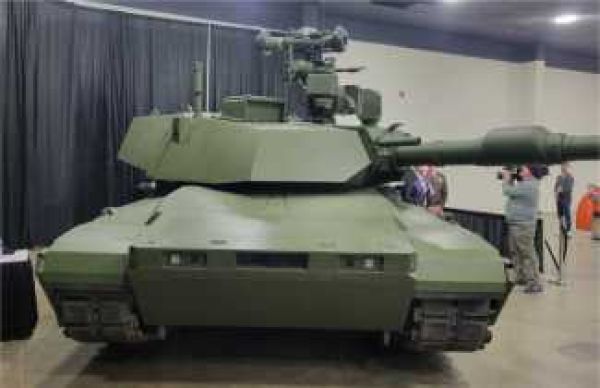
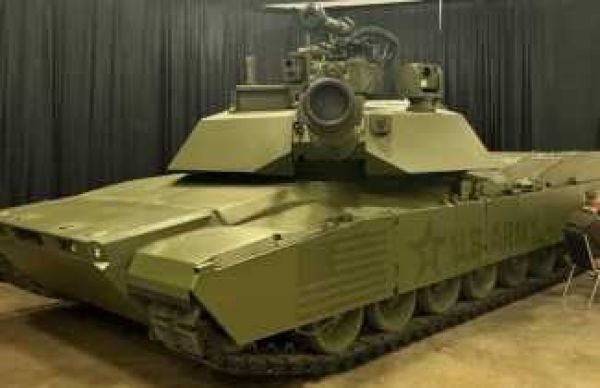
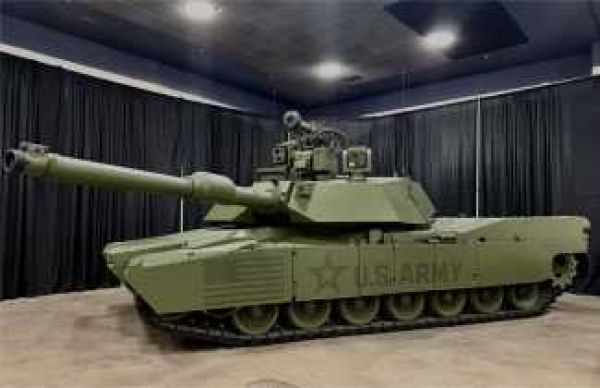
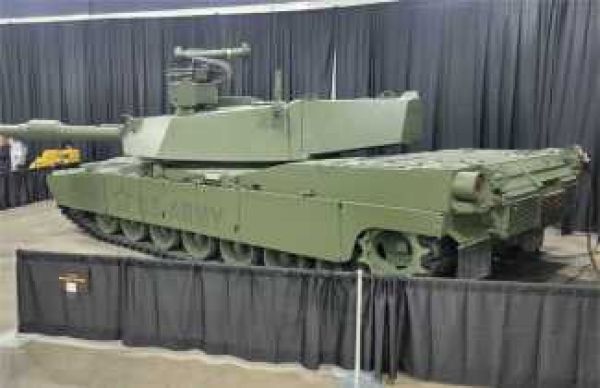
Photo Gallery