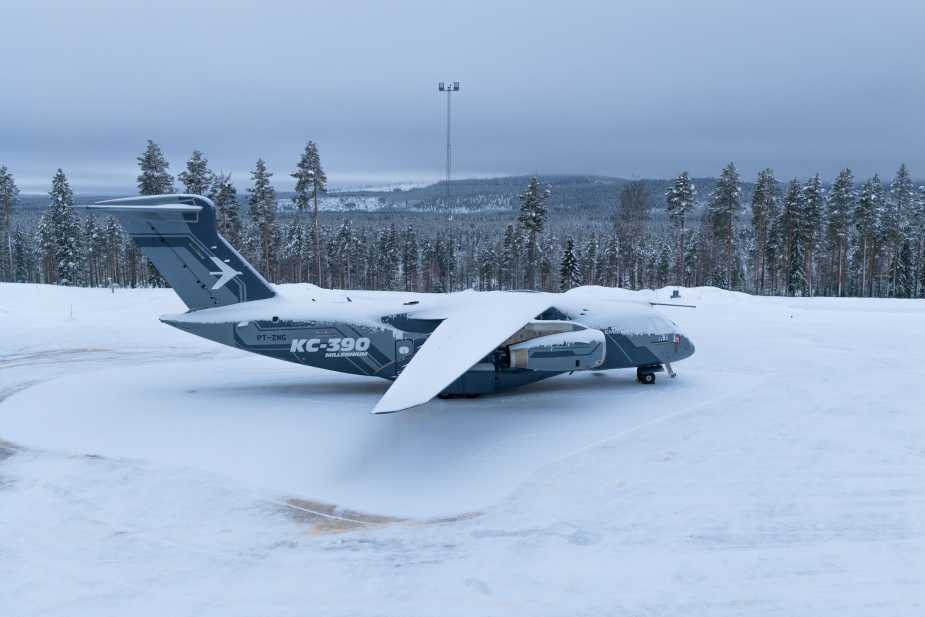
Originally, the company Embraer developed this twin-engine, jet-powered medium tanker-transport aircraft as the C-390 ("Cargo") for the Brazilian KC-X requirement. In 2011, when the Brazilian Air Force decided that aerial refueling would become a core capability to assume missions previously conducted by Boeing KC-137 tankers and adapted C-130s, the C-390 designation changed to KC-390, with K standing for tanker, following the same naming convention used by U.S. tanker aircraft such as the KC-46 Pegasus and the KC-135 Stratotanker. The KC-390 is distinguished from the commercially marketed C-390 Millennium primarily by its tanker equipment and military designation rather than by a different airframe. Both aircraft use the same fuselage, wing, engines, landing gear, cargo compartment, fly-by-wire controls, avionics architecture, fuel tanks, and basic performance characteristics.
Country users: Austria, Brazil, Colombia, Czech Republic, Greece, Hungary, Lithuania, Netherlands, Portugal, Slovakia, South Korea, Sweden, United Arab Emirates, Uzbekistan.






Technical Data
-
Design
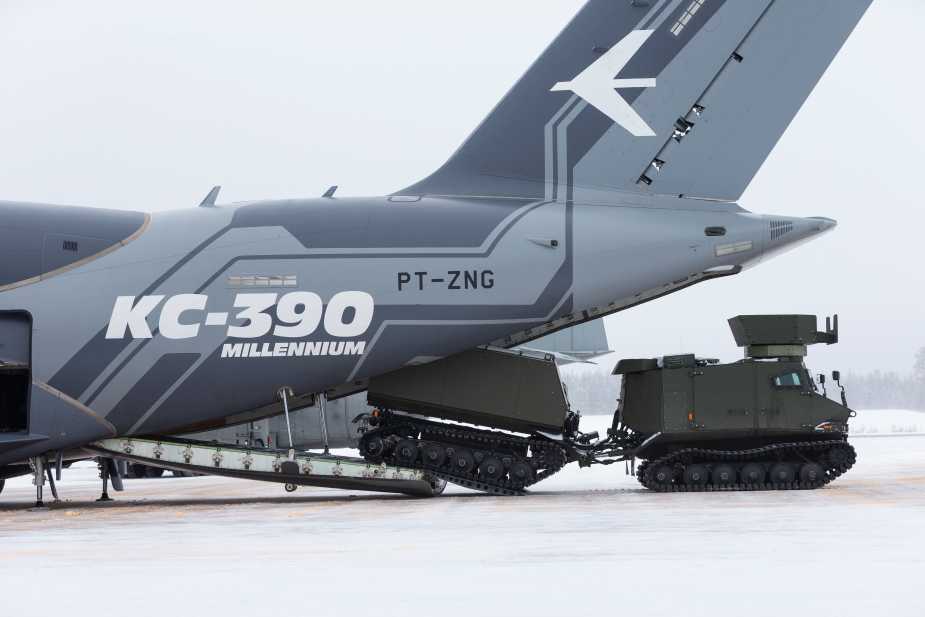
The KC-390 Millennium uses a high-mounted swept wing, anhedral geometry, T-tail, and rear cargo ramp within an airframe measuring 35.20 m in length, 35.05 m in wingspan, and 11.84 m in height. This configuration provides a continuous 169 m³ cargo compartment measuring 18.50 m along the floor and ramp, 3.45 m in width and at least 2.95 m in height. The reinforced floor supports a concentrated payload of 26,000 kg or a distributed load of 23,000 kg, including seven 463L pallets, two M113 armored personnel carriers, one Boxer or Guarani 6×6 armored vehicle, three HMMWVs, one 40-ft ISO container, 80 troops or 74 stretchers. The long hydraulically operated ramp reduces loading angles for vehicles, while onboard stabilizer struts, roller trays, software-controlled locks and a powered winch allow loading and unloading with limited external equipment. The T-tail keeps the horizontal stabilizer clear of the ramp, parachute extraction path and disturbed airflow produced during aerial delivery or paratroop operations.
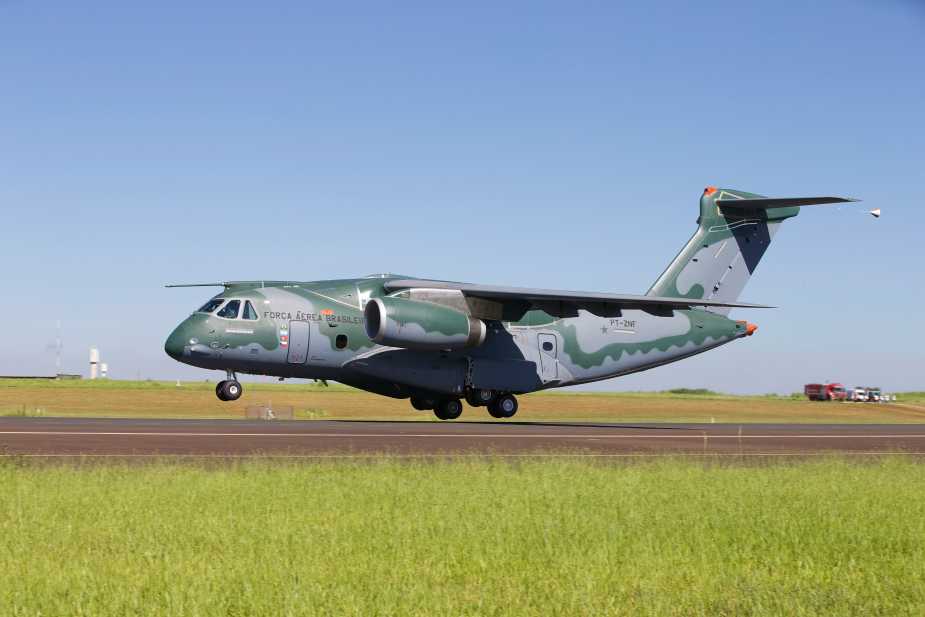
The wing and landing gear were designed to combine turbofan performance with repeated operations from short, damaged and semi-prepared airfields. Leading-edge slats and high-lift surfaces deflecting to 40° reduce stall speed to 104 KIAS, while spoilers, idle thrust and extended slats allow controlled tactical descents of up to 9,000 ft per minute at 300 KIAS. The two IAE V2500-E5 engines are mounted high and forward beneath the wing to increase ground clearance and reduce debris ingestion from gravel, sand and damaged pavement. Four-wheel main landing gear bogies, low-pressure tires and wheel-by-wheel brake-by-wire distribute the aircraft's weight and improve directional control on surfaces with uneven grip. The KC-390 can complete ten passes on CBR-4 loose sand or soft clay and operate from a 4,000-ft (1,219 m) CBR-6 runway while carrying 12 t over 500 nautical miles.
The aircraft uses a damage-tolerant, pressurized fuselage and modular mission architecture designed for repeated tactical loads, pressurization cycles, rough-field landings and operations in tropical, desert, icy and Antarctic environments. The standard crew consists of two pilots and one loadmaster, with an optional third cockpit station for managing refueling equipment, EO/IR sensors, communications or self-protection systems. Removable equipment allows the cargo compartment to accept auxiliary fuel tanks, medical modules, firefighting systems, search-and-rescue equipment, troop seating and aerial-delivery installations, with major mission reconfiguration completed in three hours or less. The cabin remains pressurized to an altitude equivalent of 8,000 ft at the aircraft's 36,000-ft ceiling and includes automatic temperature control and a heated floor for troops, medical patients and equipment. This common design allows one airframe to alternate between cargo transport, tanker, receiver, MEDEVAC, firefighting, special operations, and ground-refueling missions.
-
Avionics
The KC-390 Millennium uses the Rockwell Collins Pro Line Fusion integrated avionics suite as the common digital backbone for flight, navigation, engine monitoring, communications, warnings, and mission management. The cockpit is built around large configurable multifunction displays capable of showing primary flight data, moving maps, terrain, airspace, mission points, engine indications, crew alerts, fuel status, hydraulic and electrical synoptics, defensive-aid information, and electronic checklists. Dual head-up displays provide both pilots with airspeed, altitude, attitude, heading, flight-director guidance and navigation cues while they maintain an external view during low-level flight, tactical approaches and poor-weather landings. The Enhanced Vision System uses four external cameras to improve runway and terrain identification in darkness or reduced visibility, while the Synthetic Vision System generates a database-derived representation of terrain, obstacles and flight path when direct visibility is limited.
The mission architecture integrates the Leonardo Gabbiano T-20 tactical radar, which provides weather, navigation, air-to-air, air-to-ground, high-resolution mapping and Spotlight Synthetic Aperture Radar modes, supporting hazardous weather avoidance, tactical navigation, landing zone assessment and ground imaging through cloud or darkness. An optional EO/IR pod adds visible and infrared imagery for search and rescue, surveillance and special operations, with sensor control available from an optional third cockpit station equipped with dedicated displays and communications. The flight management system also incorporates tanker tracks, search patterns, airdrop points, fuel planning, runway limits and payload calculations within the maximum takeoff weight. Mission computers combine radar, EO/IR, navigation, communications, tanker and self-protection data on the same display architecture, while customer-dependent equipment determines the exact secure radio, satellite link, warning receiver and countermeasure configuration.
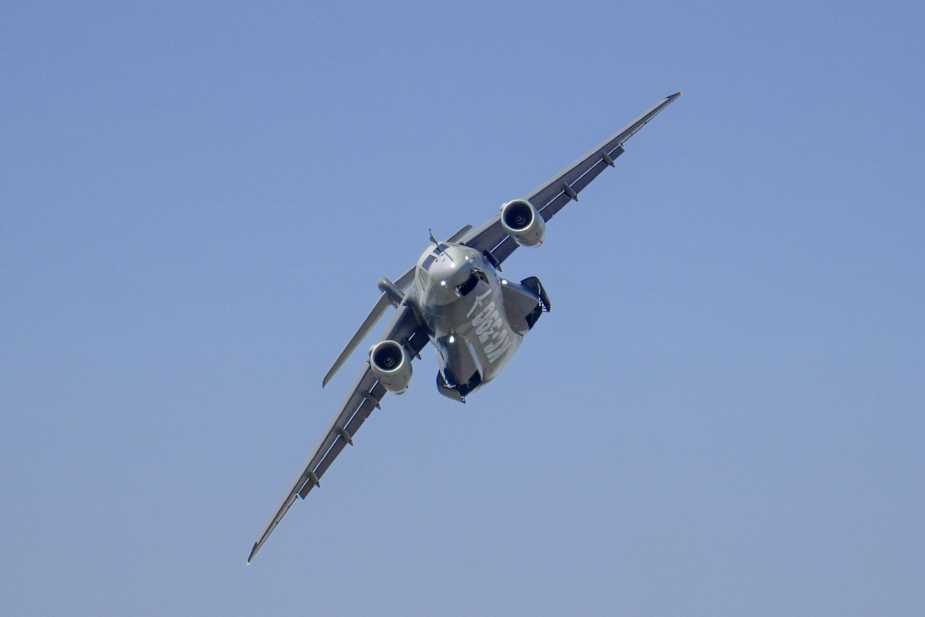
The aircraft's third-generation full digital fly-by-wire system uses closed-loop control and electronically linked active sidesticks to convert pilot inputs into commands for the flight surfaces while continuously comparing commanded and actual aircraft response. Each pilot can feel the other's sidestick movement, reducing the risk of conflicting inputs and allowing control-force characteristics to be adapted for normal transport, low-level tactical flight and close-formation aerial refueling. The control laws provide angle-of-attack limitation, stall and buffet protection, overspeed protection, structural load-factor limitation, sideslip protection, dive-speed control, turbulence compensation, auto-trim and tail-strike avoidance, helping the aircraft operate at a listed stall speed of 104 KIAS with the high-lift devices deflected to 40°.
Tanker mission avionics display pod condition, hose extension, fuel flow, transferred quantity, remaining fuel and warnings, while automatic fuel management preserves engine feed, maintains reserves and limits asymmetry when the two Cobham pods transfer fuel at different rates. Day and night cameras monitor receiver approach, drogue contact, transfer and separation, with exterior lighting compatible with night-vision equipment. An integrated Onboard Maintenance System records faults, isolates likely failed components and provides maintenance crews with diagnostic data, reducing troubleshooting time but not replacing scheduled inspections, physical servicing or depot-level maintenance.
-
Engine and flight capabilities
The KC-390 Millennium is powered by two IAE V2500-E5 high-bypass turbofan engines, each rated at 139.4 kN (31,330 lbf), for a combined installed thrust of 278.8 kN (62,660 lbf). The V2500-E5 is the first military application of the V2500 engine, which was originally developed for commercial airliners, and its selection gives the aircraft a maximum cruise speed of 870 km/h, corresponding to Mach 0.8. Maximum speed, for its part, is listed at 988 km/h, corresponding to Mach 0.93. Wide-chord metallic fan blades improve tolerance to foreign object impact, while the twin-engine arrangement reduces fuel cost and maintenance demand compared with four-engine transports like the C-130. Turbofan propulsion also reduces vibration for crews, medical patients and sensitive cargo, while the higher cruise speed cuts transit time and can increase daily sortie generation on medium-distance routes.
Stall speed with the flaps fully deployed is 193 km/h, while reference landing speed with 25,000 lb of useful load is 215 km/h. For tactical descent, the KC-390 can maintain up to 556 km/h while descending at 9,000 ft per minute using idle thrust, extended slats, and spoilers deflected to 40°, allowing it to remain at efficient cruise altitude until closer to the operating area and then lose altitude rapidly. Crew endurance is supported by a pressurized system maintaining an 8,000-ft cabin altitude at the 36,000-ft (11,000 m) service ceiling, while the aerial refueling envelope extends from 2,000 to 32,000 ft. At sea level under standard conditions, takeoff distance for a 500-nautical-mile mission is 1,524 m with a 23-t payload and 1,165 m with 16 t, a difference of 359 m. Normal landing distance with a 26-t payload is 1,000 m. The aircraft can also conduct a 500-nautical-mile mission from a 4,000-ft, or 1,219-m, CBR-6 semi-prepared runway while carrying 12 t, and it is qualified for ten passes on CBR-4 loose fine sand or soft clay.
The KC-390 Millennium has a 35,000 kg empty weight and 86,999 kg maximum takeoff weight. With 26,000 kg of payload, range is 1,080 nautical miles, or 2,000 km; reducing payload to 23,000 kg increases range to 1,470 nautical miles, or 2,720 km; and carrying 14,000 kg extends range to 2,710 nautical miles, or 5,020 km. Standard ferry range is 3,370 nautical miles, or 6,240 km, while three palletized auxiliary tanks add 12,000 kg of fuel and increase maximum ferry range to 4,570 nautical miles, or 8,460 km, a gain of 1,200 nautical miles. Total fuel capacity can therefore rise from 23.9 t to 35 t, but the tanks consume cargo floor area and payload allowance. During tanker missions, part of this fuel must be reserved for the KC-390's own transit, loiter, diversion and recovery, so the aircraft cannot simultaneously maximize cargo, range and fuel offload.
-
Onboard equipment
Cargo operations are managed through the Continuous Computed Drop Point system, which calculates release points using aircraft position, altitude, airspeed and wind data for manual or automatic gravity-drop, parachute extraction and Container Delivery System missions. The aircraft is also fully compatible with Night Vision Imaging Systems, allowing cockpit, cargo-bay and external lighting to be used with night-vision goggles during tactical landings, aerial refueling, paratroop insertion, cargo delivery and special operations. The mission equipment is supported by dedicated onboard stations and aircraft-support systems that reduce crew workload and improve expeditionary autonomy. The loadmaster station provides direct control of the rear ramp, cargo handling system and hydraulic stabilizer struts while maintaining full visibility over loading, unloading, troop movement, paratroop operations and cargo restraint.
Hydraulic stabilizers stabilize the aircraft during loading of heavy vehicles or pallets, reducing structural movement and eliminating the need for external stabilizing equipment at remote airfields. An optional third cockpit station can simultaneously supervise aerial refueling, EO/IR sensors, mission communications and defensive systems while the pilots concentrate on aircraft control. The integrated Onboard Maintenance System continuously records faults and diagnostic information from aircraft systems, helping maintenance personnel isolate failures, prepare spare parts and reduce troubleshooting time without replacing scheduled inspections. Crew endurance is supported by a pressurized cargo compartment, automatic climate control, a heated floor, reduced vibration, passenger emergency oxygen, emergency exits and a serviced lavatory, enabling long-duration missions.
The KC-390 uses a modular self-protection system that can combine a radar warning receiver, laser warning receiver, missile approach warning system (MAWS), chaff dispensers, flare dispensers and directional infrared countermeasures (DIRCMs) according to customer requirements. The radar warning receiver detects surveillance, tracking and missile-guidance radars, providing emitter direction and threat classification to support maneuvering, emission control and deployment of radar countermeasures. Laser warning sensors alert the crew to illumination by laser rangefinders or target designators, while the missile approach warning system (MAWS) detects incoming missiles and can automatically or manually cue flares or DIRCMs against infrared-guided threats encountered during low-level flight, takeoff, landing or operations near forward airfields.
Chaff creates radar-reflective false targets against radar-guided weapons, whereas flares generate intense infrared signatures to decoy heat-seeking missiles. DIRCMs complement expendable countermeasures by directing modulated infrared energy toward an incoming missile seeker to disrupt target tracking without consuming cartridges. All threat information, warning direction, and countermeasure status are displayed through the cockpit multifunction displays and optional third mission station, allowing the crew to coordinate defensive actions from a common interface. Although these systems significantly improve survivability, the KC-390 remains a conventional transport aircraft that will continue to depend on route planning, rapid tactical descent, minimized ground time, fighter escort, suppression of enemy air defenses, and dispersed operating locations in addition to its onboard defensive suite.
-
Refueling capabilities
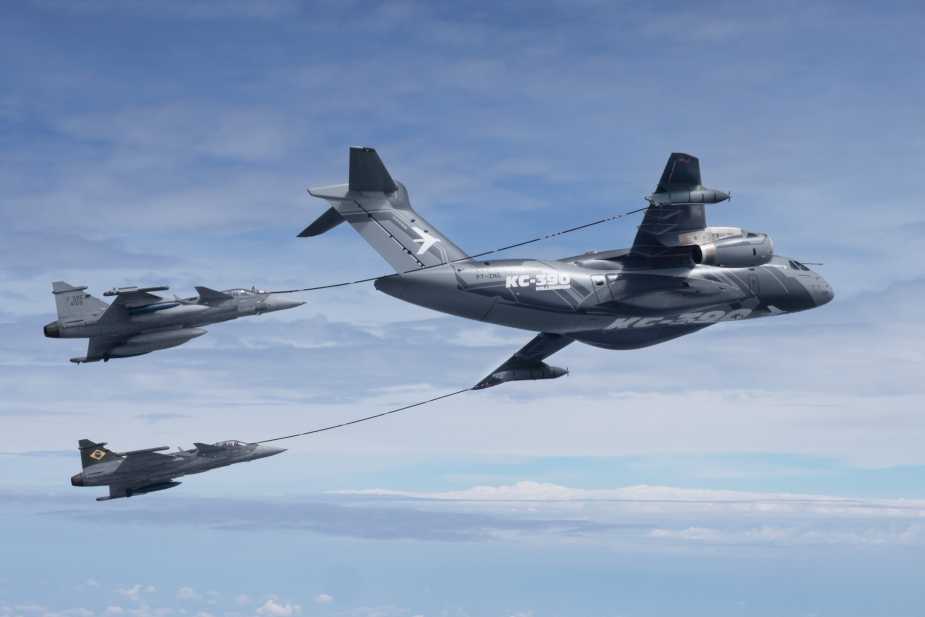
The KC-390 uses two removable Cobham 912E Wing Aerial Refueling Pods mounted beneath reinforced wing stations, with each pod incorporating an electrically driven hose reel, stabilized drogue, automatic hose-tension control, fuel-flow measurement and digital interfaces connected to the aircraft's mission and fuel-management computers. Each pod can transfer up to 1,514 liters per minute, or 400 U.S. gallons per minute, giving a theoretical combined maximum of 3,028 liters per minute when both operate simultaneously. This permits the tanker to refuel two probe-equipped receivers during the same sequence, reducing the time required to support a fighter formation and shortening exposure on the refueling track. Fixed-wing aircraft can refuel between 333 and 556 km/h at altitudes up to 32,000 ft, while helicopters operate within a lower envelope of 222 to 259 km/h between 2,000 and 10,000 ft.
High-capacity pumps, reinforced manifolds, pressure regulators, additional valves and redundant fuel piping supply the pods while preserving uninterrupted engine feed. Automatic fuel balancing limits wing asymmetry when the two receivers accept fuel at different rates, while tanker software displays pod status, hose position, transfer rate, quantity delivered, remaining fuel and fault warnings. The standard wing tanks hold 23.9 t of usable fuel, but the quantity available for transfer is always lower because the KC-390 must retain some fuel for taxi, takeoff, climb, transit, loiter, diversion and landing reserves. Up to three palletized Auxiliary Fuselage Fuel Tanks can be installed in the cargo compartment, each holding 4,000 kg, increasing total fuel capacity by 12,000 kg to a maximum cited value of 35,000 kg. These tanks use the standard Cargo Handling System and can be installed or removed within hours, but they consume floor space and payload allowance.
Day and night cameras monitor hose deployment, receiver approach, probe engagement, fuel transfer, disconnection and emergency breakaway, while night-vision-compatible exterior lighting provides visual references during low-light operations. The fly-by-wire system supports stable formation by reducing pitch, roll and turbulence-induced oscillations, but the receiver pilot remains responsible for making contact with the drogue. Certified or evaluated receivers identified for the Brazilian KC-390 currently include the F-5EM Tiger II, A-1M, AH-2 Sabre, H-36 Caracal and F-39E Gripen, with each type requiring its own campaign covering wake interaction, hose dynamics, probe geometry, fuel pressure, disconnect behavior and emergency separation.
A customer-selected receiver probe on the upper forward fuselage allows the KC-390 itself to take fuel from another hose-and-drogue tanker, including another KC-390, extending ferry range, loiter time and deployment endurance. The same fuel architecture can also support ground distribution through a removable Forward Arming and Refueling Point kit, allowing the aircraft to deliver fuel directly to helicopters, vehicles, aircraft or forward operating locations lacking fixed tanks or tanker trucks. The KC-390 currently cannot refuel boom-only receivers such as the F-35A, F-22A, B-21 or C-17 because it has no flying boom. An earlier Embraer-L3Harris Agile Tanker proposal sought to add a centerline boom, but the project ended in 2024 without a demonstrator. Since February 19, 2026, Embraer and Northrop Grumman have been developing a KC-390 Multi-Mission Tanker intended to retain the two Cobham pods while adding an autonomous centerline fly-by-wire boom and an open mission-system architecture.

For aerial delivery, a continuous computed drop point software combines the KC-390 position, altitude, airspeed, wind, and flight-path data to calculate the release point for gravity drops, parachute extraction, and container delivery system missions.


Photo Gallery