





Breaking News







Ukraine Deploys U.S.-Made V2X Tempest Counter-Drone System in Combat for First Time.
A Ukrainian Air Force New Year video appears to show a previously unseen mobile air defense vehicle destroying a Russian drone at night, assessed by analysts as the U.S.-made Tempest counter-UAS system developed by V2X. If confirmed, the footage would mark one of the earliest combat uses of a rapid-fielded American counter-drone concept designed for highly mobile, low-exposure operations.
The Air Command Center of the Ukrainian Air Force published on its official Facebook page, on 1 January 2026, a New Year video montage including a short nighttime sequence showing a previously unseen mobile air defense vehicle firing a missile that appears to destroy an incoming Russian drone. The platform is assessed by multiple open-source analysts as the new U.S.-made Tempest counter-UAS system, a V2X-developed “shoot-and-scoot” interceptor concept first presented publicly only months ago.
Follow Army Recognition on Google News at this link
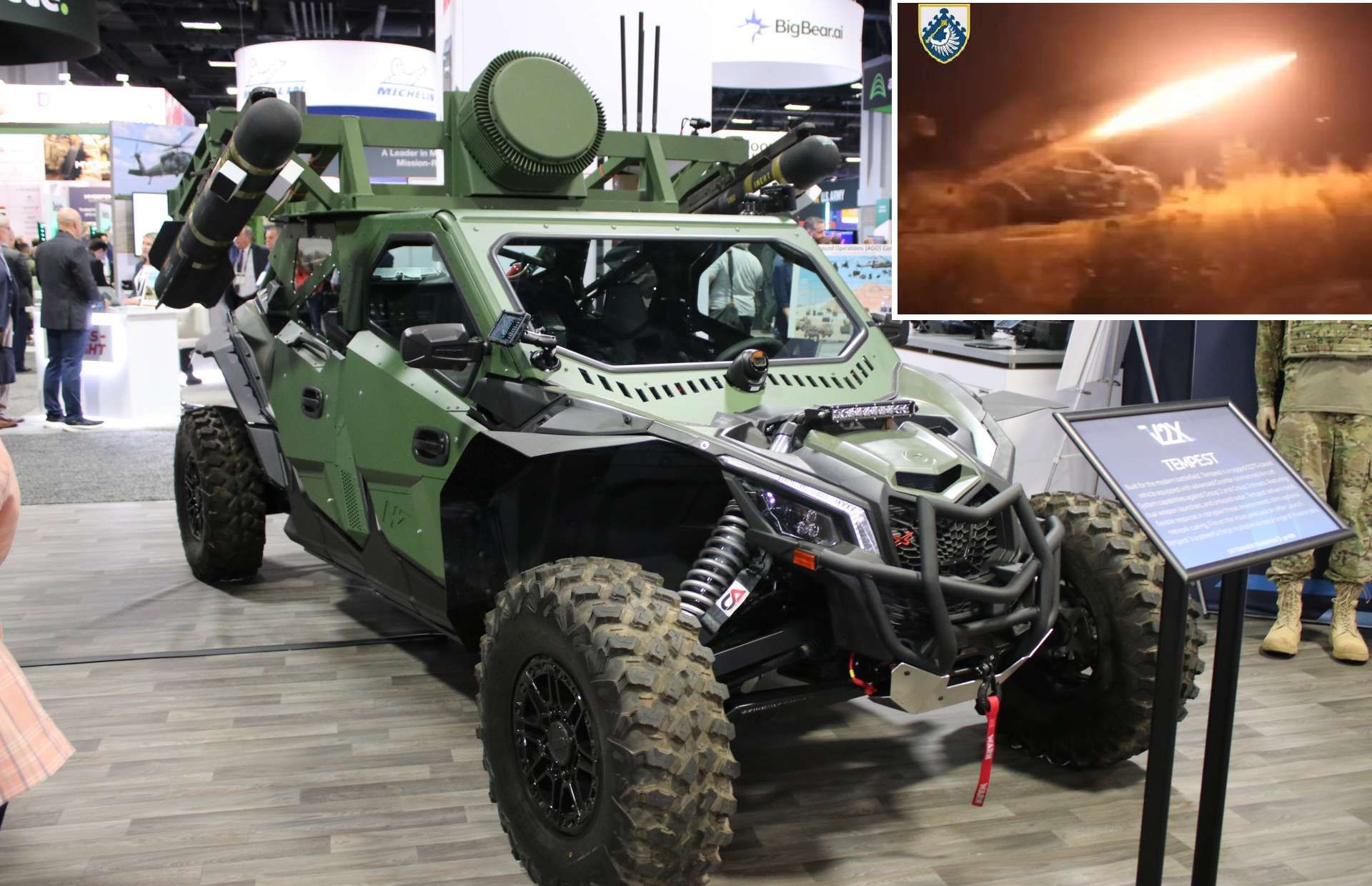
The U.S.-made Tempest is a highly mobile, fire-and-forget counter-UAS platform combining a rugged light vehicle, dual missile launchers, and an integrated sensor suite to detect, engage, and destroy Class 2 and 3 drones in contested, GPS-degraded environments, then rapidly relocate to avoid counterfire (Picture source: Army Recognition Group/ Ukraine MoD).
The Air Command Center clip shows a compact, buggy-like vehicle halted in a firing position, launching an interceptor into a dark sky while the camera captures the immediate post-launch flash and then a distant detonation consistent with a drone kill. The Ukrainian Air Force did not label the system in the video, and Kyiv has not issued a formal announcement, but the silhouette and launcher arrangement match V2X promotional imagery of Tempest. That combination of official footage without official attribution fits a pattern Ukraine has used before when introducing sensitive air defense capabilities: show results first, confirm later, if at all.
Tempest is best understood as a modernized mobile fire group tool purpose-built for the drone war. V2X describes it as a rugged, commercially based combat vehicle engineered for rapid, limited-exposure missions, equipped with dual weapon launchers and a “detect, engage, defeat” counter-UAS suite capable against Class 2 and Class 3 drones in adverse weather, followed by immediate displacement before Russian forces can cue counterfire. In practice, that points to a tactical rhythm Ukraine values highly: short halt, fast shot, rapid relocation, with minimal electronic and visual signature time on the firing point.
Army Recognition has also reviewed a V2X Tempest fact sheet given in AUSA2025 that reinforces the system’s design logic: a commercial off-the-shelf base vehicle, dual launchers, and a “fire-and-forget” operating concept intended to reduce crew exposure and speed fielding. The same document highlights operation in degraded communications and GPS environments, a direct nod to Russian jamming and the reality that many Ukrainian air defense engagements now happen under heavy electronic attack.
The most consequential technical clue is the interceptor itself. While V2X has not publicly named the missile, several defense outlets assessing Tempest’s launcher configuration and V2X display materials have pointed to the AGM-114L Longbow Hellfire as the likely effector. The Longbow variant matters because it is a true fire-and-forget weapon with an active millimeter-wave radar seeker, allowing the crew to launch and immediately move without maintaining continuous guidance, which is critical when Russian counter-battery and loitering munitions punish stationary emitters. In typical published specifications, Hellfire-class missiles carry a warhead on the order of 9 kg and offer short-range engagement distances suited to point defense and perimeter coverage rather than wide-area air defense.
From an operational perspective, pairing a Hellfire-type missile with a lightweight vehicle creates a niche Ukraine has been forced to build the hard way: a mid-tier drone killer that sits between machine guns and MANPADS on one end and costly strategic interceptors on the other. Against Shahed-type one-way attack drones, larger reconnaissance UAVs, and some loitering munitions, a radar-guided, fire-and-forget interceptor can deliver a clean kill at stand-off distance, reducing the probability of debris falling into populated areas or onto critical infrastructure. It also helps preserve high-end missiles in systems like Patriot, NASAMS, IRIS-T, and SAMP/T for the cruise and ballistic missile threat set that cheaper mobile teams cannot realistically handle.
Open reporting on the platform’s AUSA debut describes a compact radar integrated onto the vehicle, likely optimized for target acquisition and engagement support rather than full 360-degree surveillance. This is consistent with a networked air defense approach where mobile shooters receive cues from other radars and command posts, then use their onboard sensor for the final detect-to-engage timeline. If the system indeed relies on a smaller radar and a narrow sector of best performance, that still aligns with Ukrainian practice: mobile groups are vectored to expected corridors, shoot quickly, and relocate before they can be targeted.
All available indicators point to the United States as the origin, given V2X’s role and the system’s U.S. industry footprint, but neither Kyiv nor Washington has publicly detailed how many Tempest units were transferred or under what authority. The presence of the system in a New Year Air Command Center video strongly suggests that at least one vehicle was delivered and integrated late in 2025, potentially in a small quantity for operational evaluation under urgent wartime timelines. That ambiguity matters because it frames Tempest as either a limited trial asset or the first sign of a broader shift toward rapidly fielded, commercially rooted counter-UAS solutions for Ukraine’s layered air defense.
Tempest represents a philosophy of air defense shaped by the drone age: mobility, low exposure, and repeatable kills against the targets that saturate the battlespace nightly. If fielded in meaningful numbers, a Tempest-like capability could expand Ukraine’s ability to protect logistics hubs, airfields, artillery concentrations, and energy infrastructure with mobile teams that can survive in contested areas, while also easing pressure on scarce gun systems and high-end missile stocks. For the wider defense community, Ukraine’s apparent combat use would also turn the country into the most demanding proving ground for a U.S. “rapid fielding” counter-UAS concept, generating hard data on hit rates, sustainment, and survivability under real Russian tactics, not test-range assumptions.