






Breaking News






A400M Military Aircraft Tests on Soft Runways Boost Logistics and Special Forces Capability.
Airbus and the German Bundeswehr completed a series of summer trials that confirmed the A400M can handle heavier loads on soft, vegetated runways without any aircraft modifications. This new performance margin enhances the aircraft's value for dispersed logistics, rapid-response missions, and special operations support.
Airbus Defence and Space reports that its A400M military transport aircraft cleared a major operational milestone during joint trials with the German Bundeswehr at the Altengrabow training area. Over several weeks of summer 2025 testing, engineers validated the aircraft's ability to lift heavier payloads from soft, uneven ground, a scenario that typically challenges braking stability and landing gear stress on large transports. Officials familiar with the trials say the aircraft maintained predictable handling, throttle response, and rollout performance across repeated cycles, suggesting that allied forces could employ the A400M more confidently in remote or degraded environments where traditional runways are unavailable.
Follow Army Recognition on Google News at this link
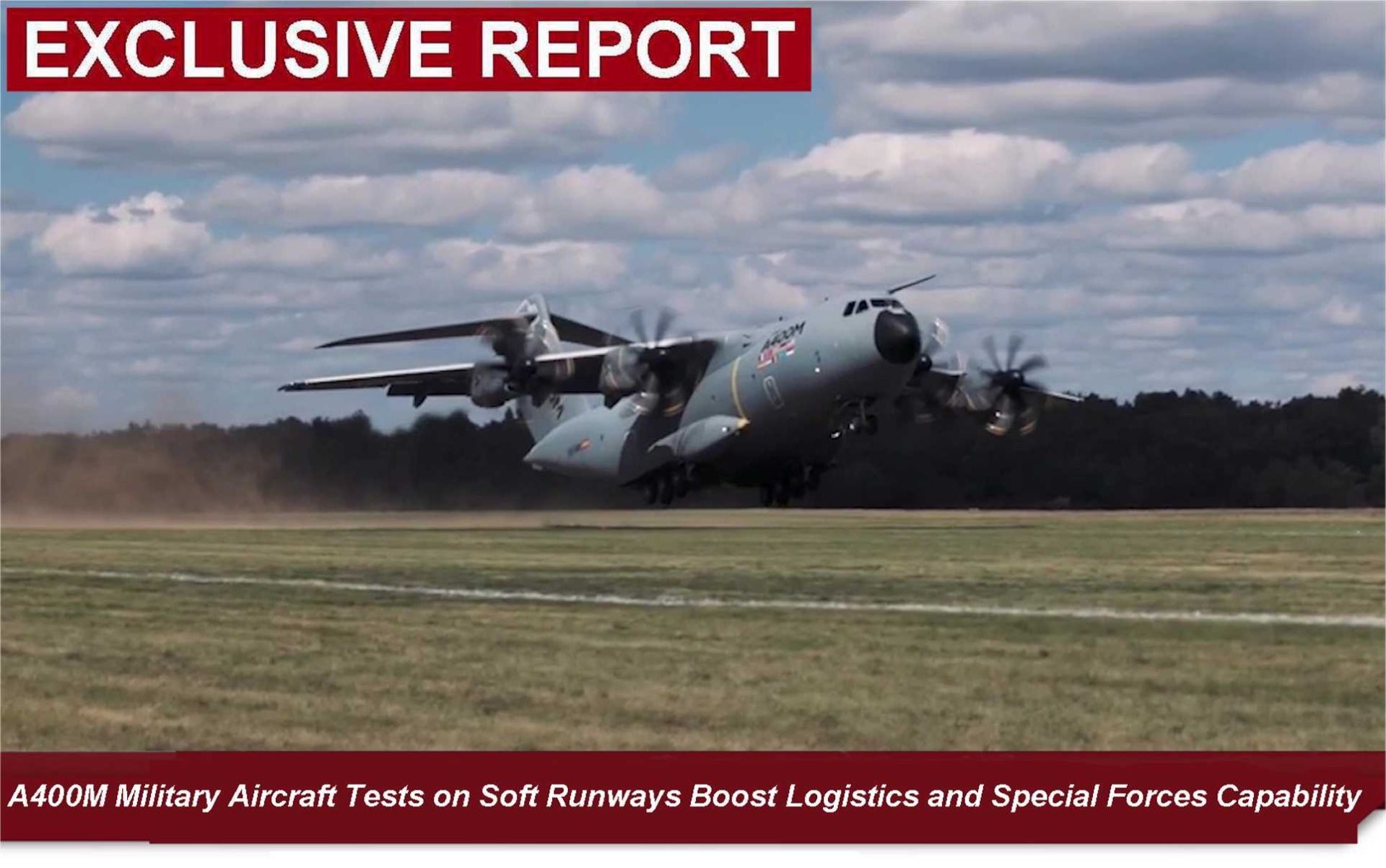
The A400M military transport aircraft take off from a soft, unpaved runway during high-weight testing with the German Armed Forces in Altengrabow. (Picture source: Airbus)
The A400M military transport aircraft's expanded performance on unpaved, vegetated ground signals a critical leap that meets global security demands for swift, flexible logistics—from quick-reaction humanitarian missions to special operations. These capability expansion tests, co-managed by OCCAR as part of the multinational A400M programme, confirm the aircraft’s ability to deliver payloads in locations with little or no airfield infrastructure.
The Altengrabow trials involved rigorous engineering assessments and daily flight operations under controlled, yet realistic, conditions. Each sortie required detailed surface measurements and load-bearing analysis to ensure the airstrip could safely accommodate the aircraft’s increased mass and dynamic footprint during landing and takeoff. The A400M’s capability to operate from natural surfaces covered in vegetation introduces a new level of mission autonomy for armed forces and humanitarian agencies operating in infrastructure-degraded environments.
This new performance threshold allows the A400M to carry larger payloads into areas previously accessible only by smaller aircraft. It significantly reduces the number of sorties required to deliver the same amount of cargo, enhancing operational tempo and minimizing vulnerability to ground or air threats. In recent humanitarian operations, such as the Mayotte cyclone response in January 2025 or the multinational relief effort in Syria and Turkey in 2023, this ability proved essential in bridging logistical gaps where runways were damaged or underdeveloped.
In the context of special operations and forward-deployed missions, the ability to land, offload, and depart from soft, narrow landing zones enhances tactical flexibility. The A400M’s operational design allows for rapid configuration changes, enabling it to carry vehicles, palletized cargo, and troops, or to switch to medevac roles within hours. The reinforced landing gear, high-mounted wings, and advanced propulsion system collectively support performance under short takeoff and landing (STOL) conditions.
The aircraft features four Europrop International TP400-D6 turboprop engines, each generating 11,000 shaft horsepower. This engine configuration enables a maximum cruising speed of Mach 0.72 and flight ceilings up to 40,000 feet, while providing exceptional performance at low altitudes and in tactical flight profiles. The A400M can transport up to 37 tonnes (81,600 pounds) of cargo, with a cargo hold measuring 17.71 meters in length, 4 meters in width, and 3.85 meters in height.
The aircraft can accommodate 116 fully equipped soldiers, or up to 66 stretcher patients and 25 medical attendants in a dedicated medical evacuation setup. The rear cargo ramp facilitates rapid loading of light and heavy vehicles, such as two 8x8 armored personnel carriers or one 30-ton infantry fighting vehicle. It can also deploy helicopters, including a CH-47 Chinook with folded rotors, and support aerial delivery of up to 25 tonnes of equipment through parachute drops.
Compared to its global counterparts, the A400M fills a crucial capability gap between the Lockheed Martin C-130J Super Hercules and the Boeing C-17A Globemaster III. The C-130J, while rugged and reliable, has a maximum payload of approximately 20 tonnes and a significantly smaller cargo bay. The C-17A offers a 77-tonne payload capacity and intercontinental range but requires large, well-prepared runways and greater logistical support. The Russian Ilyushin Il-76, although comparable in lift capacity to the A400M, lacks the A400 M's short-field agility, avionics integration, and multi-role adaptability.
The A400M's modern avionics suite, including fly-by-wire controls, advanced mission management systems, and digital cockpit architecture, reduces pilot workload and enhances situational awareness in complex airspace. Its self-protection systems provide defensive capabilities suitable for low-intensity conflict zones, including missile warning, chaff and flare dispensers, and electronic countermeasures.
Following the completion of the Altengrabow campaign, Airbus will proceed to a final certification phase. This will enable the rollout of enhanced unpaved runway capability to the global A400M user community via software upgrades and procedural refinements, without requiring structural changes to the aircraft.
Future enhancements currently under development include increased payload capacity, advanced satellite and tactical connectivity, and integration with unmanned aerial systems. One proposed configuration would allow the A400M to serve as a mothership for deploying drones during contested air operations, opening new dimensions for networked warfare and battlefield ISR.
As mobility demands intensify in global crisis regions and high-threat theaters, the A400M is steadily redefining what a military transport aircraft can accomplish. It is evolving from a strategic airlifter into a flexible operational platform capable of meeting modern expeditionary needs across multiple mission domains.
Written by Alain Servaes – Chief Editor, Army Recognition Group
Alain Servaes is a former infantry non-commissioned officer and the founder of Army Recognition. With over 20 years in defense journalism, he provides expert analysis on military equipment, NATO operations, and the global defense industry.