







Breaking News






Russia launches new Yasen-M nuclear submarine Ulyanovsk for Arctic patrols with hypersonic missiles.
On July 28, 2026, Russia launched the Project 885M Yasen-M nuclear-powered attack submarine K-563 Ulyanovsk at the Sevmash shipyard in Severodvinsk. The transition to fitting-out afloat marks the start of harbor and sea trial sequences prior to its planned transfer to the Northern Fleet in December 2027. The deployment serves Russia’s strategic objective of modernizing its undersea vector by replacing legacy Soviet-era Akula, Sierra, and Oscar-II submarines with multi-role fourth-generation vessels.
The Ulyanovsk measures 130 meters in length with a submerged displacement of 13,800 tonnes, powered by a 200 MW pressurized-water reactor capable of submerged speeds up to 31 knots. Its primary armament includes eight vertical launch modules housing up to 40 Kalibr or 32 Tsirkon hypersonic and Oniks cruise missiles, alongside ten 533 mm torpedo tubes accommodating 30 heavyweight weapons.
Related topic: Russia to replace all nuclear attack submarines with new Yasen and Yasen M units by 2035
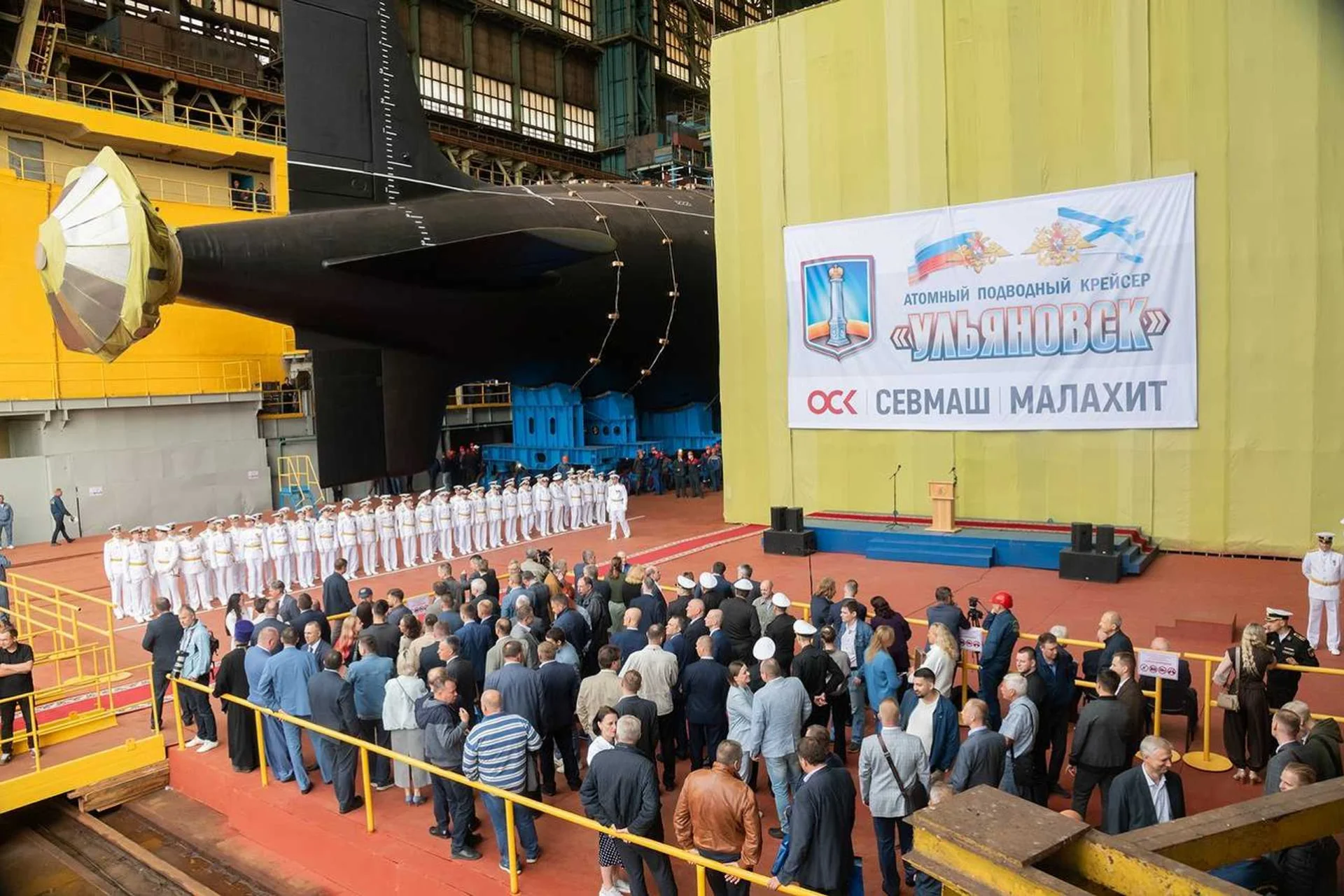
The Ulyanovsk is planned for the Northern Fleet, whose Yasen submarines operate from Zapadnaya Litsa on the Kola Peninsula, close to the Barents Sea, Norwegian Sea, Arctic Ocean, and routes leading into the North Atlantic. (Picture source: Sevmash)
On July 28, 2026, Russia launched the Yasen-M nuclear-powered attack submarine K-563 Ulyanovsk at the Sevmash shipyard in Severodvinsk, exactly nine years after its keel was laid on July 28, 2017. The Ulyanovsk is the sixth serial-built Yasen-M and the seventh submarine of the wider Project 885/885M class when the original K-560 Severodvinsk is included. The submarine has now moved from enclosed construction to fitting-out afloat, after which it must complete mooring trials, factory sea trials, deep-diving tests, navigation and propulsion checks, weapons trials, crew training and state acceptance before the Russian Navy can take delivery. Sevmash plans to transfer the submarine to the Northern Fleet in December 2027, 17 months after its launch.
The Ulyanovsk's construction is part of Russia's plan to replace the Project 971 Akula, Project 945 and 945A Sierra, and Project 949A Oscar-II fleets with a smaller number of fourth-generation Yasen/Yasen-M submarines able to combine anti-submarine warfare, anti-surface warfare and long-range strike in one hull. The nine-year construction period places the Ulyanovsk within the established production cycle for later Yasen-M submarines. The K-572 Perm, the preceding unit, was laid down on July 29, 2016, launched on March 27, 2025, and remained in sea trials during mid-2026, including voyages in May, June, and July. More than 15 months after launch, the Perm had still not been accepted, showing that the period between leaving the construction hall and entering service can exceed one year even when the hull is structurally complete.
The Ulyanovsk will follow the same sequence and will probably spend much of 2027 completing harbor work, diving trials, and weapons certification. Behind it, Sevmash is building the Voronezh and the Vladivostok, both laid down on July 20, 2020, and the Murmansk, laid down on June 17, 2026. Two additional Yasen-M units have been announced but not named, which would raise the planned program to 12 submarines. The production line is more regular than the lead-boat phase, when the K-560 Severodvinsk required 20 years between keel laying in December 1993 and delivery in December 2013, but it still produces no more than one Yasen-M launch every one to two years. Because Sevmash is also constructing Borei-A ballistic missile submarines, the yard's annual nuclear-submarine output must be divided between two programs rather than devoted entirely to the Yasen-M fleet.
The Yasen-M, also known as the Project 885M, is 130 m long and 13 m wide, with a surfaced displacement of 8,600 tonnes and a submerged displacement of 13,800 tonnes. The improved design is 9.2 m shorter than the original 139.2 m Project 885 Severodvinsk while retaining the same published submerged displacement, indicating a denser internal arrangement rather than a lighter submarine. Propulsion is based on one 200 MW pressurized-water reactor connected to steam turbines producing 43,000 shaft horsepower through a single propulsion shaft. Reported submerged speed reaches 31 knots, while the lower-noise operating figure is 28 knots and surfaced speed is placed between 16 and 20 knots. At 31 knots, the submarine would cover 1,378 km in 24 hours if it maintained maximum speed, although such a transit would produce more machinery and hydrodynamic noise and would not represent a normal covert patrol profile.
Endurance is listed at 100 days, which is equivalent to more than three months without replenishment, with food, maintenance requirements and crew condition setting the practical limit rather than reactor fuel. The operating depth is placed between 450 and 520 m and the maximum depth near 600 m. Crew size fell from about 85 aboard the original Yasen to 64 aboard Yasen-M, a reduction of 24.7%. That reduction decreases the requirement for berths, food, freshwater production and life-support capacity, but it also leaves fewer sailors available for simultaneous watchkeeping, maintenance and damage control during a 100-day patrol. The principal strike arsenal consists of eight vertical launch modules installed behind the sail. Each module can carry five Kalibr missiles, producing a theoretical maximum load of 40 weapons, or four P-800 Oniks or 3M22 Tsirkon missiles, producing a maximum of 32.
A full Kalibr load therefore gives the Ulyanovsk eight more missiles than a full Oniks or Tsirkon load, but the submarine would normally carry a mixed magazine selected for a specific patrol rather than one homogeneous load. The Kalibr includes land-attack, anti-ship and anti-submarine variants, allowing one submarine to attack inland infrastructure, surface combatants and submerged targets without changing the launch architecture. The Oniks provides a dedicated high-speed anti-ship capability, while the Tsirkon is intended to compress the time available for shipboard sensors and interceptors to detect, classify and engage an incoming missile. The Ulyanovsk is also the second Yasen-M submarine, after the Perm, constructed from the beginning for Tsirkon integration. The submarine also has ten 533 mm torpedo tubes and space for as many as 30 heavyweight torpedoes, mines or anti-submarine weapons.
This means its total theoretical missile and torpedo inventory can reach 70 weapons if the maximum 40-missile Kalibr load is combined with 30 torpedoes, although the actual patrol load will depend on internal storage, weapon availability and mission requirements. The torpedo tubes can employ Futlyar or UGST heavyweight torpedoes, while mines allow the submarine to obstruct straits, naval base approaches or reinforcement routes without exposing itself through a missile launch. The MGK-600 Irtysh-Amfora spherical sonar occupies the bow, replacing the bow torpedo-room arrangement used on earlier Soviet attack submarines. Because the sonar occupies most of the forward volume, the ten torpedo tubes are positioned farther aft and angled outward along the sides of the pressure hull.
The sonar architecture also includes flank arrays and a towed array, giving the submarine forward, lateral, and rear acoustic coverage and allowing contacts to be tracked without relying on a single bow sensor. Passive search is especially important because active sonar transmissions can reveal the submarine's position. The hull uses low-magnetic steel and acoustic treatments intended to reduce detection by magnetic-anomaly and acoustic sensors. The reactor cooling system is designed to use natural circulation under selected operating conditions, limiting the need for continuously operating primary circulation pumps, which are a major source of mechanical noise in nuclear submarines. These measures are most effective at low patrol speed, not at the published 28-knot quiet-speed figure or the 31-knot maximum speed, because flow noise rises sharply as speed increases.
Actual detection performance also depends on water depth, temperature layers, salinity, background noise, machinery condition and the geometry of hostile sensors. The design therefore trades the larger crew and specialized layouts of older Soviet submarines for a smaller complement, a larger bow sonar and a combined strike and hunter-killer architecture. Russia had five commissioned Yasen-family submarines as of July 2026. The Northern Fleet inventory consisted of the K-560 Severodvinsk, K-561 Kazan and K-564 Arkhangelsk, while the Pacific Fleet operated the K-573 Novosibirsk and K-571 Krasnoyarsk. The Severodvinsk was undergoing a multi-year mid-life overhaul that included reactor refueling, so the commissioned inventory did not equal the number of submarines immediately available for patrol.
The Perm remained in testing, the Ulyanovsk had entered fitting-out, and the Voronezh, Vladivostok, and Murmansk were under construction. If all announced units are completed, Russia would operate 12 Yasen and Yasen-M submarines, most likely divided into six for the Northern Fleet and six for the Pacific Fleet. A six-boat fleet does not mean six deployable submarines because at least one or two would normally be undergoing maintenance, post-deployment recovery, crew training, or modernization. Even with a 50% availability rate, each fleet might have only three Yasen submarines ready or deployed at one time. This is substantially fewer hulls than the combined Akula, Sierra and Oscar-II force inherited from the Soviet period, but each Yasen-M carries up to 32 to 40 vertically launched missiles in addition to torpedoes.
The modernization therefore exchanges numerical depth for higher missile capacity, broader mission flexibility and fewer submarine types. The cost is greater dependence on each individual hull, since the loss or extended overhaul of one submarine removes a larger percentage of the fleet's available strike magazine. The Ulyanovsk is intended for the Northern Fleet and is expected to operate from Zapadnaya Litsa on the Kola Peninsula, about 60 km from Norway. The base gives direct access to the Barents Sea and shortens the transit to the Norwegian Sea, Arctic Ocean and North Atlantic approaches. From this position, the submarine can conduct anti-submarine patrols, track NATO surface groups, collect acoustic and electronic intelligence, deploy mines and launch Kalibr or Tsirkon missiles against maritime or land targets.
A central task is the protection of Russian ballistic missile submarines operating from the Kola Peninsula, particularly Borei and Borei-A boats carrying 16 RSM-56 Bulava submarine-launched ballistic missiles each. Yasen-M submarines can patrol the approaches to Russian SSBN bastions, search for NATO attack submarines and threaten surface ships or maritime patrol aircraft supporting anti-submarine operations. Their likely operating areas include the Barents Sea, the Bear Gap between Svalbard and northern Norway, the Norwegian Sea and routes leading toward the Greenland-Iceland-United Kingdom (GIUK) gap. These waters connect Russia's Northern Fleet bases with the North Atlantic and also carry NATO reinforcement routes, undersea communications cables and access to northern European ports.
A Yasen-M does not need to enter the central Atlantic to threaten European infrastructure because Kalibr land-attack weapons can be fired from northern patrol areas. NATO's requirement is therefore to detect the submarine before launch, maintain contact across changing depth and speed conditions, and prevent it from breaking tracking without exposing allied submarines and P-8A aircraft to Russian counter-detection. The launch of the Ulyanovsk confirms that Russia has maintained its serial nuclear-submarine construction, but the production data do not indicate any acceleration.
Later Yasen-M submarines require eight to nine years from keel laying to launch and another one to two years before acceptance, creating a total acquisition cycle of 10 years or more per hull. Sevmash is responsible for both Project 885M Yasen-M attack submarines and Project 955A Borei-A ballistic missile submarines, concentrating hull work, reactor installation, turbine integration, sonar installation, weapons integration and state trials at one shipyard. This produces economies in workforce and infrastructure but also creates a single industrial bottleneck for the renewal of Russia's attack submarine force and sea-based nuclear deterrent.
Russia plans to replace the remaining Akula, Sierra and Oscar-II boats with Yasen/Yasen-M submarines by 2035, while Borei and Borei-A submarines replace Delta-IV SSBNs and remain in service into the 2050s and potentially the 2060s. The future fleet would therefore center on two principal nuclear submarine families rather than the larger number of specialized Soviet designs. Yasen-Ms would cover anti-submarine warfare, anti-surface warfare, intelligence collection, mine-laying, and long-range conventional strike, while Borei-As would carry the strategic nuclear mission.
Written by Jérôme Brahy
Jérôme Brahy is a defense analyst and documentalist at Army Recognition. He specializes in naval modernization, aviation, drones, armored vehicles, and artillery, with a focus on strategic developments in the United States, China, Ukraine, Russia, Türkiye, and Belgium. His analyses go beyond the facts, providing context, identifying key actors, and explaining why defense news matters on a global scale.
Explore More Defense News
• Land Defense News
• Naval Defense News
• Defense Aerospace News