










Lockheed Martin Awarded $110 Million US Navy Contract To Sustain Trident II D5 Missile Production And Support.
On August 19, 2025, Lockheed Martin confirmed the award of a $110 million contract modification for continued production and deployed systems support of the Trident II (D5) missile, as reported by GOVCONWIRE. The agreement, issued by the U.S. Department of Defense, underscores Washington’s commitment to sustain its strategic deterrence capabilities well into the 21st century. With work spread across key facilities in Utah and Florida, the program ensures the reliability of one of the cornerstones of U.S. and allied nuclear forces. The contract highlights the long-term relevance of submarine-launched ballistic missiles at a time of renewed global competition.
Follow Army Recognition on Google News at this link

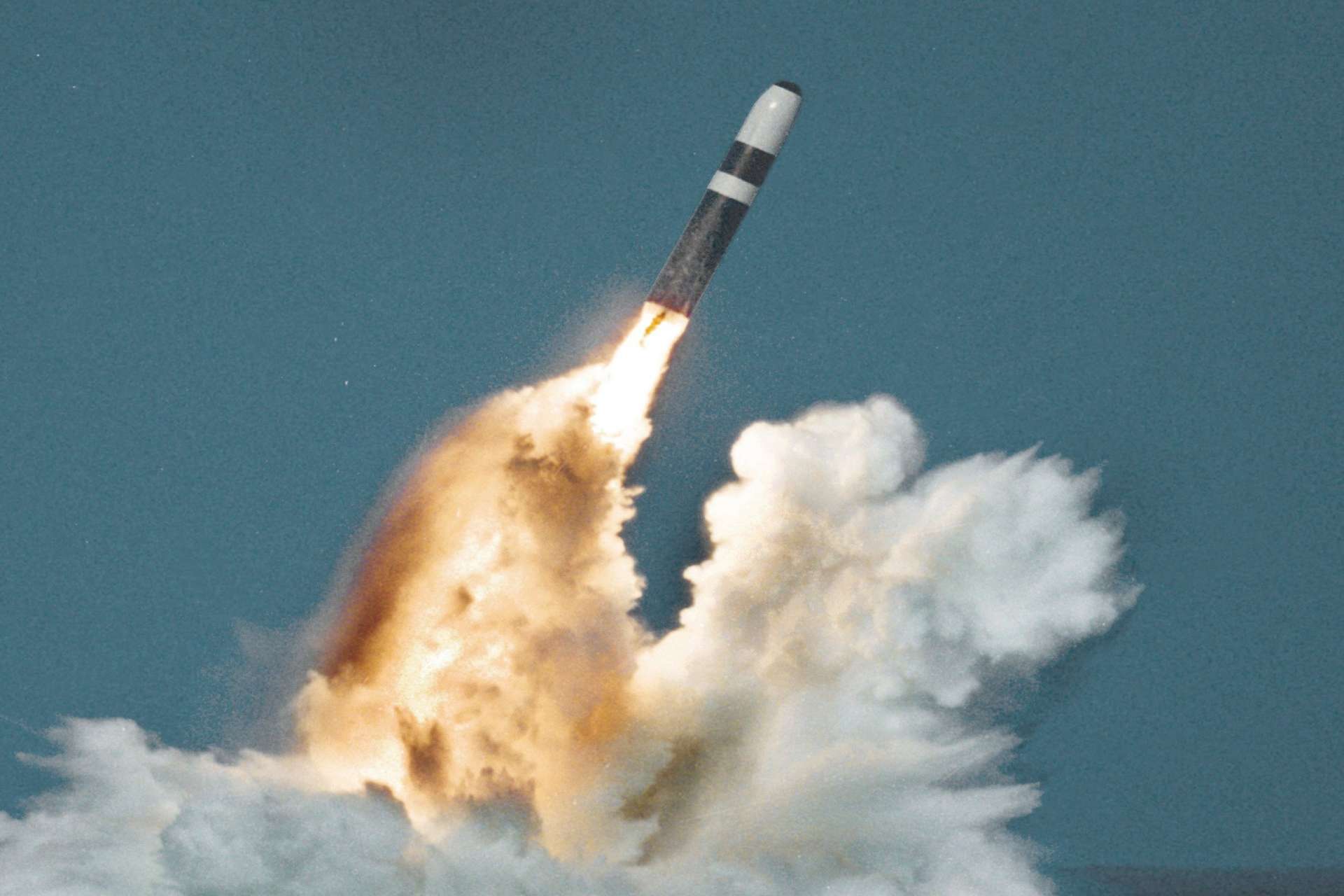
The latest contract demonstrates not only the enduring relevance of the Trident II D5 but also the continuous investment required to sustain it in an era of rapid technological and geopolitical change (Picture source: U.S. Naval Institute)
The Trident II D5 is a three-stage, solid-fuel, inertially guided submarine-launched ballistic missile (SLBM) capable of carrying multiple independently targeted reentry vehicles (MIRVs). Designed to be fired from beneath the sea, it is currently deployed on U.S. Navy Ohio-class submarines as well as the United Kingdom’s Vanguard-class, making it a central component of NATO’s nuclear deterrent. Each submarine can carry up to 20 D5 missiles, which are expelled from their launch tubes using high-pressure gas before igniting their boosters. With a nominal range of 4,000 nautical miles, the system enables strategic strikes from secure, undetected positions in the world’s oceans.
Since its first deployment in 1990, the Trident II has remained the most advanced system in a lineage of Fleet Ballistic Missiles dating back to the Polaris A1. It replaced the Trident I C4, offering improved range, accuracy, and warhead capacity. Originally intended for a service life of 25 years, the system has undergone several life-extension programs, most notably the D5 Life Extension (D5LE) and the ongoing D5LE2 modernization, designed to keep it operational until the arrival of new-generation platforms such as the Columbia-class submarines in the U.S. and the Dreadnought-class in the UK. The development reflects a continuous effort to adapt to emerging technologies and evolving threats.
Compared with earlier U.S. strategic SLBMs like the Poseidon C3, or foreign systems such as France’s M51, the Trident II D5 offers superior accuracy, range, and payload flexibility. Its MIRV capacity allows a single submarine patrol to project credible deterrence across multiple theaters simultaneously. The Trident II’s accuracy also enables it to serve both as a countervalue weapon—targeting strategic assets—and as a counterforce option against hardened military facilities. Unlike land-based ICBMs, its submarine platform makes it far less vulnerable to a first strike, enhancing second-strike survivability and deterrence credibility.
Strategically, the Trident II D5 underpins both U.S. and British nuclear posture, ensuring a reliable sea-based deterrent that complicates adversary calculations. In the context of heightened great-power rivalry, particularly with China’s modernization of its JL-3 SLBM and Russia’s emphasis on advanced strategic weapons, the continuation of the Trident program reflects Washington’s intent to maintain nuclear parity. The extension of the system through the Columbia-class submarines until at least 2084 represents a cornerstone of American and allied nuclear doctrine, providing both geopolitical leverage and military assurance in contested environments.
Financially, the $110 million modification adds to a long series of recent contracts. Earlier in 2025, Lockheed Martin was awarded a $383 million deal to advance the D5 Life Extension 2 missile for the Columbia-class. In September 2024, a $2.1 billion modification was issued covering production and support for Trident II D5 systems and associated warheads. The latest award, running through September 2029, will be managed by Strategic Systems Programs in Washington, D.C., consolidating Lockheed Martin’s role as the sole contractor for the U.S. Navy’s SLBM fleet.
The latest contract demonstrates not only the enduring relevance of the Trident II D5 but also the continuous investment required to sustain it in an era of rapid technological and geopolitical change. By reinforcing the missile’s operational credibility until new-generation systems reach maturity, the program ensures that the United States and its allies preserve a reliable, survivable nuclear deterrent in the decades ahead.