







Breaking News




Expodefensa 2025: China’s CH-3D strike drone targeting Latin America’s defense market.
China Xinxing Import and Export Co Ltd is showcasing a mock-up of the CH-3D medium altitude long endurance (MALE) armed drone at Expodefensa 2025 in Bogota, highlighting Beijing’s push into Latin America’s defense market. The system combines long-endurance ISR, precision strike options, and SATCOM-enabled control, positioning it as a direct competitor to workhorse export platforms.
At the Expodefensa 2025 defense exhibition in Bogota, Chinese state-linked trader China Xinxing Import and Export Co Ltd is pushing a new entrant in the crowded MALE drone market. On its stand, the company is displaying a mock-up of the CH-3D, a 900-kilogram class unmanned aircraft designed for long-endurance intelligence, surveillance, and reconnaissance missions with the option to carry guided bombs and lightweight missiles for precision strike. Combined with satellite communications and electronic warfare fits advertised by Chinese sources, the package illustrates how Beijing intends to stay competitive against other emerging manufacturers that are already reshaping the armed UAV export landscape.
Follow Army Recognition on Google News at this link
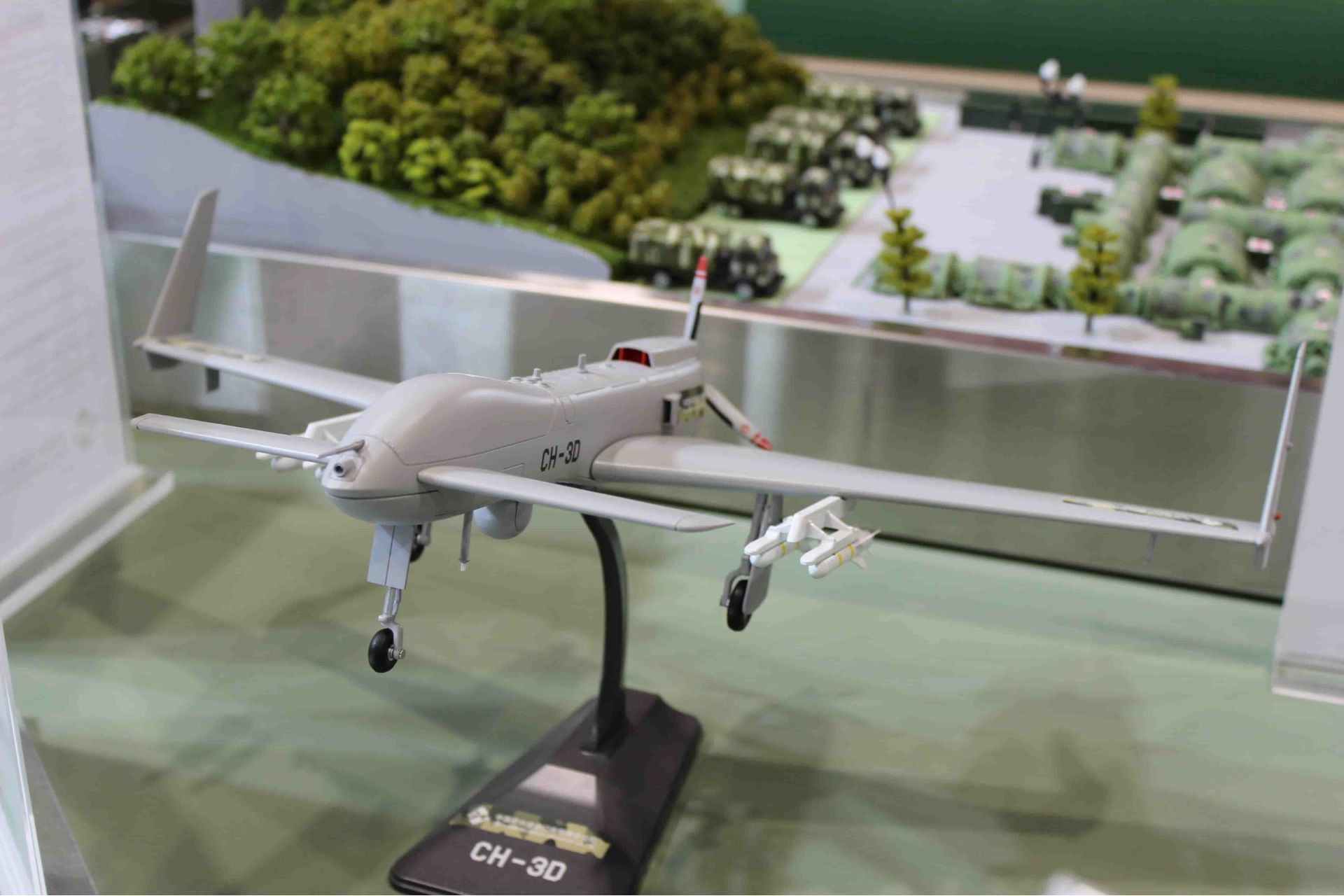
Mock-up of the Chinese CH-3D strike drone at Expodefensa 2025 in Bogota (Picture source: Army Recognition)
The CH-3D has a maximum take-off weight of 900 kg and a payload capacity of 250 kg, placing it in the class of drones capable of carrying multiple sensors together with guided weapons. Cruise speed is reported between 160 and 220 km/h, with a maximum speed close to 280 km/h, and an operational ceiling of 9,000 meters. Endurance is indicated at more than twenty-eight hours in the electro optical reconnaissance configuration, enabling extended missions over a single area, reducing the number of rotations, and ensuring almost continuous presence over the operational zone.
The airframe is designed to combine modularity and payload capacity. The CH-3D has two mission bays that can accommodate a synthetic aperture radar, electro-optical sensors, or electronic warfare equipment. Four hardpoints under the wings and one under the fuselage complete the structure, allowing integration of guided bombs and light missiles according to user requirements and export clearances. This configuration enables the drone to conduct surveillance, target acquisition, and precision strike missions against artillery, armored vehicles, or command posts using a single airframe.
The CH-3D takes off and lands conventionally on a runway using a wheeled landing gear. The required runway length is about 550 meters at sea level, which makes the drone compatible with standard air base infrastructure or appropriately prepared regional airfields. Taxiing to and from the runway can be carried out in automatic mode, while still allowing manual control by ground operators when needed to adapt to local conditions. This mode of operation is intended to ease the workload of ground crews and to support the sequencing of successive sorties when the drone is used in a sustained mission cycle.
For command and control, the CH-3D uses a line-of-sight link with a radius of about 200 km, suitable for missions flown from national territory or a forward base. When the link relies on satellite relay, the range exceeds 2,000 km, subject to adequate coverage, opening the way to extended patrols for the surveillance of long borders, distant coastal areas, or more remote points of interest. This flexibility in control architecture increases the appeal of the system for states wishing to cover large areas with a limited number of air vehicles.
The manufacturer also highlights options intended to improve survivability in jamming-prone environments. The drone can carry electronic warfare suites designed to disrupt opposing radars, protect the airframe against certain guided threats, and collect electromagnetic intelligence. Combined with the stated endurance, these options allow for prolonged intelligence and reconnaissance missions, during which the drone contributes to mapping hostile emitters and supporting the preparation of subsequent operations.
Images posted on Chinese social media on 6 October 2025, and described as taken at an AVIC test facility, show a CH-3D flight test article equipped with a SATCOM fairing and retractable landing gear. SATCOM enables beyond line of sight control, while the retractable gear reduces drag and improves cruise efficiency, extending time on station. These technical choices distinguish the CH-3D from baseline versions of Türkiye’s Bayraktar TB2, which are more oriented toward operations from austere strips with fixed gear and line of sight control, even though the TB2S variant now integrates a satellite link.
China Xinxing Import and Export Co Ltd, the Chinese company responsible for promoting this CH-3D mock- up at Expodefensa, fits into a broader strategy by Beijing to strengthen the position of its defense industry in the MALE armed drone market. The growing number of comparable systems in Africa, Asia, and Eastern Europe illustrates the proliferation of capabilities that combine long-range ISR and precision strike. If the CH-3D confirms in service the reliability, supportability, and doctrinal compatibility announced by its promoter and industrial partners, it could contribute to reinforcing China’s presence in this segment and influence the balance of a market where competition between Turkish, Chinese, and other emerging manufacturers has become a key factor in the capability choices of many states.
Written By Erwan Halna du Fretay - Defense Analyst, Army Recognition Group
Erwan Halna du Fretay is a graduate of a Master’s degree in International Relations and has experience in the study of conflicts and global arms transfers. His research interests lie in security and strategic studies, particularly the dynamics of the defense industry, the evolution of military technologies, and the strategic transformation of armed forces.