







Breaking News






US tests 21 defense companies in Falcon Peak 26.2 to counter hostile drones on Southern Border.
U.S. Northern Command and Joint Interagency Task Force-401 initiated the Falcon Peak 26.2 counter-small unmanned aircraft systems evaluation at U.S. Army Yuma Proving Ground, Arizona. Running from August 31 through September 25, 2026, the 26-day operational assessment brings together 21 defense industry participants to test low-altitude detection, tracking, and low-collateral defeat capabilities. The evaluation targets unique airspace defense requirements for the Southern Border and domestic military installations by gathering empirical performance data across diverse sensor-to-shooter architectures.
The evaluation measures key performance metrics including detection range, track-update latency, probability of defeat, and fully burdened engagement costs across twenty-one participating technology providers. Data collected during the Yuma Proving Ground trials directly inform rapid acquisition validation through the JIATF-401 Counter-UAS Marketplace.
Related topic: US Navy orders 19 Outlaw G2 target drones for Carrier Strike Group Four training in the Atlantic
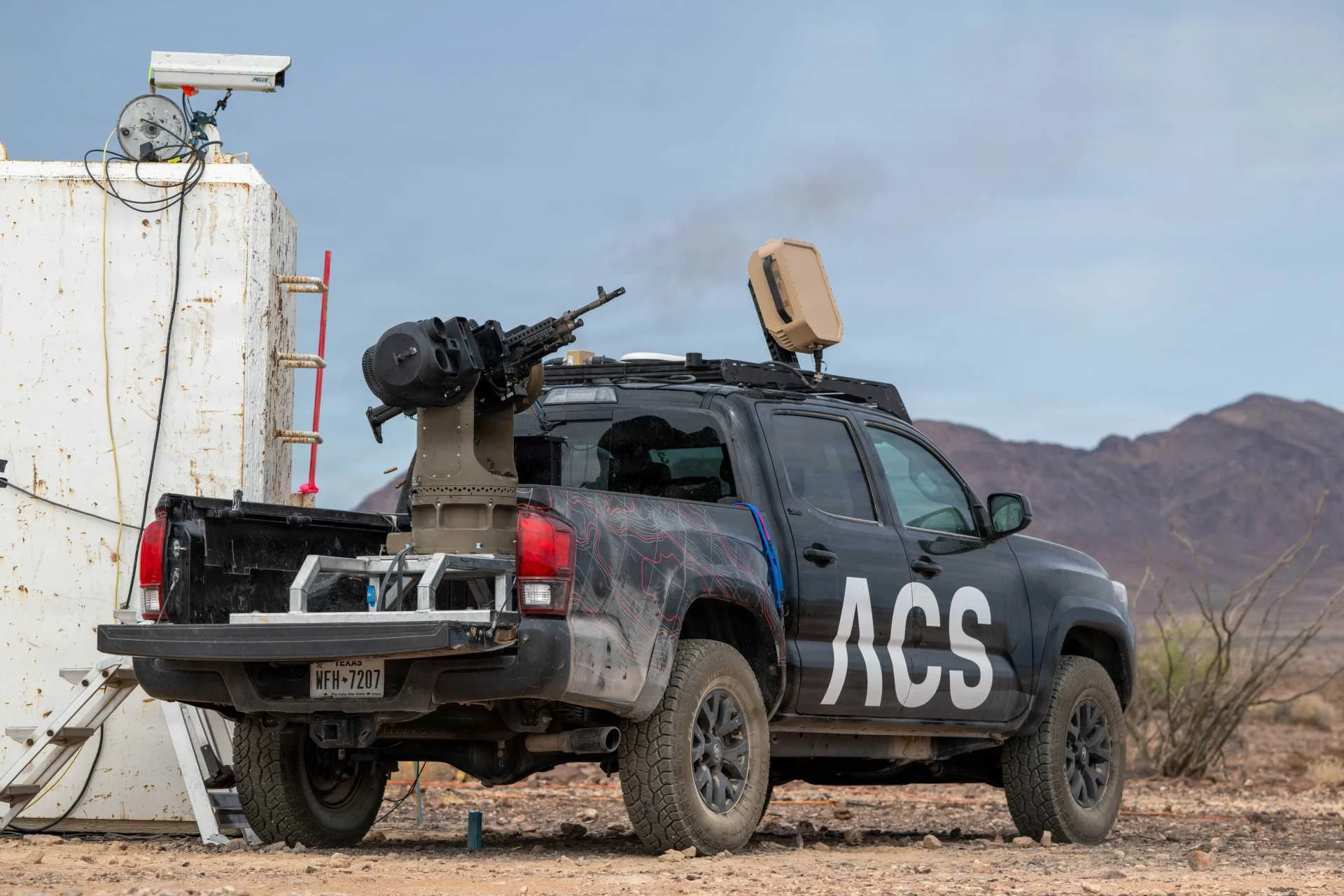
The purpose of Falcon Peak 26.2 is to evaluate the performance, detection capabilities, and effectiveness of various counter-small UAS systems to determine their suitability for U.S. domestic and Southern border defense. (Picture source: US DoD)
On September 14, 2026, the U.S. Department of War named 21 companies participating in Falcon Peak 26.2, the 26-day USNORTHCOM and Joint Interagency Task Force-401 counter-small UAS evaluation running at U.S. Army Yuma Proving Ground from August 31 to September 25. The fourth Falcon Peak iteration and first at Yuma is centered on Cibola Range, including Site 17 and Joint Experimental Range Complex 2, where low-altitude targets and desert terrain reproduce conditions relevant to the Southern Border mission. Equipment in use includes General Radar's high-power AESA, Zenith Aerotech's Quad-8, DataShapes AI's SkyTrap, Allen Control Systems' Bullfrog M240, EOS Defense's R150, Perseus Defense's Portable Kinetic Missile Interceptor with Harpe, BioRes' Aeroo Pro, and FPV drones operated by Digital Force Technologies.
The event follows the operational use of a counter-UAS system on August 25-26, when Joint Task Force-Southern Border used AMP-HEL high-energy laser systems against three hostile UAS. Falcon Peak is consequently measuring more than successful interceptions: detection range and latency, false tracks, track-update rate, target speed, probability of defeat, cost per engagement, reload and re-engagement capacity, endurance, mobility, and collateral footprint, to determine whether a system is suitable for sustained border or installation defense. The 21 participants are Allen Control Systems, Anduril, BioRes, Cover Tech, CX2, DataShapes AI, Digital Force Technologies, Drone Matrix, EOS Defense, General Radar, Genesis Arms, GT Aeronautics, Harmattan AI, Helix Defense, Lumenier, Perennial Autonomy, Perseus, PowerUS, Protora, Teledyne FLIR, and Zenith Aerotech, who occupy different portions of the sensor-to-shooter chain.
For instance, General Radar operated a high-power AESA radar on September 3 and connected it to a 480-V three-phase AC supply before a sensing engagement, exposing the power and infrastructure burden associated with this radar class. Zenith's Quad-8 instead operates from the TeUAS tethered system to provide persistent 360-degree elevated surveillance, exchanging some ground-radar horizon limitations for tether, support, and survivability requirements. Digital Force Technologies operated FPV aggressors at JERC 2 on September 9, while Yuma personnel used Opterra fixed-wing UAS, broadening the target population beyond hovering quadcopters. Earlier Falcon Peak criteria included Group 1 and Group 2 RF-emitting, low-emission, and non-emitting "dark" drones from stationary flight through 250 KIAS, making detection, classification, and continuous fire-control-quality tracking the prerequisite for every downstream interceptor.
That track has defined several quantitative requirements. Earlier Falcon Peak criteria sought at least 10 observations per second, equivalent to one target-state update every 100 milliseconds, with latitude, longitude, elevation, Earth-Centered Earth-Fixed coordinates, velocity, acceleration and attitude available rather than only bearing and range. Sensor evaluation included initial detection range, time to detection, false contacts, false alarms, track management and identification, separating the ability to discover an object from the ability to maintain a usable engagement track. Equipment was expected to operate from -30°C to +50°C, an 80°C temperature envelope, remain functional for 24-48 hours without resupply, and transition toward redeployment within one hour. Generator requirement, cabling, antenna emplacement, calibration, crew size, and teardown time therefore affect a system's operational value alongside detection distance.
Against small drones maneuvering through clutter or terrain masking, as seen daily in Ukraine, the decisive sensor output of Falcon Peak 26.2 becomes sufficiently accurate, persistent position and velocity data to cue another company's gun or interceptor without losing target custody. Allen Control Systems' Bullfrog M240 tests a different proposition: whether automated tracking and fire control can make standard 7.62×51 mm ammunition a deep-magazine hard-kill layer against small UAS. An M240 was installed on the Bullfrog on September 8, and the system was used against drone targets at JERC 2 on September 9, using existing machine gun ammunition instead of consuming a purpose-built C-UAS missile. The principal requirement is subsequently angular tracking accuracy because an FPV drone crossing the field of fire requires the prediction of target movement, ammunition ballistics, and lead rather than just aiming at its instantaneous position.
Missed 7.62×51 mm rounds continue beyond the target, so azimuth, elevation, background terrain, and beaten-zone geometry constrain where the Bullfrog can actually fire. EOS Defense's R150, operated at Cibola Range Site 17 on September 14, provided a second remotely operated ballistic architecture for comparison in slew rate, stabilization, acquisition time, ammunition expenditure, and re-engagement. The practical metric for these two is consequently rounds per kill multiplied by ammunition cost and engagement time, combined with magazine depth and the ground-danger area generated by each burst. Perseus Defense's Portable Kinetic Missile Interceptor placed the Harpe between machine guns and conventional air defense missiles. The Harpe is approximately 61 cm long, has a stated 2-km engagement range, and operates from a launcher weighing less than 36 kg, while Perseus targets an engagement cost below $10,000 per interceptor.
On September 11, the system was prepared and launched at Cibola Range Site 17 before the Perseus team reviewed engagement data, with interceptor debris also visible after testing. External track reception allows the launcher to occupy a different position from the radar or other sensor providing the target track, while maintaining adequate accuracy and latency. This creates a specific quantitative niche: guided hard kill to approximately 2 km from a light launcher at a targeted sub-$10,000 cost per shot. Its usefulness therefore depends on whether that expenditure provides enough probability of kill and engagement distance to justify using the Harpe where gunfire lacks range or acceptable firing geometry but a conventional surface-to-air missile would impose greater cost and emplacement requirements. For its part, BioRes' Aeroo Pro tests physical capture rather than projectile interception.
During a September 8 engagement at JERC 2, the interceptor used a radio-commanded net to entangle an FPV's propellers, while General Chereshnya's Bullet represents the Ukrainian drone-on-drone approach of disabling a target through high-speed ramming. Both remove the stream of downrange projectiles associated with the Bullfrog and R150 and avoid a conventional missile warhead, but the interceptor drone must physically close the distance with its target. That transfers part of the performance requirement to detection-to-launch latency, interceptor transit time, and continuous target custody, as every second spent reaching the intercept point reduces the distance remaining between the hostile UAS and the targeted asset. Earlier Falcon Peak Low Collateral Defeat criteria required catastrophic defeat of Group 1 and Group 2 targets at speeds up to 175 KIAS, defined as recognizable loss of control authority or immediate inability to remain airborne.
Net capture and ramming therefore have to be compared through the probability of capture or collision, reusable components, recovery and sortie generation, target debris and residual interceptor debris rather than simply being categorized as lower-collateral alternatives. Falcon Peak also feeds a counter-UAS acquisition structure reorganized since 2024. USNORTHCOM became the Department's lead synchronizer for homeland counter-small-UAS operations in the continental United States and Alaska in November 2024, covering a protection problem involving more than 350 homeland military installations. JIATF-401 followed in August 2025, replacing the Army-led Joint Counter-small UAS Office and concentrating validation, integration, training, and accelerated acquisition.
Its Counter-UAS Marketplace reached initial operational capability on February 24, 2026, with "401 Verified" intended to separate validated system performance from manufacturer specifications. Australia, Poland, and South Korea also signed procurement agreements during 2026, and JIATF-401 awarded AeroVironment a three-year, $500 million counter-UAS contract in July. On September 8, the task force also released an 89-page Counter-Small UAS Quick Reference Guide covering Groups 1-3, extending to unmanned aircraft weighing 1,320 lb, and roughly 40 commercial systems. These include Anduril Pulsar-L and Anvil, Epirus Leonidas, Echodyne EchoShield, D-Fend Solutions EnforceAir2, and AeroVironment Locust, placing Falcon Peak's 21-company Yuma evaluation inside a considerably larger validation and procurement effort.
Explore More Defense News
• Land Defense News
• Naval Defense News
• Defense Aerospace News
Written by Jérôme Brahy
Jérôme Brahy is a defense analyst and documentalist at Army Recognition. He specializes in naval modernization, aviation, drones, armored vehicles, and artillery, with a focus on strategic developments in the United States, China, Ukraine, Russia, South Korea, Türkiye, and Belgium. His analyses go beyond the facts, providing context, identifying key actors, and explaining why defense news matters on a global scale.