"Developing disruptive technologies and quickly
getting them into the hands of our sailors is what our SwampWorks program
is all about," said Craig A. Hughes, Acting Director of Innovation
at ONR. "This demonstration really underpins ONR's dedication and
ability to address emerging fleet priorities."
The successful submerged launch of a remotely deployed UAS offers
a pathway to providing mission critical intelligence, surveillance
and reconnaissance (ISR) capabilities to the U.S. Navy's submarine
force.
Operating under support of the Los Angeles class USS Providence (SSN
719) and the Naval Undersea Warfare Center-Newport Division (NUWC-NPT),
the NRL developed XFC UAS—eXperimental Fuel Cell Unmanned Aerial
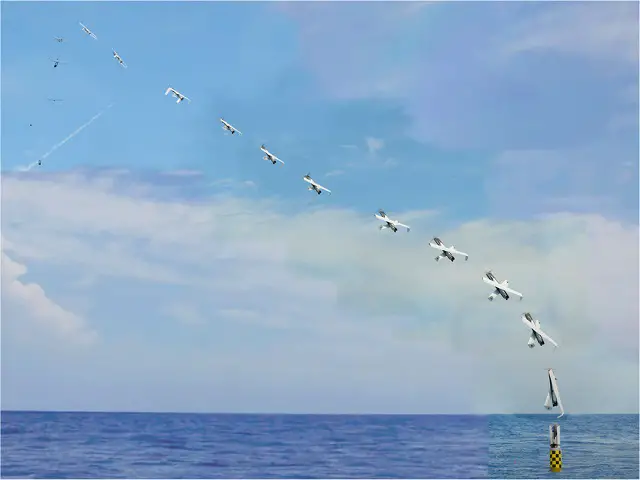
System—was fired from the submarine's torpedo tube using a 'Sea
Robin' launch vehicle system. The Sea Robin launch system was designed
to fit within an empty Tomahawk launch canister (TLC) used for launching
Tomahawk cruise missiles already familiar to submarine sailors.
Once deployed from the TLC, the Sea Robin launch vehicle with integrated
XFC rose to the ocean surface where it appeared as a spar buoy. Upon
command of Providence Commanding Officer, the XFC then vertically
launched from Sea Robin and flew a successful several hour mission
demonstrating live video capabilities streamed back to Providence,
surface support vessels and Norfolk before landing at the Naval Sea
Systems Command Atlantic Undersea Test and Evaluation Center (AUTEC),
Andros, Bahamas.
"This six-year effort represents the best in collaboration of
a Navy laboratory and industry to produce a technology that meets
the needs of the special operations community," said Dr. Warren
Schultz, program developer and manager, NRL. "The creativity
and resourcefulness brought to this project by a unique team of scientists
and engineers represents an unprecedented paradigm shift in UAV propulsion
and launch systems."
The NRL Chemistry and Tactical Electronic Warfare Divisions team
includes the design-builder of the Sea Robin, Oceaneering International
Inc., Hanover, Md.; the fuel cell developer Protonex Technology Corp.,
Southborough, Mass.; and NUWC-NPT's Autonomous and Defensive Systems
Department for Temporary Alteration (TEMPALT) and test demonstration
support.
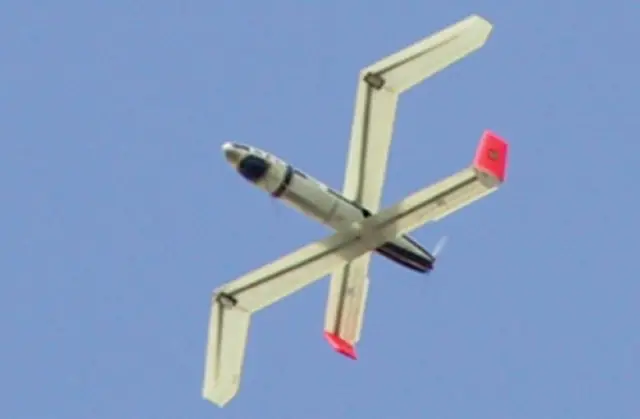
The XFC is a fully autonomous, all electric fuel cell powered folding
wing UAS with an endurance of greater than six hours. The non-hybridized
power plant supports the propulsion system and payload for a flight
endurance that enables relatively low cost, low altitude, ISR missions.
The XFC UAS uses an electrically assisted take off system which lifts
the plane vertically out of its container and therefore, enables a
very small footprint launch such as from a pickup truck or small surface
vessel.
From: U.S. Naval Research Laboratory