

- Details
- Written by: Administrator
- Category: Defence & Security Industry Technology
- Hits: 3626










Türkiye’s defense manufacturer FNSS is developing the PARS ALPHA, a next-generation 8×8 armored combat vehicle engineered to confront the evolving threats of modern warfare. The platform combines mobility, protection, and digital integration to meet the tactical demands of high-intensity battlefields.
Istanbul, Türkiye, October 26, 2025 - Turkish-based Company FNSS has developed the PARS ALPHA, a new generation 8×8 armored fighting vehicle designed to operate in increasingly lethal, technology-driven combat environments. The company describes the vehicle as a response to lessons learned from recent conflicts, where conventional armored platforms have faced greater vulnerability from precision munitions, drones, and electronic warfare. The PARS ALPHA program reflects Türkiye’s ambition to field adaptable, network-ready vehicles that align with future NATO and allied operational concepts.
Follow Army Recognition on Google News at this link
The Turkish-made FNSS PARS ALPHA 8x8 is a new-generation armored combat vehicle designed to deliver enhanced mobility, protection, and digital integration for modern battlefield operations. (Picture source: FNSS)
Military planners are adapting to a new threat landscape shaped by drone swarms, loitering munitions, top-attack anti-tank weapons, and real-time battlefield surveillance. These factors have highlighted the limitations of legacy infantry fighting vehicles, especially in terms of survivability, mobility, and situational awareness. At the same time, modern militaries are seeking armored platforms that can serve as digital combat nodes, integrate easily into networked command structures, and support modular mission configurations.
With the PARS ALPHA, FNSS introduces a completely reengineered layout. The powerpack is placed in the front, allowing the driver and commander to sit side by side behind the engine. This not only enhances frontal protection but also improves crew coordination and battlefield awareness. The crew is supported by 360-degree day and night vision through a suite of cameras and multispectral sensors. The system architecture is designed to accommodate future upgrades, including remote control, autonomous functions, and active protection systems.
Mobility is one of the platform’s standout features. The vehicle uses a new generation of fully independent hydropneumatic suspension, all-wheel drive, and all-wheel steering, allowing it to maneuver with exceptional agility for its weight class. It can turn within a tight radius and maintain a road speed of over 115 kilometers per hour. Its combat weight is rated at up to 40 tons, and the platform offers an operational range exceeding 800 kilometers. FNSS has also integrated a next-generation digital control suite that is compatible with future hybrid-electric propulsion systems.
In its standard configuration, the PARS ALPHA is armed with the TEBER-II 30/40 remote turret. The turret includes a 30mm dual-feed cannon (upgradeable to 40mm), a coaxial 7.62mm machine gun, and optional integration of anti-tank guided missiles. It supports hunter-killer engagement modes and dynamic target tracking, making it suitable for both high-threat conventional engagements and asymmetric warfare.
Protection is scalable to meet mission requirements. The vehicle meets STANAG 4569 Level 4 baseline protection and can be upgraded with reactive armor, soft-kill and hard-kill active protection systems, and CBRN shielding. Internally, blast-attenuating seats and decoupled flooring are used to increase survivability against mines and improvised explosive devices. The vehicle is fully compatible with NATO-standard digital communications and battlefield management systems.
The PARS ALPHA is designed for modularity, supporting a wide range of roles including reconnaissance, mobile gun system, command post, ambulance, and mortar carrier. It is also fully air-transportable by platforms such as the A400M and C-17, enhancing its strategic mobility for rapid deployment scenarios.
With the new PARS ALPHA 8x8 armored fighting vehicle, FNSS is aiming to challenge leading 8x8 competitors such as the German Boxer, Patria AMV XP from Finland, and American Stryker A1 by offering a more future-proof solution that combines battlefield survivability with cutting-edge technology and logistical adaptability.
For full technical specifications and system integration details of the PARS ALPHA 8x8, visit our dedicated technical data page.
Written by Alain Servaes – Chief Editor, Army Recognition Group
Alain Servaes is a former infantry non-commissioned officer and the founder of Army Recognition. With over 20 years in defense journalism, he provides expert analysis on military equipment, NATO operations, and the global defense industry.
Read more: Türkiye’s FNSS develops PARS ALPHA 8×8 combat vehicle to counter new battlefield threats

- Details
- Written by: Administrator
- Category: Defence & Security Industry Technology
- Hits: 4732
Northrop Grumman and the U.S. Army have conducted the first live-fire test of the new Integrated Battle Command System using production hardware. The successful demonstration shows the system’s ability to link and control air and missile defense units ahead of deployment in Europe and the Indo-Pacific.
Washington D.C., United States, October 22, 2025 - Northrop Grumman announced on October 20, 2025, that it has completed the first live-fire demonstration of the Integrated Battle Command System (IBCS), in collaboration with the U.S. Army, using operational production hardware. The test confirmed the system’s ability to integrate sensors, launchers, and command nodes from multiple defense units into one coordinated network.
Follow Army Recognition on Google News at this link
Pictured above is the Engagement Operations Center, the central hub for data processing and communications within the Integrated Battle Command System IBCS. (Picture source: U.S. Department of War)
U.S. Army officials said the event represents a major step toward deploying the system to forward commands in Europe and the Indo-Pacific, where it will help strengthen regional defense coordination against advanced threats.
In a decisive show of modernization momentum, the U.S. Army has completed its first live-fire demonstration of the Integrated Battle Command System (IBCS) using deployable Low-Rate Initial Production (LRIP) hardware. This watershed moment signals operational readiness as the system begins deployment to forward theaters in Europe and the Indo-Pacific. IBCS is the U.S. Army’s next-generation command-and-control system designed to integrate sensors, weapons, and decision-making tools across air and missile defense units. It enables a unified battlespace picture, allowing faster and more accurate responses to evolving aerial threats. This advanced networked architecture replaces legacy stovepiped systems, linking radars and effectors across domains to deliver unprecedented flexibility and precision on the modern battlefield.
Conducted in August 2025, at White Sands Missile Range, New Mexico, the test simulated a hostile air-breathing target, challenging the U.S. Army’s new command and control architecture to detect, track, classify, and neutralize the threat. Leveraging real-time sensor fusion between the IBCS system and the in-development Lower Tier Air and Missile Defense Sensor (LTAMDS), the operation culminated in the successful engagement of the target with a Patriot PAC-3 Missile Segment Enhancement interceptor. All elements from initial track to kill confirmation were orchestrated by IBCS, which performed autonomously and seamlessly under live-fire conditions.
This marked the first time that the U.S. Army has fired a live interceptor controlled by field-ready IBCS hardware, rather than lab-based prototypes or simulation suites. Sources close to the program describe the test as a tactical turning point that represents a transition from development to operational deployment. The system’s performance not only confirmed the integrity of its fire control and decision-support algorithms but also validated its battlefield survivability under real-world operational tempo.
Northrop Grumman, which leads the IBCS program under a series of Pentagon contracts, delivered the LRIP hardware and software suite now entering service. The company has already completed major deliveries under its low-rate production schedule and is transitioning to full-rate production at its Enhanced Production and Integration Center (EPIC) facility in Huntsville, Alabama. This new production hub enables scaled manufacturing of IBCS units, ensuring readiness for large-scale fielding to both U.S. and allied forces.
Kenn Todorov, Northrop Grumman’s vice president and general manager for command and control and weapons integration, emphasized the broader implications of the successful test. He stated that it proves IBCS is fully capable of supporting U.S. and allied forces in the world’s most demanding operational environments. According to Todorov, the live-fire performance "demonstrates IBCS is not just ready, but indispensable for modern, multi-domain air and missile defense missions." He also underscored the system’s role in enhancing international cooperation, calling it a vital tool for strengthening both homeland and allied security in the face of rapidly evolving threats.
At its core, IBCS is built around several key components that operate together to deliver distributed command and control across dispersed units. The system’s architecture includes Engagement Operations Centers (EOCs), which serve as the primary command nodes for processing sensor data, executing fire control decisions, and coordinating engagement orders. These EOCs are connected via a resilient Integrated Fire Control Network (IFCN) that links sensors and shooters regardless of physical location or platform type. Sensors feeding into IBCS include the Sentinel radar, the AN/MPQ-65 radar used with Patriot systems, and the next-generation LTAMDS. On the effector side, IBCS can command a range of interceptors including PAC-2, PAC-3 MSE, and future systems such as the Lower Tier Interceptor (LTI). The system also incorporates Battle Management Command and Control (BMC2) software hosted on ruggedized, modular computing systems, giving commanders real-time access to an integrated air picture across all threat axes. This highly adaptable framework enables rapid kill chain execution and empowers tactical commanders with unmatched situational awareness and operational flexibility.
For the U.S. Army, the operational value of IBCS lies in its ability to unify previously isolated systems into a single, integrated command structure capable of controlling a wide variety of air and missile defense assets. Historically, U.S. air defense units were constrained by closed, proprietary fire control systems that limited sensor-to-shooter interoperability. IBCS breaks those barriers by creating a modular, open-architecture network that links every sensor and shooter on the battlefield, regardless of manufacturer, range, or domain, into a cohesive ecosystem.
IBCS can control and integrate data from multiple sensor platforms including the Patriot radar, Sentinel radar, and the LTAMDS. On the effector side, it is fully capable of managing engagements using interceptors such as the Patriot PAC-2 and PAC-3, the forthcoming Lower Tier Interceptor, and even emerging directed energy weapons and future hypersonic interceptors. The system is also designed to incorporate third-party and allied systems, making it adaptable for coalition operations under NATO or joint-force command structures.
This flexibility allows IBCS to deliver what military planners refer to as "any sensor, best shooter" capability. For example, a target detected by a forward-deployed Sentinel radar can be tracked and classified by IBCS and then engaged by a Patriot launcher positioned miles away, without the need for manual coordination. This drastically reduces response time and increases the likelihood of intercepting high-speed or low-observable threats such as cruise missiles, ballistic missiles, and unmanned aerial systems.
In practical terms, IBCS enables U.S. air defense units to outpace the speed and complexity of the modern threat environment, where adversaries are deploying coordinated salvos of missiles, drones, and aircraft in an attempt to saturate defenses. With IBCS, commanders can see across domains and react with a unified picture that stretches beyond the range of any single radar or launcher.
IBCS is already in active service with international partners. Poland became the first allied nation to field the system as part of its WISŁA medium-range air defense program. In September, Poland’s Ministry of National Defense conducted its first live operational exercise using IBCS, validating its capability under NATO-aligned conditions. The move underscores growing transatlantic trust in IBCS as a cornerstone for European air defense.
With deployments now underway to U.S. Indo-Pacific Command and U.S. European Command, IBCS is entering a new phase of geostrategic significance. By enhancing sensor and shooter interoperability across domains, the system offers Combatant Commanders a force multiplier against growing missile threats from near-peer adversaries. Analysts note that IBCS could become a critical node in the future architecture of integrated deterrence, particularly in regions like the Taiwan Strait and Eastern Europe, where early warning and rapid decision-making are essential to preempting escalation.
This milestone comes as the Pentagon accelerates efforts to field multi-domain command and control capabilities across the services. IBCS, originally envisioned to modernize the U.S. Army’s air defense command layer, is increasingly being integrated into joint concepts under the Department of Defense’s Joint All-Domain Command and Control (JADC2) initiative. As such, the recent flight test not only demonstrated tactical functionality but also confirmed strategic viability for broader force-wide integration.
By moving from prototype to fielded capability, IBCS reaffirms the U.S. Army’s shift toward a digitally integrated battlespace, where speed, resilience, and interoperability define combat advantage. With global deployments now underway, the live-fire test sends an unmistakable signal: the future of air and missile defense is no longer theoretical; it is operational.
Written by Alain Servaes – Chief Editor, Army Recognition Group
Alain Servaes is a former infantry non-commissioned officer and the founder of Army Recognition. With over 20 years in defense journalism, he provides expert analysis on military equipment, NATO operations, and the global defense industry

- Details
- Written by: Administrator
- Category: Defence & Security Industry Technology
- Hits: 11000
The U.S. Army’s XM30 Infantry Fighting Vehicle is emerging as the service’s next-generation replacement for the aging M2 Bradley. Designed to endure drone swarms, top-attack munitions, and digital-age warfare, the XM30 signals a leap in how mechanized forces will fight and survive.
Washington D.C., United States, October 20, 2025 - The U.S. Army is moving forward with its XM30 Infantry Fighting Vehicle program, a clean-sheet design that breaks from decades of incremental upgrades to the M2 Bradley. Developed under the Optionally Manned Fighting Vehicle initiative, the XM30 is intended to thrive on battlefields defined by electronic warfare, autonomous systems, and near-peer threats. Army acquisition officials describe it as a networked, modular vehicle capable of operating with or without a crew, integrating seamlessly with the Army’s future command and control architecture.
Follow Army Recognition on Google News at this link
The American Rheinmetall Vehicles Lynx KF41 (left) and General Dynamics Land Systems Griffin III (right), the two competing prototypes selected by the U.S. Army for the XM30 Mechanized Infantry Combat Vehicle program, aimed at replacing the legacy M2 Bradley in frontline mechanized units. (Picture source: Army Recognition Group)
Developed under the U.S. Army’s Next Generation Combat Vehicle portfolio, the XM30 is engineered to give Armored Brigade Combat Teams a decisive edge with modular design, hybrid-electric propulsion, advanced sensor integration, and superior lethality. It is not just a new vehicle; it is a transformational shift in how the U.S. Army conceives of armored infantry warfare.
As of October 20, 2025, the XM30 IFV (Infantry Fighting Vehicle) U.S. Army program is well into the Engineering and Manufacturing Development phase following a Milestone B decision taken in June 2025. This critical approval moved the project from the design phase into the physical prototyping stage. Both General Dynamics Land Systems and American Rheinmetall Vehicles are currently constructing full-scale prototypes, scheduled for delivery to the U.S. Army in early 2026. Evaluation and trials will inform the final selection process, with a low-rate initial production decision expected by late 2027.
The U.S. Army has established clear threshold requirements across three core areas: mobility, armament, and protection. These define the technological foundation of the XM30 and represent a fundamental leap beyond what the M2 Bradley is capable of delivering.
Mobility
The XM30 must outperform the M2A4 Bradley in terms of both tactical and operational mobility. It will be equipped with a hybrid-electric propulsion system to enable silent mobility, rapid acceleration, and expanded onboard power generation. This is essential for powering advanced sensors, communications equipment, and future energy-based weapon systems. Air transportability remains a hard requirement, with two XM30s needing to fit inside a single C-17 aircraft. The Army also demands superior cross-country performance, improved power-to-weight ratio, and better endurance in austere environments.
Armament
The XM30 will feature a remote-operated turret integrating a 30mm autocannon with growth potential to the XM913 50mm chain gun. This firepower upgrade is paired with a coaxial machine gun and integrated launchers for precision-guided anti-tank missiles. The vehicle must also support advanced fire control systems, laser rangefinders, day and night targeting sensors, and artificial intelligence-enabled targeting support. These features are essential for engaging enemy IFVs, personnel, and drones across complex environments while minimizing exposure of the crew to hostile fire.
Protection
The XM30 is expected to deliver a dramatic improvement in survivability over the Bradley IFV. The vehicle must feature modular passive armor, underbody blast protection, and advanced Active Protection Systems capable of intercepting rocket-propelled grenades and guided missiles. Crew and dismount safety against IEDs and top-attack munitions is a top priority. The XM30 must also integrate full-spectrum countermeasures against UAV threats, along with chemical, biological, radiological, and nuclear protection and onboard fire suppression systems.
Each vehicle will carry a crew of two, a driver and a commander, and transport at least six to nine fully equipped infantry soldiers. The interior layout is being designed to allow rapid dismounting under fire, while also supporting long-duration missions with integrated situational awareness and mission planning tools.
The two current competitors bring distinct approaches to the program. General Dynamics Land Systems has proposed a Griffin III-based design that draws on ASCOD chassis heritage and technologies proven during the U.S. Army’s Mobile Protected Firepower program. American Rheinmetall Vehicles, in partnership with Raytheon and Textron Systems, is adapting its Lynx KF41 platform to meet U.S. requirements, emphasizing modularity, digital architecture, and soldier-centric design.
Both teams received a combined 1.6 billion dollars in prototype development contracts from the U.S. Army in 2023 and are under close scrutiny as testing timelines tighten. Industry insiders report that vehicle integration and power management systems are being closely examined by Army officials ahead of the upcoming field trials.
One of the most important ground vehicle programs for the U.S. Army
The XM30 is not just a new armored vehicle. It is one of the most strategically significant ground combat programs currently underway in the U.S. defense apparatus. For more than 40 years, the M2 Bradley has served as the backbone of U.S. mechanized infantry operations. While it has undergone dozens of upgrades, its core structure can no longer support the technological requirements of modern warfare. Its limitations in protection, digital integration, power generation, and internal volume have become more acute as threats evolve.
The replacement of the Bradley is not a routine fleet modernization. It is a critical force transformation aimed at enabling multi-domain operations against near-peer adversaries like Russia and China. The XM30 must integrate seamlessly with joint and allied forces, support advanced communications and command networks, and defeat a new class of threats including loitering munitions, top-attack ATGMs, and swarm drones.
The U.S. Army’s vision for the XM30 is clear. It must deliver decisive overmatch in lethality, mobility, and protection, while remaining flexible enough to adapt over decades of service life. Its open architecture and digital backbone are designed for continuous upgrade, ensuring the platform remains relevant through 2040 and beyond.
With rising tensions in the Indo-Pacific and continued pressure to deter Russian aggression in Europe, Army leaders are treating the XM30 as a keystone modernization priority. It directly addresses operational gaps identified over two decades of combat deployments and prepares U.S. armored forces for high-intensity warfare against peer adversaries.
For Army Recognition readers, the future XM30 IFV for U.S. Army offers a rare window into the future of U.S. ground combat doctrine. Beyond its industrial significance, the technologies being tested, from hybrid-electric propulsion to AI-enabled targeting, are likely to influence armored vehicle design and procurement strategies across NATO for the next generation.
As the prototypes near delivery and the evaluation phase begins, the XM30 stands at the center of a historic transition in American land warfare. Its success could redefine what it means to fight and win in the 21st-century battlespace.
Written by Alain Servaes – Chief Editor, Army Recognition Group
Alain Servaes is a former infantry non-commissioned officer and the founder of Army Recognition. With over 20 years in defense journalism, he provides expert analysis on military equipment, NATO operations, and the global defense industry.
Read more: Future U.S. Army Infantry Fighting Vehicle XM30 Designed to Survive Modern Battlefields

- Details
- Written by: Administrator
- Category: Defence & Security Industry Technology
- Hits: 5303
BAE Systems has introduced the new M109A7 52 caliber self-propelled howitzer, pairing the M109A7 Paladin howitzer tracked chassis with Rheinmetall’s L52 155mm cannon to significantly increase range. The design marks a quick-turn solution for the U.S. Army’s long-range fires gap following the ERCA program’s halt.
Washington D.C., United States, October 19, 2025 - BAE Systems is offering the U.S. Army a practical upgrade in its pursuit of extended-range firepower. The company’s new M109A7 52 caliber self-propelled howitzer prototype combines the proven M109A7 Paladin howitzer tracked chassis with the German Rheinmetall 155mm L52 cannon, delivering greater range and rate of fire while maintaining full logistical compatibility with existing fleets.
Follow Army Recognition on Google News at this link
BAE Systems showcases the M109A7 52-caliber self-propelled howitzer, featuring the 155mm 52-caliber Rheinmetall gun integrated on the M109A7 chassis, during the AUSA 2025 exhibition in Washington, D.C., marking a key step in U.S. Army artillery modernization. (Picture source: Army Recognition Group)
The M109A7 is the latest iteration of the long-serving M109 Paladin series and serves as the U.S. Army’s primary tracked self-propelled howitzer. It provides indirect fire support to armored brigade combat teams with improved survivability, mobility, and power generation compared to earlier models. Built on a modified Bradley Fighting Vehicle chassis, the M109A7 integrates a fully electric gun drive system, enhanced digital fire control, and upgraded onboard diagnostics. Crucially, it maintains compatibility with the legacy 39-caliber 155mm howitzer, while offering a modernized platform ready for growth, such as the integration of longer-range cannons like the L52. With the Army prioritizing maneuverability and rapid response in large-scale combat operations, the M109A7 serves as the foundational platform for future artillery capability enhancements like the M109A7 52 caliber.
This new platform is not just a speculative prototype. It is a deliberate blend of combat-tested hardware and NATO-standard firepower. After years of struggling with the technical risks of experimental artillery concepts, BAE Systems has opted for a lower-risk integration that could fast-track the U.S. Army’s long-range fires gap closer to operational readiness.
Unlike the now-cancelled ERCA platform, which ran into technical bottlenecks including rapid barrel degradation and excessive system weight, the M109A7 52 caliber takes a pragmatic path forward. By grafting the proven Rheinmetall L52 long-barrel cannon onto the M109A7’s digital fire control and robust electric-drive chassis, the system promises a significant leap in range without redesigning the entire vehicle architecture. BAE officials describe the project as leveraging mature subsystems while doubling down on NATO compatibility. The L52 cannon is already in frontline use with platforms such as the German PzH 2000 155mm self-propelled tracked howitzer and the Swedish Archer, making it a logical choice for cross-force interoperability.
From a technical perspective, the leap in performance is substantial. The current M109A7, armed with a 39-caliber gun, delivers effective fire at roughly 23 kilometers using standard high-explosive rounds and about 30 kilometers with rocket-assisted projectiles. With the Rheinmetall L52 integrated, the unassisted range extends beyond 30 kilometers, while rocket-assisted rounds reportedly reach as far as 60 kilometers. This effectively doubles the operational fire envelope and could significantly alter force posture at the brigade level. While those figures are subject to continued field validation, they reflect real potential to regain the standoff advantage in peer-level engagements.
The M109A7 52 caliber’s development is being advanced under a Cooperative Research and Development Agreement (CRADA) with the U.S. Army’s Combat Capabilities Development Command Armaments Center (DEVCOM-AC). Testing milestones include successful live-fire trials at Camp Ripley, Minnesota, where the new cannon was mounted and fired from the M109A7’s existing turret structure. Early reports confirm full mechanical integration with the vehicle’s existing recoil system and gun mount, a critical factor in limiting development costs and simplifying eventual fielding.
This program also carries significant strategic weight. The failure of ERCA left a conspicuous gap in the Army’s long-range precision fires modernization roadmap. The M109A7 52 caliber appears to fill that void not by revolutionizing artillery, but by upgrading what already works. That reflects a broader shift inside Army Futures Command, a move away from moonshot programs toward more incremental, achievable modernization that can withstand congressional scrutiny and budgetary pressure.
The adoption of a foreign-made cannon also signals a notable shift in acquisition philosophy. For decades, U.S. ground systems have relied almost exclusively on domestic cannon designs. By integrating Rheinmetall’s L52, BAE and the Army are accepting that in a race for capability, allied solutions may sometimes offer the fastest path to the battlefield. That could have ripple effects on domestic cannon producers and the broader U.S. artillery industrial base.
However, questions remain about long-term sustainability. The L52’s barrel, while proven, may still face wear issues under sustained firing conditions. Autoloader integration remains uncertain. The current M109A7 52 caliber configuration appears to retain manual loading, which could limit rate of fire in high-intensity operations. And while the system enhances range, accuracy and lethality will depend heavily on integration with the Army’s wider networked fires architecture, including sensors, targeting systems, and real-time data links.
It is also unclear how soon the M109A7 52 caliber could enter serial production or at what scale. BAE has not released unit costs or production timelines, though the use of existing vehicle platforms is expected to help contain overall program expense. Still, any decision to procure the system at scale would likely come as part of the FY2026 or FY2027 U.S. defense budget cycles.
In operational terms, the M109A7 52 caliber is a meaningful bridge, not a destination. It brings immediate improvements in range and coalition interoperability while the Army continues developing longer-range systems like Precision Strike Missile (PrSM) variants and extended-range rocket artillery. For heavy brigade combat teams, however, it may restore the relevance of tracked self-propelled artillery in high-intensity, contested domains, particularly in Europe or the Indo-Pacific.
This development reflects a broader recalibration of the U.S. Army’s fires modernization priorities. Having learned the hard lessons of ERCA, the M109A7 52 caliber represents a disciplined, evolution-based approach. It leverages field-proven technology, cross-NATO standardization, and rapid integration timelines to meet urgent operational needs. It is not revolutionary, but it might be exactly what the Army needs right now: range, reliability, and readiness without the risks of reinvention.
Written by Alain Servaes – Chief Editor, Army Recognition Group
Alain Servaes is a former infantry non-commissioned officer and the founder of Army Recognition. With over 20 years in defense journalism, he provides expert analysis on military equipment, NATO operations, and the global defense industry.
Read more: BAE’s new M109A7 52 caliber howitzer gives U.S. Army Paladin long-range capability

- Details
- Written by: Administrator
- Category: Defence & Security Industry Technology
- Hits: 3862
U.S. soldiers from the 101st Airborne Division tested a 3D printed munition dropper called Widowmaker, mounted on a PDW C100 drone, during Combined Resolve 26 1 in Germany. The system represents a new frontier in soldier-driven innovation, combining field fabrication with real-time battlefield utility.
GRAFENWOEHR, Germany - On October 9 2025, the U.S. Department of War reported that soldiers from the Multi Purpose Company, 1st Battalion, 502nd Infantry Regiment, 2nd Mobile Brigade Combat Team, 101st Airborne Division tested a 3D printed munition dropper system known as Widowmaker during the multinational exercise Combined Resolve 26 1. Mounted on a PDW C100 drone, the compact device enables precision release of M67 fragmentation grenades, M18 smoke grenades, and training munitions. Developed and manufactured entirely in theater through additive manufacturing, the project underscores how deployed units can design and field mission-specific tools within days.
Follow Army Recognition on Google News at this link
U.S. soldiers from the 101st Airborne Division monitor a PDW C-100 drone in flight, outfitted with the Widowmaker munition dropper, during exercises in Germany. (Picture source: U.S. Department of War)
The combat capabilities offered by the Widowmaker fundamentally alter the dynamics of small-unit warfare. At its core, the system empowers platoon-level forces to carry out independent precision strikes from the air without waiting for external fire support or rotary-wing assets. Instead of requesting artillery or airstrikes through lengthy approval chains, infantry squads equipped with the Widowmaker can identify, engage, and neutralize enemy positions within minutes using coordinated drone operations. Typically, one drone serves as a forward observer, locating and tracking targets, while another executes the munition drop. This compresses the sensor-to-shooter timeline into a tactical advantage at ground level.
The platform enabling this capability is the PDW C-100 drone, a rugged, electric quadcopter designed by Pacific Defense Works and selected by the U.S. Army under its Company-Level Small Unmanned Aircraft System (sUAS) initiative. With a payload capacity exceeding 5 pounds, VTOL capability, a flight endurance of over 30 minutes, and a compact, foldable frame, the C-100 is purpose-built for dismounted infantry operations. Its low acoustic signature and stable flight profile make it ideal for precision munition delivery in urban, wooded, or mountainous terrain, exactly the types of environments where conventional fires are often delayed or unavailable.
During testing in Germany, the Widowmaker demonstrated the ability to release up to four grenades per sortie with accuracy from standoff ranges exceeding 100 meters. The system uses a lightweight, 3D-printed pylon-mounted dropper affixed beneath the drone’s fuselage, with electronic release mechanisms triggered by the operator via remote control. What sets it apart is the flexibility of its design. The dropper system can be tailored to various mission needs and quickly reprinted or modified in the field. Soldiers with no formal engineering background produced the current prototype using commercial CAD software and standard Army additive manufacturing kits, showcasing the potential of low-cost, soldier-led development for tactical systems.
From a combat perspective, this represents more than an incremental improvement. It introduces a disruptive capability at the squad level, transforming infantry units into autonomous strike teams with their own air-delivered munitions. Whether used to flush out enemy forces from cover, deliver obscuring smoke to screen maneuvers, or harass opposing positions during assaults, the Widowmaker provides new options for shaping the battlefield in real time. In decentralized, contested environments where mobility, responsiveness, and self-sufficiency are paramount, the system fills a critical gap between man-portable fires and higher-echelon support.
The broader implications are equally significant. The Widowmaker is not the product of a defense contractor or formal acquisition program. It is a solution built by Soldiers, for Soldiers, conceived, designed, and iterated entirely within the ranks of the 101st Airborne Division. The design has already been transferred to EagleWerx, the division’s innovation lab at Fort Campbell, Kentucky, for refinement and potential wider implementation across U.S. Army formations. This aligns directly with the Army’s “Transforming in Contact” doctrine, which encourages bottom-up innovation and rapid field experimentation in operational environments.
As modern conflicts trend toward greater decentralization, electronic warfare threats, and the erosion of uncontested air superiority, the ability to generate effects at the lowest levels becomes more valuable. Systems like the Widowmaker offer scalable lethality, battlefield adaptability, and logistical simplicity, all critical attributes in peer-to-peer combat. They also reflect a growing institutional recognition that warfighters closest to the problem often hold the key to the solution.
The 101st Airborne’s pioneering use of this technology signals a turning point in how tactical capabilities are developed and deployed. More than just a successful prototype, the Widowmaker could serve as a blueprint for a new generation of soldier-designed drone munitions, modular, mission-configurable, and made for the fight at hand. If adopted at scale, it could fundamentally reshape how infantry units apply force, extending their reach and survivability in ways previously reserved for larger, slower-moving formations.
Army Recognition will continue following the Widowmaker’s evolution as it advances from operational testing into potential program-level adoption. For now, its impact is clear: the future of infantry combat is airborne, adaptive, and increasingly in the hands of the Soldiers themselves.
Written by Alain Servaes – Chief Editor, Army Recognition Group
Alain Servaes is a former infantry non-commissioned officer and the founder of Army Recognition. With over 20 years in defense journalism, he provides expert analysis on military equipment, NATO operations, and the global defense industry.
Read more: U.S. soldiers test 3D printed Widowmaker grenade dropper on PDW C100 drone in Germany

- Details
- Written by: Administrator
- Category: Defence & Security Industry Technology
- Hits: 5388
At DSEI 2025 defense exhibition in London, UK, American Company Lockheed Martin delivered a strong strategic signal to U.S. allies and competitors alike with the expanded promotion of its AN/TPY-4 radar system. The high-performance long-range surveillance radar, which has recently completed early delivery to the U.S. Air Force under the Three-Dimensional Expeditionary Long-Range Radar (3DELRR) program, took center stage at the company’s exhibition with a prominent static display and new details following Sweden’s confirmed selection of the system in June 2025. The Nordic nation now becomes the third confirmed operator of the TPY-4, following the United States and Norway, in what defense officials describe as a strategic acceleration of regional air defense integration within NATO.
Follow Army Recognition on Google News at this link
Scale model of Lockheed Martin's TPY-4 radar on display at DSEI 2025, illustrating its modular design and expeditionary configuration optimized for strategic mobility and NATO interoperability. (Picture source Army Recognition Group)
The Swedish Defence Materiel Administration (FMV) announced its decision to procure the TPY-4 after a multi-phase evaluation campaign focused on radar survivability, interoperability, and long-range detection under electronic warfare conditions. By June 2025, it was announced that Sweden had selected the TPY-4, becoming the latest NATO member to align its air defense architecture with U.S.-developed radar technology. Lockheed Martin confirmed that Sweden will receive its first unit by late 2027 under a multi-system contract, with plans to field the radars along Sweden’s eastern air defense belt facing the Baltic Sea. Integration into Sweden’s national air picture will be coordinated with NATO’s Integrated Air and Missile Defense System (NATINAMDS), marking a milestone in Sweden’s defense modernization following its full NATO accession earlier this year.
The TPY-4 radar, developed under the U.S. Air Force’s 3DELRR initiative, is designed to replace legacy AN/TPS-75 units and redefine expeditionary radar capability across the L-band spectrum. Built around a gallium nitride-based active electronically scanned array (AESA), the radar provides full 360-degree surveillance, enabling simultaneous tracking of tactical ballistic missiles, cruise missiles, fifth-generation aircraft, and small unmanned systems. Lockheed Martin officials detailed to Army Recognition how the radar’s digital beamforming and adaptive signal processing provide persistent surveillance even under intense jamming or clutter environments. The system’s software-defined architecture allows seamless upgrades and tailored mission configurations without hardware changes.
Key performance specifications include detection ranges beyond 550 km in 360-degree coverage mode, and extended reach of over 1,000 km when operated in a focused directional "stare" mode. These capabilities are designed to provide early warning and threat tracking across multiple domains, enabling rapid cueing of missile defense assets and fighter intercepts. A company spokesperson highlighted the radar’s operational flexibility as a decisive advantage for NATO forces facing simultaneous air, missile, and drone threats across broad theaters of operation.
Compared to its predecessor, the AN/TPS-75, the TPY-4 represents a generational leap in radar technology and operational relevance. While the TPS-75 relied on older analog architecture with limited electronic protection and fixed operating modes, the TPY-4 introduces a fully digital, software-defined sensor framework powered by gallium nitride (GaN) transmit-receive modules. This shift enables not only significantly extended detection ranges and higher resolution tracking but also allows the radar to dynamically adapt waveforms in response to emerging threats and jamming attempts in real time. Unlike the TPS-75’s directional and mechanically steered array, the TPY-4 offers true 360-degree coverage in a rotating configuration and can operate in both mobile and fixed roles. Its built-in cybersecurity hardening, modular architecture, and plug-and-play integration with modern command-and-control networks make it fully compatible with NATO's evolving digital battlespace requirements. These advancements position the TPY-4 as not just a replacement but a full-spectrum upgrade over the previous generation of ground-based air surveillance radars.
The U.S. Air Force has already taken delivery of its first TPY-4 unit and has contracted 19 systems under a 472 million dollar procurement, with long-term plans to deploy up to 35 units by 2028. The system is being integrated into the Air Force’s broader Advanced Battle Management System (ABMS) and Joint All-Domain Command and Control (JADC2) infrastructure. Early testing at Hill Air Force Base has demonstrated not only superior detection ranges but rapid operational setup and high mobility, with the entire system transportable via C-130 or wheeled platforms for agile deployment.
For Sweden, the acquisition marks a significant leap in national air surveillance and a broader shift toward NATO-standard integrated defense. The TPY-4’s selection sends a clear message: Stockholm is investing in capabilities that extend beyond territorial defense, aiming to contribute to NATO’s collective situational awareness and deterrence posture across northern Europe. Defense analysts see the radar as central to Sweden’s plans to harden its Baltic flank, especially given the increasing air and missile threat from Russia’s Western Military District and naval forces operating in the region.
As of September 2025, Lockheed Martin has confirmed ongoing discussions with additional European partners including Romania, the Netherlands, and Greece, each seeking to modernize legacy air surveillance networks in the face of growing aerial and missile threats. The TPY-4’s strong showing at DSEI and the momentum gained from Sweden’s June acquisition suggest that Lockheed Martin’s radar is on track to become NATO’s primary ground-based long-range sensor over the next decade.
The company is also exploring co-production and sustainment agreements with select European customers, an effort aimed at reducing delivery timelines and strengthening local industrial participation. Sources close to the Swedish deal noted that at least one Swedish defense electronics firm will be involved in integration and life-cycle support, reflecting the growing emphasis on transatlantic defense industrial cooperation.
With its advanced threat tracking, rapid deployability, and modular growth potential, the TPY-4 is now firmly positioned as the radar centerpiece of NATO’s next-generation air defense strategy.
Written by Alain Servaes – Chief Editor, Army Recognition Group
Alain Servaes is a former infantry non-commissioned officer and the founder of Army Recognition. With over 20 years in defense journalism, he provides expert analysis on military equipment, NATO operations, and the global defense industry.

- Details
- Written by: Administrator
- Category: Defence & Security Industry Technology
- Hits: 2992
The U.S. Air Force has significantly expanded the combat versatility of its F-15E Strike Eagle fighter jet through the rapid integration of the AGR-20F Advanced Precision Kill Weapon System II. This precision-guided rocket, originally developed for lightweight platforms, is now fully operational aboard the Strike Eagle, bringing new counter-drone and precision strike capabilities to one of the Air Force’s most powerful multirole aircraft. The integration effort, executed by the 96th Test Wing and 53rd Wing, progressed from ground testing to combat deployment in just nine days, redefining rapid fielding for tactical airpower.
Follow Army Recognition on Google News at this link
A 96th Test Wing F-15E Strike Eagle conducts a test flight with AGR-20F laser-guided rockets over Eglin Air Force Base, Florida, on May 22, 2024. The 96th and 53rd Wings accelerated integration of the precision weapon to rapidly field the new counter-drone capability. (U.S. Air Force photo by Staff Sgt. Thomas Barley)
The AGR-20F is a laser-guided version of the 70mm Hydra rocket, designed to strike with high accuracy while offering a cost-effective alternative to larger guided bombs. With a weight of roughly 30 pounds and a standoff range of 5 to 7 kilometers, the weapon fills a critical gap between unguided munitions and expensive precision systems like the GBU-39 or AGM-65. Its integration onto the F-15E adds a scalable option for engaging low-cost threats such as small drones, light vehicles, and fast-attack craft with minimal collateral risk.
Unlike traditional bomb racks designed for larger payloads, the F-15E had no existing method to carry the AGR-20F. Engineers resolved this by repurposing legacy Triple Ejector Rack-9A systems and LAU-131 rocket launchers. These 1970s-era components were salvaged from long-term storage and modified for modern use. This approach avoided the delays of new hardware development and allowed the test team to proceed with live integration under an expedited schedule.
Equally critical was the creation of a digital interface that allowed the AGR-20F to communicate with the F-15E's avionics. Prior to this integration, no such interface existed. The solution was based on prior work completed for the F-16, and required the adaptation of both software and wiring architecture. The new connection enabled the rocket to receive in-flight targeting data and respond to laser designation cues provided by the aircraft's targeting pod. This ensured real-time terminal guidance and allowed for accurate engagements across a range of mission profiles.
Flight testing included both land-based and overwater scenarios. The AGR-20F proved effective against mobile and static ground targets simulating unmanned aerial systems and light armor. Maritime testing confirmed the weapon's ability to strike small surface threats, expanding the Strike Eagle’s role in littoral and coastal strike missions. The rocket's lightweight profile and fast time-on-target make it ideal for operations in cluttered or contested airspaces where traditional munitions may be unsuitable due to cost, size, or risk of collateral effects.
With the AGR-20F, the F-15E Strike Eagle gains a tactical capability long absent from its mission set. While originally built for deep-strike and interdiction roles, the aircraft can now engage drones and asymmetric targets during the same sortie, without reconfiguring loadouts or relying on support platforms. This modularity enhances mission flexibility, enabling squadrons to adapt to evolving threats mid-mission while preserving larger precision weapons for high-value targets.
The fielding of the AGR-20F on the F-15E reflects a broader shift in U.S. Air Force munitions strategy. As adversaries increasingly field low-cost drones and fast-moving unconventional systems, the Air Force is prioritizing affordable precision options that can be widely deployed across its legacy and frontline fleets. The AGR-20F offers a low-cost-per-shot solution that extends the lifespan of more expensive munitions and allows aircraft to conduct volume fires against drone swarms or soft-skinned vehicles with surgical accuracy.
This capability is now operational in a combatant command theater, where F-15E units are actively flying with the AGR-20F following the rapid test and integration sprint. The deployment includes not only the rockets but also associated launch systems, targeting procedures, and maintenance support packages. This ensures full operational readiness and provides combat aircrews with immediate access to the new capability under live-fire conditions.
By merging legacy hardware with modern weapons and avionics, the AGR-20F integration demonstrates how adaptability and speed can reshape the tactical landscape. The U.S. F-15E Strike Eagle’s new role in the counter-UAS fight highlights the aircraft’s ongoing relevance in modern warfare and signals the Air Force’s intent to outpace emerging threats with agility and precision.
Written by Alain Servaes – Chief Editor, Army Recognition Group
Alain Servaes is a former non-commissioned officer in infantry units and the founder of Army Recognition Group. With over 20 years of experience in defense journalism, he specializes in military equipment analysis, NATO operations, and global defense industry coverage. His combined military background and editorial leadership have made Army Recognition a key source for defense professionals, armed forces, and industry leaders worldwide.
Read more: U.S. F-15E fighter jet integrates AGR 20F laser-guided rockets for counter-drone missions

Technology: Israel’s Rafael to enhance protection of Polish K2 tanks with Trophy anti-missile system
- Details
- Written by: Administrator
- Category: Defence & Security Industry Technology
- Hits: 4711
During MSPO 2025 in Kielce, Poland, Rafael Advanced Defense Systems from Israel and South Korea’s Hyundai Rotem Company finalized a strategic teaming agreement to integrate the Israeli-developed Trophy Active Protection System (APS) onto the Polish army's K2 main battle tank and its future variants. The agreement was signed at the Hyundai Rotem booth in the presence of senior executives from both companies, symbolizing a deepening of Israeli-Korean defense ties with significant implications for both domestic force modernization and international armored vehicle markets.
Follow Army Recognition on Google News at this link
Polish Army K2 main battle tanks will be equipped with the Israeli Trophy active protection system to enhance survivability against modern anti-tank threats. (Picture source: U.S. DoD)
The new agreement formalizes earlier cooperation under a Memorandum of Understanding and now establishes a full-spectrum collaboration covering system integration, production, lifecycle support, and joint marketing of the combat-proven APS for the Republic of Korea's defense programs. Rafael's Trophy system, the world’s first operational APS with extensive battlefield deployment experience, is set to become a core survivability feature on the Polish Army K2 Main Battle Tank (MBT), including the Polish-customized K2PL variant, marking the first integration of an APS into a Korean-built main battle tank.
This partnership represents a major leap in active protection for the K2, a platform already recognized for its cutting-edge mobility, firepower, and digital battlefield capabilities. By incorporating Trophy, the K2 gains a hard-kill defense layer capable of intercepting and neutralizing incoming anti-tank threats such as RPGs and guided missiles, significantly increasing crew survivability in high-threat environments. Hyundai Rotem confirmed that the system will be fully adapted to the K2's architecture, ensuring optimized integration with the tank’s existing command, control, and sensor suites.
Trophy, developed by Rafael in cooperation with Israel Aerospace Industries' Elta Systems, operates as a 360-degree active protection shield that uses advanced radar to detect, track, and instantly intercept incoming threats with explosive countermeasures before impact. Unlike passive or reactive armor, which absorbs or deflects damage, Trophy proactively eliminates the threat mid-flight. The system has been successfully deployed on the Israeli Merkava IV and Namer armored vehicles, as well as U.S. Army M1A2 Abrams tanks, and is credited with saving lives in numerous real-world combat engagements.
The war in Ukraine has underscored the vulnerability of even modern tanks to man-portable anti-tank guided missiles, loitering munitions, and top-attack drones. Russian and Ukrainian forces have suffered substantial armored vehicle losses due to these evolving threats, which have been employed with high frequency and accuracy. In this operational context, Trophy’s battle-proven capabilities offer a decisive layer of survivability that directly addresses the most pressing threats faced by armored formations on today’s dynamic battlefield.
For the Polish Army, which is currently acquiring a significant number of K2 and K2PL tanks as part of a broader force modernization program, the integration of Trophy is a critical upgrade. It provides real-time, autonomous defense against Kornet-style ATGMs, RPG-29s, and drone-launched munitions that have proven highly lethal in Ukraine. Trophy not only intercepts these threats but also pinpoints their origin, enabling immediate counter-engagement by the tank or supporting units. This threat localization capability transforms the K2 into both a protected and a more lethal platform, enabling it to respond faster and more effectively in ambush or complex combat scenarios.
The move comes amid increasing demand for advanced survivability systems as modern armored forces face evolving threats in contested battlefields, especially in Europe. The K2, currently being delivered to Poland under a multi-phase contract, is seen as a frontrunner for several upcoming tenders, including in NATO-aligned countries seeking next-generation MBT capabilities. The addition of Trophy is expected to enhance the K2's competitiveness against European and American designs that are either considering or already deploying APS technology.
For Rafael, the deal signifies another export success for Trophy, which is already deployed on Israel’s Merkava IV tanks and Namer APCs, as well as selected U.S. Army M1A2 Abrams variants. For Hyundai Rotem, it reinforces the company’s strategic pivot toward high-value partnerships and indigenous industrial growth, particularly through localized production and technology transfer initiatives that will shape Korea’s future armored forces.
With battlefield survivability becoming a critical factor in MBT procurement, the Rafael-Hyundai Rotem alliance positions the K2 MBT as a leading-edge solution for both domestic and allied forces, underscoring a growing trend in global defense: the fusion of combat-tested systems with agile, next-gen platforms for operational superiority in multi-domain conflicts.

- Details
- Written by: Administrator
- Category: Defence & Security Industry Technology
- Hits: 7737
On August 29, 2025, the U.S. Department of Defense announced that the U.S. Army has recently showcased the AH-64E Apache’s ability to detect, track, and defeat hostile unmanned aircraft systems during a live demonstration in South Carolina, United States. The event was organized by Program Manager Apache in collaboration with Program Manager Tactical Aviation and Ground Munitions, the Joint Program Executive Office Armaments and Ammunition team responsible for advanced 30mm proximity-fused ammunition, and the South Carolina Army National Guard. This trial emphasized how the Apache, long regarded as a premier attack helicopter, now provides commanders with a versatile airborne counter-UAS platform in an era where drones dominate modern battlefields.
Follow Army Recognition on Google News at this link
A U.S. Army AH-64E Apache Guardian helicopter from the 4th Squadron, 6th Cavalry Regiment, 16th Combat Aviation Brigade, Joint Base Lewis-McChord, Washington, conducts a flight during the joint strike exercise Super Garuda Shield 25 in Baturaja, Indonesia, on August 31, 2025. (Picture source: U.S. DoD)
U.S. Army AH-64E Apache attack helicopter crews carried out engagements using an array of munitions including the Joint Air-to-Ground Missile, multiple HELLFIRE variants, Hydra-70 Guided Rockets equipped with the Advanced Precision Kill Weapon System (APKWS), and 30mm cannon fire. The demonstration proved the versatility of the platform, with all missile launches destroying their targets, APKWS rockets neutralizing three out of four threats, and 30mm rounds successfully disrupting designated drones. The performance highlighted how Apache weapon systems can offer commanders scalable effects, balancing range, accuracy, and risk management while maintaining rapid engagement capability.
The AH-64 Apache’s combat value rests in the synergy of its advanced sensor suite and diverse arsenal. The AN/APG-78 Longbow fire control radar mounted above the rotor mast gives the helicopter a 360-degree capability to detect, classify, and prioritize aerial and ground targets even in adverse weather or obscured conditions. This radar is now being leveraged to track small drones that would otherwise evade traditional static radars. Complementing the radar is the Modernized Target Acquisition and Designation Sight/Pilot Night Vision Sensor (M-TADS/PNVS), which provides high-resolution day and night imagery, laser designation, and tracking functions, essential for identifying and engaging low-flying drones. These systems, combined with secure datalinks such as Link 16, allow the Apache to share targeting information in real time with other aircraft and ground-based air defenses, extending the protective shield across the battlespace.
Its weapon systems provide layered and flexible counter-UAS effects. The AGM-114 Hellfire missile delivers precision engagement against larger aerial or ground targets, while its successor, the Joint Air-to-Ground Missile (JAGM), expands lethality with advanced seekers and greater range. For mid-range threats, Hydra-70 rockets equipped with APKWS kits transform unguided rockets into precision-guided munitions, offering a cost-effective way to destroy smaller drones. At close quarters, the M230 30mm chain gun, now paired with new proximity-fused ammunition, gives the Apache the ability to neutralize drones with rapid bursts of fire. This combination of sensors and weapons forms a multi-layered defense system in a single airborne platform.
Since its introduction in the 1980s, the American AH-64E Apache has been primarily employed for anti-armor missions, deep strike operations, and close air support. Across conflicts from Operation Desert Storm to Iraq and Afghanistan, the helicopter proved its effectiveness against conventional armored forces and insurgent threats. The emergence of drones on modern battlefields, however, demanded a new operational role. Small and swarming unmanned systems have become one of the most pressing challenges for militaries worldwide, as seen in Ukraine and the Middle East where low-cost drones inflict disproportionate damage on ground forces. This has driven the Army to adapt the Apache’s mission set from a traditional tank-killer into a flexible aerial platform capable of countering unmanned threats in addition to its core strike functions.
Lessons from recent conflicts illustrate why this adaptation is essential. In Ukraine, small quadcopters and loitering munitions have overwhelmed static defenses, targeting artillery, armor, and logistics nodes with precision at low cost. During the Nagorno-Karabakh conflict, Azerbaijani forces used Turkish-made Bayraktar TB2 drones to devastating effect, exploiting gaps in Armenian air defenses to destroy tanks, air defense radars, and artillery positions. Similarly, in Syria and Iraq, both state and non-state actors employed commercial drones for surveillance and strikes, challenging conventional air defenses designed for higher-end threats. These experiences underscore the need for mobile, flexible platforms like the Apache that can move with ground forces, detect concealed drones, and engage them before they strike.
Compared to ground-based air defense systems, AH-64E Apache attack helicopters offer unique advantages. Standard surface-to-air missile systems such as Patriot or NASAMS provide effective coverage but are limited to fixed positions and rely heavily on radar signatures, leaving gaps against low-flying drones or those operating in cluttered environments. Apache platforms, by contrast, combine advanced sensors with mobility, allowing them to patrol vulnerable zones, detect threats concealed from static radars, and engage targets at varying ranges with a wide choice of munitions. They also deliver a cost-benefit advantage, as using precision rockets or 30mm rounds against small drones is more economical than expending high-value air defense interceptors.
Additionally, compared to other combat assets like jet fighters, the Apache provides persistent battlefield presence and slower operational speeds that improve detection and engagement of small, low-signature drones. Fighters are optimized for high-speed air dominance missions and are less efficient in sustained counter-UAS operations. The AAH-64E pache’s ability to remain on station for extended periods, integrate with ground units, and share real-time situational awareness via networked systems reinforces its role as a frontline guardian against drone incursions.
U.S. Army leadership emphasized the significance of the trial. Chief Warrant Officer 5 Daniel York underscored the relevance of the Apache, stating that the demonstration confirmed the platform’s ability to adapt to evolving threats while maintaining its decisive role in combat. Lieutenant Colonel Cusack, responsible for HELLFIRE and JAGM programs, noted that Apache aircrews have repeatedly proven the helicopter’s adaptability, stressing that the key challenge lies in sustaining investment in training and munition integration to maximize crew effectiveness and maintain tactical superiority.
The successful trial reaffirms the U.S. Army AH-64E Apache as more than just an attack helicopter. It is evolving into a flexible and economical counter-UAS solution, offering persistent coverage and rapid reaction capabilities. For ground commanders, this means a critical enhancement to force protection, denial of adversary airspace, and sustained dominance in highly contested environments where drones increasingly shape the battlefield.

- Details
- Written by: Administrator
- Category: Defence & Security Industry Technology
- Hits: 3534
According to information published by the X account of U.S. Company Northrop Grumman on September 1, 2025, the U.S. defense manufacturer has confirmed delivery of its Mk44 30mm Stretch Bushmaster® Chain Gun® to Polish defense company Huta Stalowa Wola (HSW) for integration into the Borsuk Infantry Fighting Vehicle (IFV). This development solidifies a key phase in Poland’s most ambitious armored modernization program in decades and elevates the firepower and mission flexibility of the Borsuk to NATO’s most advanced standards.
Follow Army Recognition on Google News at this link
The Borsuk is Poland’s new-generation amphibious infantry fighting vehicle designed to replace Soviet-era platforms, offering modular armor, advanced firepower, and full NATO interoperability for modern battlefield operations. (Picture source: Army Recognition Group)
The Borsuk IFV (Infantry Fighting Vehicle), meaning “Badger” in Polish, is a fully amphibious tracked combat vehicle developed under the New Amphibious Infantry Fighting Vehicle (NBPWP) program. Spearheaded by HSW in cooperation with the Polish Armaments Group (PGZ), the platform was designed from inception to meet the operational needs of the Polish Army’s mechanized brigades in both continental and riverine environments. The vehicle can accommodate three crew members and up to eight dismounted troops, with full amphibious capabilities allowing waterborne operation without prior preparation.
On March 27, 2025, the Polish Ministry of Defense signed a contract for the first batch of 111 Borsuk IFVs, valued at approximately 6.57 billion Polish złoty. This was followed in May by a historic framework agreement to procure a total of 1,400 tracked armored vehicles based on the Borsuk chassis, including over 1,000 IFVs and multiple specialist variants such as command, reconnaissance, medical evacuation, recovery, and NBC reconnaissance vehicles. Deliveries under the framework are expected to continue through the end of the decade, positioning Borsuk as the backbone of Poland’s future mechanized force structure.
Central to the Borsuk’s combat effectiveness is its remote-controlled ZSSW-30 turret, which integrates the Mk44S Bushmaster II chain gun produced by Northrop Grumman. The Mk44 Stretch variant delivered for the Borsuk offers an extended receiver allowing compatibility with both standard 30×173mm ammunition and future growth to 40mm Super Forty rounds. This modularity is vital for adapting to evolving battlefield threats, especially in anti-personnel and anti-drone engagements.
The Mk44 Stretch fires at a rate of approximately 200 rounds per minute and supports programmable airburst munitions such as the Mk310, allowing the operator to detonate rounds at precise distances for engaging targets behind cover or in elevated positions. It features a dual-feed system, external power drive, and an elevation range of -10° to +60°, enabling full-spectrum engagement of both ground and aerial threats. With an effective firing range of up to 3,000 meters and a maximum range exceeding 4,000 meters, the Mk44 delivers precise firepower across varied combat scenarios. Its lethality extends to light and medium armored vehicles, fortified positions, infantry in defilade, and low-flying UAVs. Armor-piercing fin-stabilized discarding sabot (APFSDS) rounds are capable of penetrating over 55 mm of RHA at 1,000 meters, allowing the Borsuk to neutralize enemy IFVs and lightly protected assets with ease. The programmable airburst capability further allows effective neutralization of enemy troops concealed in urban environments or behind natural obstacles.
Designed with simplicity and battlefield resilience in mind, the externally powered chain gun maintains a low maintenance profile, with a proven mean rounds between failure exceeding 22,000. Its track record across multiple NATO platforms highlights its operational reliability in high-intensity and prolonged engagements.
In addition to the main armament, the ZSSW-30 turret includes a 7.62mm coaxial machine gun and dual launchers for Rafael’s Spike-LR anti-tank guided missiles, offering long-range precision strike capability against armored threats. Advanced optronics with independent thermal sights for both commander and gunner, laser rangefinders, and auto-tracking functionality further enhance target acquisition and engagement in day and night conditions.
With a combat weight of approximately 28 tons, the Borsuk is powered by an MTU 8V199 TE20 diesel engine delivering up to 870 horsepower. The vehicle achieves road speeds of 65 to 70 km/h and water speeds of up to 8 km/h, enabled by rear-mounted water jets. Its modular armor is scalable to mission-specific threat levels, and internal systems are designed with NATO C4ISR integration in mind, ensuring interoperability across multinational operations.
The decision to arm the Polish-made Borsuk tracked IFV with the U.S.-made Mk44 Bushmaster not only brings unmatched firepower and proven reliability to Poland’s new IFV fleet but also ensures long-term access to a global supply chain, extensive ammunition options, and compatibility with the most advanced NATO-standard systems. This strategic integration enhances Poland’s deterrence posture, aligns with Western interoperability goals, and strengthens the industrial-defense partnership between Polish and American manufacturers. Ultimately, the Mk44-equipped Borsuk IFV sets a new benchmark for 21st-century tracked combat vehicles within NATO.
Read more: Polish New Borsuk Infantry Fighting Vehicle Gains Firepower with U.S. Mk44 30mm Chain Gun

- Details
- Written by: Administrator
- Category: Defence & Security Industry Technology
- Hits: 7705
The British Army Expo 2025 in Edinburgh unveiled the Boxer 8x8 armored vehicle as the new Mechanised Infantry Vehicle (MIV), marking a turning point in the modernization of UK land forces. The showcase highlighted Boxer’s modular design, which separates a common drive module from interchangeable mission modules, enabling the same chassis to be adapted rapidly for infantry transport, command and control, medical evacuation, indirect fire support, or electronic warfare. This flexibility, combined with advanced protection and NATO interoperability, makes Boxer the central platform for the British Army’s new Strike Brigades and a defining element of Britain’s land warfare strategy for the next generation.
Follow Army Recognition on Google News at this link
The British Army’s latest 8x8 wheeled armored vehicle, BOXER, was displayed at British Army Expo 2025. (Picture source: British MoD)
The Boxer programme represents the largest armored vehicle procurement by the British Army in decades. A £2.8 billion contract signed in November 2019 with ARTEC, managed through the OCCAR procurement agency, covered an initial 523 vehicles across multiple variants. In April 2022, the Ministry of Defence expanded the order with an additional 100 vehicles, bringing the total fleet to 623. UK production is led by Rheinmetall BAE Systems Land in Telford and WFEL in Stockport, supported by a supply chain that secures 60 percent domestic content and sustains over 1,000 skilled jobs. This approach reinforces sovereign industrial capability while ensuring long-term sustainment of the Boxer fleet.
The UK fleet will consist of a wide range of mission-specific variants. Infantry Carrier Vehicles will move mechanised infantry sections into battle, while Command and Control versions will deliver enhanced digital battlefield management. Engineer Section Vehicles will support mobility and counter-mobility operations, while Repair and Recovery variants will sustain combat power. Mortar Carriers will provide indirect fire, Fire Support versions will reinforce reconnaissance units, and Observation Post Vehicles will direct artillery fire. Electronic warfare and signals intelligence variants will strengthen the Army’s ability to operate in contested electromagnetic environments, while dedicated Ambulance modules will deliver enhanced medical support. This diverse mix ensures Boxer can cover the full spectrum of mechanised operations.
Compared to the legacy tracked platforms it replaces, Boxer represents a generational leap. The FV432 armored personnel carrier, first introduced in the 1960s, was a versatile workhorse but no longer offers adequate survivability in modern conflicts. Warrior MCV-80 IFV (Infantry Fighting Vehicle), brought into service in the 1980s, delivered firepower and tracked mobility but lacks the digital systems, protection levels, and adaptability required today. Boxer, with a combat weight of more than 38 tonnes, combines high road speed of around 100 km/h with strong cross-country performance, while its modular armor and V-shaped hull provide superior protection against mines, improvised explosive devices, and medium-caliber threats. Its architecture allows continuous integration of new technologies and mission systems, extending service relevance well into the 2050s.
The British Army’s transition from tracked to wheeled platforms reflects both strategic and operational imperatives. Wheeled vehicles like Boxer provide far greater strategic mobility, able to self-deploy rapidly over long distances without relying on heavy transporters. This is especially relevant for NATO reinforcement in Europe, where fast road movement across allied territory is essential. Wheeled designs also reduce strain on infrastructure, consume less fuel, and require less maintenance than tracked vehicles, lowering the logistic burden of mechanised formations. Modular construction further reduces fleet complexity and life cycle costs, while survivability features address the threats that dominated recent campaigns in Iraq and Afghanistan. Within the Strike Brigade concept, Boxer delivers a lighter, faster, and more sustainable force that retains robust protection and combat power.
The programme has already reached key milestones. Verification and validation trials began in early 2024 at Millbrook Proving Ground. In January 2025, the first fully UK-built Boxer rolled out of the RBSL production line, with dozens more vehicles scheduled for delivery this year. Initial Operational Capability is expected before the end of 2025, while Full Operational Capability is planned for 2032, at which point Boxer will have fully replaced Warrior and FV432 across mechanised infantry units.
The unveiling of the Boxer 8x8 armored vehicle at the British Army Expo 2025 demonstrated more than the introduction of a new vehicle. It showcased a broader strategic shift in how the British Army equips, supports, and deploys its mechanised forces. By combining modular adaptability, advanced protection, digital integration, and high mobility in a wheeled platform, Boxer ensures the British Army is prepared for rapid deployment, NATO interoperability, and the demands of high-intensity operations. It is not simply a replacement for outdated vehicles but the foundation of a new combat philosophy built on speed, resilience, and flexibility.

- Details
- Written by: Administrator
- Category: Defence & Security Industry Technology
- Hits: 5729
According to recent information published by a French Army officer on LinkedIn, the French Army’s Technical Section (STAT) has completed development of the PROTEUS Standard 1 system, a fast-track modernization of the AA53 T2, a single-barrel 20mm automatic gun mount. Finalized in just four months, this upgrade marks a strategic leap in the French military’s response to the rapidly expanding threat of drones and remotely piloted munitions on contemporary battlefields.
Follow Army Recognition on Google News at this link
The French Army's PROTEUS system upgrades the legacy AA53 20mm automatic cannon with modern optics and fire control to deliver a low-cost, short-range counter-drone solution tailored for today’s saturated aerial drone threat environment. (Picture source: French MoD)
Originally, the AA53 automatic cannon was introduced by the French Army in the post-World War II era as part of a broader effort to standardize and modernize its support weapons. Derived from the AA52 machine gun family, the AA53 was developed specifically for anti-aircraft and light anti-vehicle roles. Chambered in 20x139mm NATO caliber, the weapon was gas-operated, air-cooled, and capable of firing up to 720 rounds per minute. It could be deployed in fixed defensive positions, mounted on tripods, or integrated into light armored vehicles, primarily for short-range air defense or direct fire support. While eventually overshadowed by newer systems, the AA53 remained in use for decades due to its mechanical reliability, compact profile, and adaptability.
The PROTEUS Standard 1 introduces a comprehensive overhaul of fire control, transforming the legacy AA53 T2 into a precise, all-weather, day-and-night counter-UAV weapon system. By integrating a stabilized TV and infrared camera, a digital ballistic calculator, and an inertial navigation system, STAT has tripled the accuracy of the original platform. These enhancements give operators the ability to detect, track, and engage aerial threats with far greater efficiency while keeping costs exceptionally low. This balance between performance and affordability is key as the French Army adapts to a future battlespace where drone saturation is expected to be constant.
This development comes in direct response to the dramatic shift in modern warfare driven by the mass use of low-cost, commercially adapted and military-grade drones. From loitering munitions to quadcopters and fixed-wing UAVs used for reconnaissance, electronic attack, and direct strikes, the battlefield is now saturated with aerial threats operating at low altitudes and short ranges. The ongoing conflicts in Ukraine and the Middle East have shown how drone swarms can overwhelm traditional air defense systems and inflict serious damage on logistics hubs, artillery positions, and command posts.
High-end missile systems such as MANPADS, SHORAD batteries, or radar-guided surface-to-air missiles are often too expensive or too slow to deploy in sufficient numbers to counter persistent drone threats. These systems are designed to engage larger or faster-moving targets and come with significant procurement and maintenance costs. Worse, firing a costly missile at a small, low-cost drone creates an unsustainable economic imbalance. PROTEUS offers a direct alternative to this problem by providing an effective and reusable kinetic solution capable of neutralizing drones at close range using inexpensive 20mm ammunition.
Initial deliveries of the PROTEUS Standard 1 are underway to the 35th Parachute Artillery Regiment (35e RAP) in Tarbes, one of the French Army’s elite rapid-reaction units. Their airborne role and operational flexibility make them an ideal first adopter to evaluate and validate the system in field conditions. Lessons learned from this deployment are expected to guide future rollouts across additional formations.
The French initiative is part of a broader international trend in which legacy gun systems are being reconfigured to meet the demands of modern drone warfare. In Ukraine, Soviet-era ZU-23-2 twin 23mm cannons have been adapted for mobile counter-drone use, often mounted on tactical vehicles and paired with commercial-grade optics, thermal sights, and digital range-finding systems. These low-cost solutions have proven their effectiveness in countering low-flying drones used in both surveillance and strike roles.
In Israel, the military is currently examining the potential of adapting the M61 Vulcan cannon as a ground-based drone-killing platform. According to the Israel Defense Forces, this six-barrel, electrically driven Gatling-style rotary cannon is capable of firing up to 6,000 rounds per minute. Originally developed for use on U.S. fixed-wing aircraft and produced by General Dynamics, the M61 is now being assessed for ground-based applications to defeat dense drone swarms and loitering munitions.
Turkey has also adapted its Aselsan SARP remote weapon stations to include drone-tracking algorithms and programmable ammunition, enabling effective engagement of low-altitude drones with 12.7mm or 20mm calibers. These developments reflect a shared tactical philosophy seen across multiple armed forces, focused on repurposing existing gun systems with modern sensors and targeting suites to build cost-effective counter-UAS capabilities.
What distinguishes PROTEUS is the French Army's structured, institutional approach to the problem. STAT’s ability to convert the AA53 into a modern counter-drone platform in under four months is a direct answer to operational urgency. The system is designed for scale, simplicity, and sustainability. It fills the critical gap between handheld anti-drone rifles and high-end missile systems, offering a permanent, reusable solution suited to static defense points, mobile artillery protection, and forward operating bases.
PROTEUS represents a new generation of battlefield innovation focused not on prestige systems but on survivability, readiness, and economy. As drone warfare evolves into a standard feature of every conflict zone, affordable and upgradable platforms like this will be key to ensuring the tactical superiority and adaptability of front-line forces.

- Details
- Written by: Administrator
- Category: Defence & Security Industry Technology
- Hits: 7148
The Ukrainian army’s 429th separate regiment of unmanned systems, known as “Achilles,” has demonstrated once again how low-cost FPV kamikaze drones are reshaping the balance of power on the modern battlefield. In recent operations, Ukrainian operators used first-person-view drones to strike and immobilize the Russian T-90M “Proryv” or “Breakthrough” tank, currently the most advanced and expensive main battle tank in the Russian arsenal. Despite its advanced armor protection and countermeasures, the $4.5 million vehicle proved highly vulnerable to swarms of drones that cost only a fraction of that price.
Follow Army Recognition on Google News at this link
A Ukrainian first-person view drone strikes and disables a Russian T90M main battle tank, highlighting the growing vulnerability of modern armor to low-cost aerial threats. (Picture source: Ukrainian army’s 429th separate regiment)
The T-90M Main Battle Tank (MBT), officially introduced into Russian service in 2020, represents the pinnacle of Russia’s armored warfare development with improved Relikt explosive reactive armor, upgraded fire control, and survivability enhancements intended to withstand modern anti-tank guided missiles. However, its encounter with Ukrainian FPV drones highlights the rapidly growing threat posed by cheap, easily deployable unmanned aerial systems capable of targeting weak spots such as engine compartments, optics, and ammunition storage. In this case, drone operators from the Achilles unit successfully bypassed traditional armor protection by steering explosive-laden drones directly into vulnerable areas, forcing crew evacuation and rendering the tank inoperable.
This incident does not merely signal a tactical success for Ukraine but raises an alarm that resonates far beyond the current conflict. For NATO, the event serves as a live demonstration that even the most advanced main battle tanks in Western inventories, such as the German Leopard 2A8, the U.S. M1A2 Abrams SEP v3, or the future British Challenger 3 tank, could be exposed to the same vulnerabilities if faced with mass FPV drone assaults. These Western tanks were designed to survive against kinetic penetrators and guided missiles, yet their armor and active protection systems were never optimized to counter swarms of small, precise, and expendable aerial systems attacking from unconventional angles.
The war in Ukraine has completely changed the way main battle tanks are employed. Once regarded as the decisive spearhead of ground offensives, tanks are now increasingly forced to operate under the constant threat of aerial observation and drone attack. This shift has not eliminated the relevance of heavy armor but has created a pressing need to adapt tank doctrine and technology. Survivability no longer rests primarily on passive protection but on the ability to defeat aerial threats before they can strike. The demand for counter-drone solutions, ranging from electronic jammers and radar-guided weapons to compact directed-energy systems, has now become central to the future of tank modernization.
Exclusive commentary from Western defense experts underscores this new reality. A retired German Leopard 2 commander told Army Recognition that “the war in Ukraine proves armor cannot rely on armor alone. If drones costing a few hundred euros can destroy multi-million-euro tanks, our doctrine must evolve immediately. Protection must now be electronic as much as it is physical.” Similarly, a US-based defense analyst stressed that “NATO tanks are not immune to this threat. Unless electronic warfare, jamming, and directed-energy solutions are built into every armored brigade, NATO could face catastrophic losses in the opening stages of a future high-intensity conflict.”
This urgent need is already being recognized by leading Western defense manufacturers. Rheinmetall, which recently rolled out the Leopard 2A8, has signaled that future iterations of the tank will incorporate advanced counter-drone capabilities, including integrated sensors and active protection layers designed to detect and neutralize small aerial threats. The German Leopard 2A8’s modular architecture makes it suitable for add-on counter-UAS systems, a feature likely to become standard across NATO fleets.
General Dynamics Land Systems, the manufacturer of the Abrams, is also investing in integrating short-range air defense modules and jammers directly onto the U.S. Abrams M1A2 SEP v3 tank. Test campaigns in the United States are exploring drone defeat systems mounted on armored chassis. Meanwhile, BAE Systems is designing the Challenger 3 with digital infrastructure that will allow rapid upgrades, including the future installation of laser-based or electromagnetic counter-drone technologies.
These industry initiatives point to a future in which the main battle tank is not just a heavily armored vehicle but a mobile node in a wider counter-drone ecosystem. Tanks may soon carry their own layered protection suites against unmanned threats, supported by accompanying vehicles equipped with high-powered electronic warfare and laser systems. In this sense, the lessons from Ukraine are driving a convergence of armored warfare and air defense, forcing the tank to evolve into a hybrid platform that can both withstand and actively repel drone swarms.
The Ukrainian example illustrates that the next generation of tank warfare will unfold not in duels between steel giants but in a complex battle against invisible, fast, and cheap aerial hunters. NATO must adapt its armored doctrine to this reality or risk seeing its most advanced land platforms neutralized in future conflicts. The downfall of the Russian T-90M tank at the hands of FPV drones is not just a Russian problem. It is a strategic warning to every military power that still considers the tank an undisputed symbol of battlefield superiority.

- Details
- Written by: Administrator
- Category: Defence & Security Industry Technology
- Hits: 8339
Following recent pictures published on social networks, in August, 2025, Ukrainian forces have begun applying field upgrades to U.S.-donated M1A1 SA Abrams tanks, equipping them with explosive reactive armor (ERA) and improvised anti-drone structures to address critical protection gaps. The modifications come in response to mounting losses attributed to new battlefield threats such as FPV kamikaze drones, loitering munitions, and top-attack anti-tank guided missiles which have exposed the vulnerabilities of the base M1A1 SA configuration in the Ukrainian theater.
Follow Army Recognition on Google News at this link
Ukrainian-upgraded US M1A1 SA Abrams tank fitted with Kontakt-1 ERA blocks and turret cage armor to counter modern battlefield threats including drones and top-attack munitions. (Picture source: Ukraine MoD)
A total of 31 M1A1 SA Abrams tanks were delivered to Ukraine by the United States in late 2023 as part of a military assistance package aimed at strengthening Ukrainian armored capabilities. However, Ukrainian soldiers operating the tanks reported that the vehicles, while mechanically reliable and effective in traditional engagements, lacked sufficient protection against modern asymmetric threats. Most notably, the original M1A1 SA does not feature an active protection system, reinforced turret roof armor, or any dedicated anti-drone defense measures. These limitations left the tanks highly vulnerable to top-down attacks and precision strikes from relatively low-cost unmanned aerial systems now proliferating across the battlefield.
The M1A1 SA is an export-standard variant based on the U.S. Army’s M1A1 platform, originally developed for large-scale mechanized warfare during the Cold War. It retains a powerful 120mm smoothbore gun and robust frontal composite armor but lacks some of the key survivability features of newer Abrams variants. Most notably, the version delivered to Ukraine does not include depleted uranium armor inserts or reactive armor kits which leaves the tank vulnerable to tandem-charge warheads and shaped charges. The side skirts and turret flanks provide only limited resistance to modern anti-tank guided missiles while the engine compartment and turret roof remain exposed to drone strikes and loitering munitions.
These structural weaknesses became apparent in combat where Ukrainian tank crews experienced losses from threats that bypassed traditional frontal armor by attacking from above or the rear. The vulnerability of the M1A1 SA in the face of these new-generation threats highlighted a critical need to reinforce its protection levels with modern solutions. The realities of the Ukrainian battlefield proved that even a tank as capable as the Abrams cannot survive without adaptations tailored to the current threat environment. The M1A1’s armor, designed for the threats of past decades, is no longer adequate without further enhancements.
To address these weaknesses, Ukrainian engineers and frontline tank crews have installed Kontakt-1 explosive reactive armor modules on the U.S. M1A1 SA tanks. ERA is a form of modular armor designed to neutralize the effects of incoming shaped-charge warheads. It consists of explosive-filled metal tiles that detonate outward when struck by a high-explosive anti-tank projectile, disrupting the penetrating jet before it can pierce the base armor. Kontakt-1, developed by the Soviet Union in the 1980s, is one of the earliest generations of ERA and is effective at reducing the impact of single-charge HEAT warheads although it offers limited protection against newer tandem-warhead designs and kinetic energy penetrators.
The application of Kontakt-1 bricks to the hull front, side skirts, turret cheeks, and even the turret roof represents a pragmatic adaptation by Ukrainian forces to compensate for the M1A1 SA’s lack of modular protection. In addition to ERA, Ukrainian crews have installed cage armor on the turret roof and rear engine deck to protect against aerial drone strikes, creating a layered defense system more suited to current combat conditions. While these modifications add considerable weight to the vehicle and introduce logistical challenges, they significantly improve survivability in a drone-dominated battlespace.
This field-driven upgrade initiative sends a strong signal to U.S. and NATO military planners. The combat experience in Ukraine demonstrates that even advanced Western main battle tanks require continuous evolution in protection systems to counter emerging threats. The vulnerability of the M1A1 SA has revealed a clear need for the U.S. Army to reevaluate its legacy fleet and consider integrating new-generation protection packages including roof-mounted ERA, active protection systems, and modular drone-defense solutions.
The battlefield in Ukraine has become a proving ground not only for tactics and strategy but for the technology that underpins survivability. The Ukrainian modification of the M1A1 SA Abrams stands as both a lesson and a warning that future armored warfare will be defined by the ability to adapt to threats that no longer come from the front but from the skies above.

- Details
- Written by: Administrator
- Category: Defence & Security Industry Technology
- Hits: 8229
An exclusive analysis by Army Recognition based on verified technical specifications and firsthand data from the ongoing use of the Russian T-90M in the Russia-Ukraine conflict reveals critical insights into how the latest Russian and German Leopard 2A8 main battle tanks could perform in a future European war scenario. As the T-90M undergoes continuous field-driven upgrades to counter modern threats such as drones and loitering munitions, the newly unveiled Leopard 2A8 enters service with cutting-edge digital systems but lacks an integrated active protection system. This evolving competition highlights two diverging philosophies of armored warfare and raises urgent questions about battlefield survivability in an era dominated by top-attack and aerial threats.
Follow Army Recognition on Google News at this link
The German Leopard 2A8 and the Russian T-90M represent two distinct approaches to modern tank design, differing in terms of firepower, protection, and battlefield adaptability. (Picture source: Army Recognition Group)
The Russian T-90M “Proryv” is armed with the 125mm 2A82-1M smoothbore gun, offering enhanced barrel life, increased pressure resistance, and higher muzzle velocity compared to its predecessors. This gun can fire a variety of ammunition, including the Vacuum-1 APFSDS round designed to penetrate NATO-standard composite armor at distances exceeding 2,000 meters. Critically, the T-90M retains the ability to launch 9M119M Refleks-M anti-tank guided missiles through the main gun tube, with engagement ranges up to 5,000 meters. These missiles can target both armor and low-flying helicopters, offering a decisive standoff capability. This long-range versatility is not available on Western tanks, giving the T-90M an asymmetric edge in mixed terrain or defensive scenarios. Secondary armament includes a coaxial 7.62mm PKTM machine gun and a 12.7mm Kord heavy machine gun mounted on a remote-controlled weapon station, fully integrated with the commander’s panoramic sight for independent engagement.
The German Leopard 2A8 is armed with the 120mm L55A1 smoothbore cannon, optimized for firing the latest DM73 kinetic energy round, which delivers superior penetrative power over its predecessor. The cannon is designed for high accuracy and minimal barrel deflection over extended engagements. However, unlike the T-90M, the Leopard 2A8 cannot launch guided missiles from its main gun, limiting its maximum effective engagement range to around 4,000 meters with kinetic rounds and approximately 5,000 meters with programmable HE ammunition. While the tank excels in sensor fusion, reaction time, and first-hit probability, the absence of missile capability reduces its flexibility against distant or concealed threats. Its secondary armament typically includes a coaxial 7.62mm MG3 machine gun and an FLW-200 remote weapon station, which can be configured with a 12.7mm MG or a 40mm grenade launcher, depending on the customer.
In terms of protection, the Russian T-90M combines traditional heavy armor design with battlefield-driven innovations. The core protection consists of multilayer composite armor supplemented by Relikt explosive reactive armor on the hull and turret, which is designed to defeat both tandem-charge warheads and kinetic penetrators. The vehicle's survivability has been significantly enhanced during combat in Ukraine through field retrofits, including the widespread adoption of slat and cage armor over the turret roof and engine deck. These structures are intended to prematurely detonate loitering munitions and FPV drones before impact. Additional protection upgrades include new ERA modules adapted for vertical engagement angles, smoke grenade arrays designed for upward dispersion, and thermal signature-reduction camouflage nets. Recent sightings also confirm the integration of UV and radar-based proximity sensors linked to electronic countermeasure suites designed to disrupt incoming drones. While these upgrades are not part of a unified active protection system, they represent a functional and layered response to the most common tank-killing threats in modern combat.
The German Leopard 2A8 is equipped with the latest passive armor suite developed by Rheinmetall, incorporating a new generation of modular composite armor modules. These include ceramic and nano-structured materials optimized for kinetic and shaped-charge threats. Protection has been reinforced along the frontal arc, turret cheeks, and roof, and the underbelly has been upgraded to withstand large-caliber mines and IED blasts. Internal spall liners, ammunition compartmentalization with blowout panels, and crew survivability features meet NATO's latest protection standards. However, the Leopard 2A8 does not come with an integrated hard-kill APS. The EuroTrophy system has been tested and offered as an option, but no current production units have been delivered with it. The lack of top-attack protection and drone countermeasures leaves the tank potentially exposed to aerial and loitering threats that have proven lethal in Ukraine. In this regard, the Leopard 2A8 is technologically advanced but not yet adapted to the real-world conditions that define today’s armored battles.
Mobility comparison also reflects divergent design philosophies. The Russian T-90M, at approximately 48 tons, is powered by a V-92S2F diesel engine producing 1,130 horsepower, delivering a power-to-weight ratio of 23.5 hp/ton. It features a torsion bar suspension and friction clutch steering system, optimized for rugged terrain and battlefield durability. The T-90M has a top forward speed of 60 km/h and a reverse speed of up to 15 km/h, critical for repositioning under fire. Its operational range reaches 550 km on internal fuel, extendable with external fuel drums. Compact and agile, it is easily transported by rail or truck and designed for rapid deployment in austere environments.
The German Leopard 2A8 is a significantly heavier platform at over 67 tons. It is powered by the MTU MB 873 Ka-501 1,500 hp diesel engine, achieving a power-to-weight ratio of roughly 22.3 hp/ton. Despite its weight, the 2A8 features a modernized drivetrain, enhanced suspension, and steering system enabling high-speed maneuverability on roads and moderate off-road capability. Its top forward speed is 70 km/h, while reverse speed is limited to 31 km/h, thanks to improvements in its Renk HSWL 354 transmission. The tank has a maximum operational range of 450 km without auxiliary fuel. While it delivers high performance in prepared environments, its weight and logistical footprint require specialized transport and restrict maneuverability in soft or narrow terrain.
Ultimately, the Russian T-90M and German Leopard 2A8 tanks are built around fundamentally different assumptions. The T-90M prioritizes battlefield adaptability, long-range missile engagement, and reactive protection upgrades under combat pressure. The Leopard 2A8 embodies Western emphasis on networked precision, digital firepower, and passive protection, but lacks tested solutions against the small, inexpensive drones and loitering munitions reshaping armored warfare. In future European conflicts where urban terrain, electronic warfare, and unmanned aerial systems dominate, survivability may favor the tank that adapts fastest, not necessarily the one with the most advanced sensors. The T-90M is evolving under fire. The Leopard 2A8 must catch up before it is tested in the same crucible.
- Details
- Written by: Administrator
- Category: Defence & Security Industry Technology
- Hits: 9790
According to information published by European Pravda on July 28, 2025, Ukrainian Ambassador to Germany Oleksii Makeiev confirmed that Ukrainian air defence forces have successfully intercepted Russian short-range ballistic missiles using the German-made IRIS-T SLM air defense missile system in several documented cases. This marks the first public confirmation of the German-made system engaging ballistic missile threats in live combat, reinforcing its multi-role effectiveness under high-intensity battlefield conditions.
Follow Army Recognition on Google News at this link
German-made IRIS-T SLM air defense missile launcher of Ukraine's 11th Anti-Aircraft Missile Brigade on duty. (Picture source: Ukraine MoD)
Since February 2022, Germany has delivered seven IRIS-T SLM air defence missile systems to Ukraine as part of its military assistance program to bolster the country’s layered air defence against sustained Russian missile and aerial attacks. These systems have been deployed to shield strategic assets, urban centers, and energy infrastructure from a variety of aerial threats including cruise missiles, drones, and now, confirmed ballistic missile strikes.
Ballistic missiles differ fundamentally from other aerial threats such as cruise missiles, aircraft, or drones. They follow a high-arching, suborbital trajectory after being launched from the ground or air and re-enter the atmosphere at very high speeds, often exceeding several kilometers per second. This makes them extremely difficult to intercept, as their velocity, altitude, and brief flight windows allow for minimal response time. Additionally, their unpredictable terminal path and potential use of decoys or maneuverable reentry vehicles complicate interception. Unlike cruise missiles that fly at lower altitudes and are more predictable, ballistic missiles require advanced radar tracking, high-speed computing, and interceptors capable of rapid vertical launch and extreme maneuverability.
The IRIS-T SLM, developed by German company Diehl Defence, is a highly advanced medium-range air defence system designed to counter a wide spectrum of threats including fighter jets, helicopters, cruise missiles, UAVs, guided rockets, and short-range ballistic missiles. Each system includes a vertical launcher, the TRML-4D active electronically scanned array radar developed by Hensoldt, and a command-and-control center capable of integrating into broader NATO-standard air defence networks. The IRIS-T missiles themselves feature infrared homing guidance and thrust vector control, providing exceptional agility and high hit-to-kill probability.
The system offers engagement ranges up to 40 kilometers and altitudes of approximately 20 kilometers. Its rapid reaction time, 360-degree coverage, and simultaneous multi-target engagement make it particularly effective against saturation attacks and high-speed targets. Ukrainian military reports have previously highlighted the system’s success in intercepting cruise missiles and drones with near-perfect effectiveness. In one confirmed case, an IRIS-T SLM battery neutralized eight cruise missiles with eight interceptors in under thirty seconds.
The confirmation of successful intercepts against Russian ballistic missiles significantly enhances the strategic relevance of the IRIS-T SLM system. While Diehl Defence had declared the system technically capable of engaging short-range tactical ballistic missiles, real-world combat validation now supports that claim. This milestone places the IRIS-T SLM in a select category of medium-range systems that can address not only conventional air threats but also ballistic missile challenges—capabilities typically associated with more complex and expensive platforms such as the US Patriot PAC-3 or Israel’s David’s Sling.
Ukraine’s ability to neutralize ballistic missile threats using the IRIS-T SLM represents a breakthrough in European air defence performance. As Western partners consider the evolving threat landscape, the system’s proven effectiveness against one of the most challenging aerial threats is likely to influence future procurement decisions and support broader adoption within NATO frameworks.
By demonstrating its ability to counter high-speed ballistic missile threats, the German-made IRIS-T SLM air defense missile system has elevated its operational status and shown that European defence technology can provide robust, battlefield-tested solutions to some of the most difficult challenges in modern warfare.
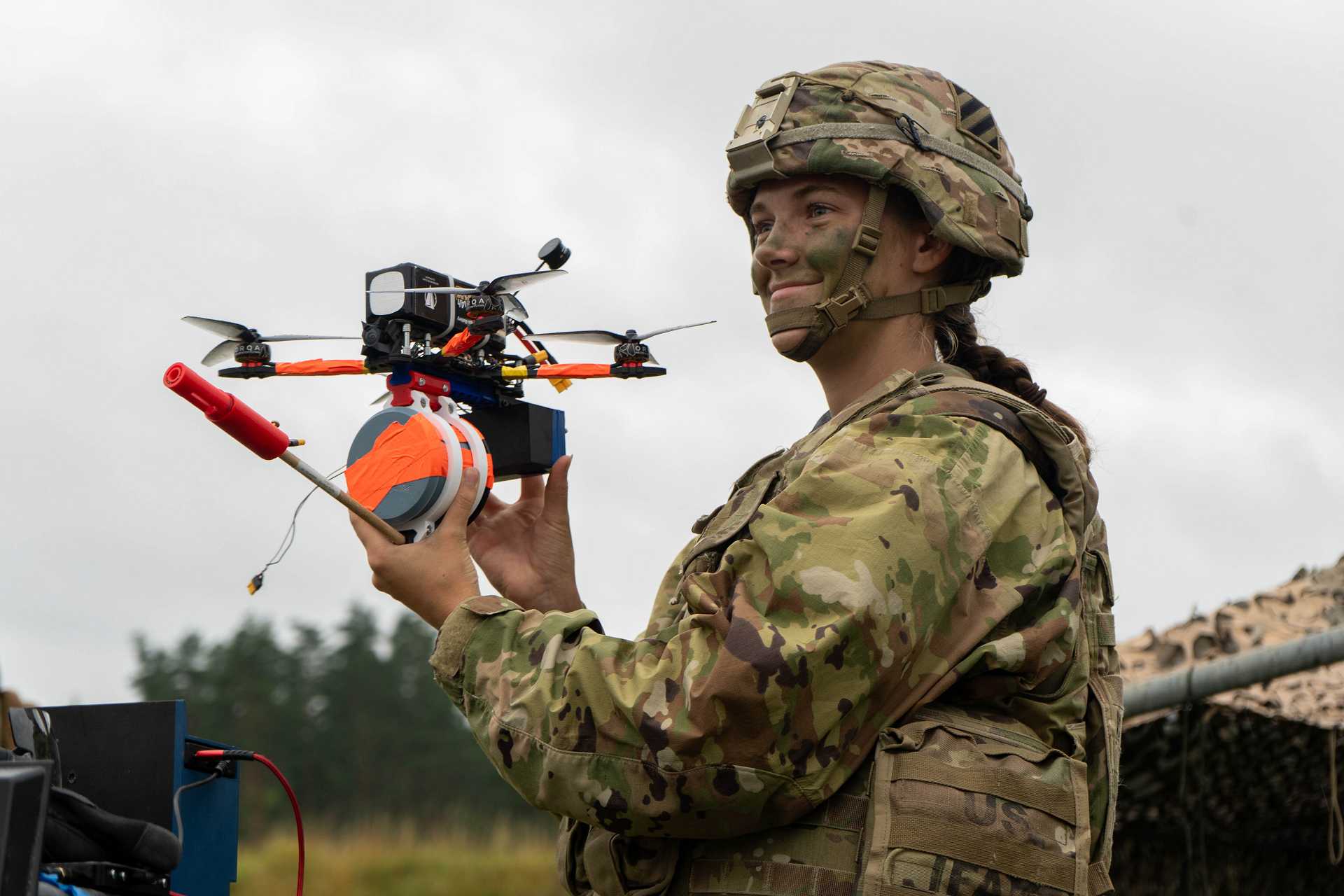
- Details
- Written by: Administrator
- Category: Defence & Security Industry Technology
- Hits: 5876
According to information published by the U.S. Department of Defense on July 22, 2025, the United States Army has initiated field trials of armed First Person View (FPV) drones under live-fire conditions in the forests of Germany as part of its TiC (Transformation in Contact) modernization effort. Soldiers from the 3rd Infantry Division are conducting these trials with FPV drones designed as low-cost, munitions capable of striking moving or stationary targets, highlighting a significant step in the Army’s evolution toward decentralized, drone-enabled lethality at the tactical level.
Follow Army Recognition on Google News at this link
U.S. Army Sergeant Elena Killough from the Deathwatch Platoon, 10th Brigade Engineer Battalion, 1st Armored Brigade Combat Team, 3rd Infantry Division, displays a fully assembled First Person View drone before a flight qualification at Grafenwöhr Training Area on July 21, 2025. (Picture source: U.S. DoD)
The development of the U.S. Army's use of armed FPV (First Person View) drones marks the first operational application of Purpose Built Attritable Systems (PBAS), a category of FPV drones engineered to deliver both lethal and non-lethal payloads while maintaining affordability and tactical portability. With each PBAS drone package including FPV goggles, a controller, a display unit, and a mix of 10" and 5" air vehicles at a unit cost of approximately $5,000, the system is designed to be scalable and rapidly fieldable across a range of combat formations. The live-drone missions executed in Germany are intended to validate PBAS effectiveness in wet, forested terrain and to refine operational drone tactics as part of TiC 2.0 experimentation.
An FPV drone, or First Person View drone, is a small unmanned aerial system (sUAS) piloted remotely by an operator using a head-mounted display or screen that receives live video feed from a forward-facing camera onboard the drone. This configuration gives the pilot a real-time view as if they were inside the drone, allowing for precise maneuvering and target acquisition in confined or complex environments. Unlike traditional autonomous or pre-programmed drones, FPV drones are manually flown and offer unmatched control for close-quarters navigation, making them ideal for strike missions, reconnaissance, and support operations in dense urban or natural terrain. When configured as loitering munitions, these drones can carry explosive payloads and be guided directly into enemy positions with high accuracy and tactical surprise.
FPV drones can be equipped with a variety of munitions tailored to mission requirements and target profiles. Lethal payloads may include anti-armor shaped charges, high-explosive fragmentation warheads, or improvised explosive devices capable of neutralizing light vehicles, defensive positions, or enemy personnel. In a non-lethal configuration, FPV drones can be adapted to deliver electronic warfare modules, smoke canisters, flashbangs, or chemical irritants for crowd control or disruption missions. Their flexible payload capacity makes them suitable for a wide spectrum of tactical applications, including direct attack on armored or soft-skinned vehicles, suppression of enemy air defenses, clearing of trench lines, breaching fortified positions, or disabling infrastructure such as radar arrays or command posts.
These drones are particularly effective in close-combat support roles, where ground forces require immediate and precise firepower to overcome fortified enemy positions or defend against counterattacks. Their agility and small size make them difficult to detect and engage by traditional air defense systems, and their first-person navigation enables operators to strike with precision in cluttered and dynamic environments such as urban combat zones, forested areas, and mountainous terrain. FPV drones also enhance special operations capabilities by enabling silent and low-signature attacks behind enemy lines without risking personnel.
The tactical adoption of FPV drones by the U.S. Army is directly influenced by battlefield innovations observed during the ongoing conflict between Russia and Ukraine, where FPV drones first emerged as a game-changing technology. Since early 2022, both Ukrainian and Russian forces have employed FPV drones to deliver direct-strike capabilities at a fraction of the cost of traditional precision munitions. Ukraine, in particular, pioneered the wide-scale use of low-cost FPV drones configured as loitering munitions to target armored vehicles, artillery positions, and even dismounted troops with high accuracy and minimal logistical burden. These drones, often modified commercial platforms, have demonstrated how small, nimble, and manually piloted systems can bypass traditional defenses and deliver devastating effects, changing the calculus of land warfare.
In the context of modern combat, FPV drones offer a suite of advantages that significantly enhance battlefield effectiveness. Their small size and agility enable them to maneuver through urban, forested, or cluttered environments where larger UAVs cannot operate safely. Equipped with explosive payloads or reconnaissance modules, FPV drones can function as precision-guided munitions or real-time surveillance tools depending on mission requirements. The first-person navigation system allows the operator to guide the drone with near-visual accuracy, enabling complex engagements against mobile or partially hidden targets.
Moreover, FPV drones support distributed and decentralized warfare by allowing small units to engage enemy assets independently, reducing reliance on larger and more vulnerable systems such as artillery or crewed vehicles. Their low cost and expendable nature make them ideal for saturation attacks, diversionary tactics, and high-risk strikes on high-value targets. They also offer significant logistical advantages by being lightweight, modular, and easy to transport, store, and deploy under battlefield conditions.
As the U.S. Army continues to integrate PBAS and FPV drones into its combat formations, the experience gathered in these early tests will shape future doctrine and procurement. The objective is clear: to deliver affordable, precise, and adaptive drone capabilities directly to the edge of the battlefield, empowering Soldiers with cutting-edge tools to dominate across domains.
- Details
- Written by: Administrator
- Category: Defence & Security Industry Technology
- Hits: 4822
During the IDEF 2025 defense exhibition in Istanbul, Turkish armored vehicle manufacturer Otokar unveiled a specially configured version of its Cobra II 4x4 armored tactical vehicle developed for the Romanian Armed Forces. This marks the first official presentation of the Romanian variant, signaling a key milestone in Romania’s armored vehicle modernization program and reinforcing the growing defense partnership between Türkiye and Romania.
Follow Army Recognition on Google News at this link
Turkish armored vehicle manufacturer OTOKAR displays for the first time at IDEF 2025 its Cobra II variant configured for the Romanian Army.
The Cobra II is a new-generation armored platform designed by Otokar to deliver enhanced mobility, survivability, and multi-role capability for modern battlefield demands. Compared to the original Cobra, the Cobra II features a larger and more robust monocoque hull, increased internal volume, improved ballistic and mine protection, and superior off-road performance. The vehicle is powered by a high-torque diesel engine, paired with an automatic transmission and independent suspension system, ensuring high maneuverability in complex terrain. With a combat weight of approximately 13 tons, it accommodates up to nine personnel, including the driver and commander, and can be adapted to various roles such as troop transport, command vehicle, ambulance, reconnaissance, and support missions.
The version of the Cobra II selected for the Romanian Army is fitted with a remotely operated weapon station armed with a 7.62 mm machine gun. This system allows the gunner to operate and engage threats from inside the armored hull, providing increased crew protection and precision fire capability under various combat conditions. The inclusion of a remote weapon station supports Romania’s operational requirements for force protection and lethality in both conventional and asymmetric scenarios.
On November 27, 2024, Otokar signed a contract valued at approximately €857 million with Romtehnica, the Romanian Ministry of Defence’s procurement agency, for the delivery of 1,059 Cobra II armored vehicles. The contract outlines that the first 278 units will be manufactured in Türkiye, while the remaining vehicles will be assembled in Romania. This localization effort is being implemented through a joint venture established in 2025 between Otokar and Romanian defense company Automecanica SA, under the name SAROM (Sisteme Apărare România), which will also be responsible for long-term support and maintenance.
Deliveries are scheduled to begin in the fourth quarter of 2025 and continue over a five-year period. The initial shipment of 14 vehicles was successfully completed in June 2025, marking the official launch of the program. The Romanian Cobra II fleet will be deployed in multiple configurations tailored to national operational requirements and will contribute significantly to enhancing mobility, force protection, and mission flexibility for Romania’s land forces. This large-scale acquisition also underscores Romania’s commitment to building a modern, NATO-interoperable armored capability with strong industrial cooperation at its core.
Over the past decade, Otokar has significantly expanded its presence in the international armored vehicle market, including across Europe. Its Cobra, Cobra II, Arma 6x6, Arma 8x8, and Akrep II families of wheeled armored vehicles are now fielded by more than 40 countries worldwide. In Europe, Otokar notably secured a €130 million contract with Estonia in 2023 for the delivery of Arma 6x6 armored vehicles, with initial deliveries scheduled for 2025. Other European users include NATO and EU member states, reinforcing the company’s reputation for reliability, adaptability, and high-performance combat vehicles.
Otokar’s development in the field of wheeled armored vehicle manufacturing began in the 1990s, building on its early production of Turkey’s first indigenous armored vehicles. The original Cobra, launched in the late 1990s, marked a breakthrough in Turkey’s tactical mobility capabilities. Since then, the company has continuously invested in research and development to expand its product range, focusing on modularity, multi-role adaptability, and survivability. The Cobra II, introduced in 2013, was developed in response to operational feedback and modern threat environments, offering a higher payload, greater protection, and enhanced crew ergonomics. Otokar’s product evolution has also led to the launch of the Arma platform, designed for heavier combat roles and capable of carrying larger-caliber weapon systems and advanced mission equipment.
Today, Otokar’s armored vehicle portfolio covers the full spectrum of wheeled tactical systems from 4x4 to 8x8 platforms. With more than 33,000 vehicles in service globally and a growing footprint in NATO-aligned countries, Otokar has established itself as a leading manufacturer in the wheeled combat vehicle segment. Its success lies in its ability to combine combat-proven performance, flexible configurations, and strong industrial partnerships, which have been key to securing major contracts such as the Romanian Cobra II program.
Read more: Türkiye's Otokar Unveils Cobra II 4x4 Armored Vehicle for Romanian Army during IDEF 2025
- Details
- Written by: Administrator
- Category: Defence & Security Industry Technology
- Hits: 4187
During IDEF 2025, a defense exhibition in Türkiye, Turkish Company ASELSAN, the flagship of Turkey’s defense electronics industry, unveiled its latest innovation in tactical air defense with the introduction of the GÜRZ 150 Mobile Multi-Role Air and Missile Defense System. This fully autonomous and modular system represents a strategic leap forward in the Turkish defense sector's ambition to rival global counterparts such as the Russian Pantsir-S1, targeting both domestic deployment and export markets. Designed to protect against a wide array of aerial threats, the GÜRZ 150 is positioned as a next-generation solution for short and very short-range air and missile defense missions.
Follow Army Recognition on Google News at this link
Turkish defense company ASELSAN displays its new Gürz 150 Multi-Role Air Defense System at IDEF 2025. (Picture source: Army Recognition Group)
Developed to counter traditional aerial platforms such as fixed-wing aircraft, helicopters, and various missile types, the GÜRZ 150 is also optimized to address the growing prevalence of asymmetric aerial threats observed in recent conflicts, particularly the war in Ukraine. That war has highlighted the urgent need for multi-layered short-range air defense systems capable of detecting and neutralizing low-cost, agile threats like FPV drones, loitering munitions, kamikaze UAVs, and drone swarms. ASELSAN has engineered the GÜRZ 150 to fulfill both conventional and modern threat profiles, giving it broad operational relevance on today’s battlefield. Its multi-effector design ensures adaptability in fast-changing combat environments where saturation attacks and unmanned platforms increasingly dominate the threat spectrum.
The GÜRZ 150 is built around a domestic fire control algorithm that performs real-time threat evaluation and automated weapon assignment, enabling highly efficient engagement decisions without operator input. It can track and engage multiple targets simultaneously and execute sequential firing in complex airspace scenarios. The system’s sensor suite includes an Active Electronically Scanned Array (AESA) radar, a dedicated fire control radar, an advanced electro-optical tracking suite, an Identification Friend or Foe (IFF) system, and an integrated tracking platform. Together, these subsystems ensure superior target detection, tracking, and threat discrimination across a wide operational envelope.
The system’s multi-layered weapon architecture combines kinetic and non-kinetic effectors. It features a 35mm air defense gun capable of firing both conventional and air-burst munitions via a linkless automatic feeding system, with full 360-degree firing capability. Complementing the gun are four very short-range and four short-range surface-to-air missiles, providing rapid response against fast and maneuvering aerial targets. The GÜRZ 150 is also equipped with a soft-kill system that employs electromagnetic and electro-optical jammers, along with a machine gun for close-range self-defense against ground-based or low-flying threats.
Mounted on an 8x8 tactical wheeled chassis, the GÜRZ 150 is designed for high mobility, rapid redeployment, and sustained operations in contested environments. The system supports fire-on-the-move and “hide-fire-displace” tactics, which are essential for survivability against precision artillery and missile strikes. It operates effectively day and night, in all weather conditions, and incorporates nuclear, biological, and chemical (NBC) protection for crew survivability. A robust positioning and navigation system ensures accuracy and integration with higher-echelon Command and Control (C2C) networks, allowing seamless coordination in joint and coalition air defense structures.
The GÜRZ 150’s modular and open-architecture design ensures adaptability to future threats and mission-specific configurations. Its architecture supports easy upgrades, system expansion, and the integration of emerging technologies, ensuring long-term viability on the modern battlefield. This future-proof approach aligns with evolving military doctrines that emphasize networked operations, rapid mobility, and the ability to engage diverse threats with minimal human intervention.
The unveiling of the GÜRZ 150 reflects a broader strategic vision within the Turkish defense industry to anticipate and respond to the shifting dynamics of modern warfare. Drawing lessons from ongoing conflicts such as the war in Ukraine, Turkish defense manufacturers are demonstrating their ability to rapidly adapt and deliver advanced, multi-layered air defense systems capable of addressing both conventional and unconventional aerial threats. With a focus on modularity, autonomy, and integration of indigenous technologies, Turkey is positioning itself as a self-reliant and competitive force in the global defense market, committed to equipping its armed forces and allies with systems tailored for the increasingly complex and unpredictable battlefield of the future.

- Details
- Written by: Administrator
- Category: Defence & Security Industry Technology
- Hits: 2757
During the Rapid Prototype Display event held on July 16, 2025, at the Pentagon Center Courtyard in Arlington, Virginia, American defense manufacturer L3Harris unveiled its new Red Wolf kinetic vehicle for long-range precision strikes. The event showcased fast-tracked, next-generation defense technologies developed to meet the evolving requirements of joint operations across multiple domains. Red Wolf stood out among the displays as a cutting-edge solution aimed at strengthening U.S. force projection through advanced, standoff precision firepower.
Follow Army Recognition on Google News at this link
U.S. service members look at unmanned aerial and ground system prototypes during the Rapid Prototype Display event at the Pentagon Center Courtyard, Arlington, Va., July 16, 2025. (Picture source: U.S. DoD)
The L3Harris Red Wolf represents a leap in kinetic precision-strike capabilities, designed for deep-penetration and long-range engagement missions. In military terms, kinetic precision-strike refers to the use of guided physical weapons, such as missiles or projectiles, to hit specific targets with high accuracy. These strikes are guided by advanced systems and are designed to eliminate high-value or time-sensitive threats while minimizing collateral damage. The Red Wolf is being positioned to provide this capability from significant distances, offering the U.S. military a tool to strike deep into hostile territory while keeping launch platforms safely outside enemy defenses.
The Red Wolf is also classified as an Air-Launched Effects (ALE) vehicle. These are small, unmanned systems that can be launched from helicopters, aircraft, or ground vehicles. ALEs are used to extend the range and effectiveness of manned platforms by acting as remote sensors or weapon carriers. They are capable of conducting surveillance, jamming enemy systems, relaying communications, or executing precision strikes, often ahead of friendly forces in contested environments. This allows commanders to gain situational awareness or eliminate threats without directly exposing human crews to danger.
While full technical specifications were not publicly disclosed, L3Harris representatives emphasized the Red Wolf’s modular design and advanced targeting capabilities. The system reportedly includes AI-driven sensor fusion and fire control, allowing it to identify and engage targets autonomously while remaining responsive to mission updates. Its scalable architecture suggests it could be integrated with multiple launch platforms and tailored to suit both tactical and strategic roles.
L3Harris’ Red Wolf is part of a broader family of unmanned systems known as the "wolf pack," designed to be launched from air, ground, or maritime platforms using standard interfaces. These multi-role vehicles have been integrated not only with L3Harris systems but also with third-party aircraft and ground-based launchers, underscoring their flexibility. The company claims its rapid integration technique is quick, cost-effective, and combat-relevant. Notably, Red Wolf is currently the only launched effect known to have been successfully deployed from a U.S. Marine Corps AH-1Z Viper attack helicopter, marking a significant milestone in operational readiness and cross-platform compatibility.
The debut of the Red Wolf highlights L3Harris’s contribution to the Pentagon’s broader modernization strategy, particularly in the field of long-range fires and unmanned combat systems. With potential applications in the Indo-Pacific and European theaters, the platform reflects an urgent need to develop fast, adaptable, and survivable strike solutions in environments where access is heavily contested. Army Recognition will continue to follow developments surrounding the Red Wolf as the U.S. military evaluates its operational potential and prepares for future conflicts where speed, precision, and reach are paramount.
- Details
- Written by: Administrator
- Category: Defence & Security Industry Technology
- Hits: 7518
According to information published by Boeing on July 16, 2025, the United Kingdom’s Chinook Mk 6 tactical transport helicopter has successfully completed its first flight equipped with an advanced Infrared Suppression System (IRSS). This significant milestone marks a critical advancement in the survivability of the British Army’s rotary-wing fleet, enhancing its defenses against heat-seeking missile threats commonly encountered in modern conflict zones. The trial was conducted as part of Boeing’s IRSS development and validation campaign and it represents the largest trial installation on a UK Chinook platform in more than a decade.
Follow Army Recognition on Google News at this link
UK British Army Chinook Mk 6 helicopter on the ground fitted with the new Infrared Suppression System (IRSS) visible near the engine exhausts designed to reduce infrared signature and increase survivability against heat-seeking missile threats. (Picture source: Boeing)
The IRSS (Infrared Suppression System) works by modifying the aircraft’s exhaust system to reduce its infrared signature, which is the primary means by which heat-seeking missiles detect and target helicopters. The flight test aircraft was equipped with extended exhaust mounts designed to cool and disperse engine heat, a core principle of infrared suppression. By reducing this signature, the Chinook becomes significantly harder for infrared-guided munitions such as shoulder-fired MANPADS and air-to-air missiles to lock onto. This capability is especially vital in asymmetric warfare environments where such threats are commonly used by irregular and non-state actors and in future peer-level conflicts where air defense systems are more sophisticated.
The Chinook Mk 6 is the latest and most advanced British-specific variant of the CH-47 Chinook series, based on the U.S. CH-47F Block I model but tailored extensively to meet UK operational and technical requirements. It features a fully digital automatic flight control system (DAFCS) for enhanced handling and stability, uprated Honeywell T55-GA-714A engines each delivering 4,868 shp, and a cockpit fully integrated with British Army communication and navigation systems including BOWMAN-compatible secure radios. The Mk 6 is also fitted with a modern glass cockpit, GPS/INS navigation with digital moving maps, and an advanced Defensive Aids Suite (DAS) that includes missile warning systems and countermeasure dispensers.
In 2021, the UK Ministry of Defence signed a 2 billion dollar Foreign Military Sales contract with the U.S. government to acquire 14 new CH-47 Extended Range (CH-47ER) Chinooks from Boeing. These aircraft are intended to replace older Mk 5 and Mk 6 variants and will come equipped with long-range fuel tanks, upgraded avionics, and the full suite of survivability enhancements including the IRSS now under trial. The new helicopters are expected to remain in operational service into the 2040s, forming a core element of the British Army’s tactical and strategic lift capability.
The Chinook has been a cornerstone of the British Army’s Joint Helicopter Command since 1980, performing a wide range of critical missions including tactical troop transport, battlefield resupply, casualty evacuation, special operations support, and humanitarian relief. With a maximum internal payload exceeding 10 tonnes and the ability to carry up to 55 fully equipped soldiers, it is the UK’s primary heavy-lift helicopter platform. Its proven performance in diverse environments from the deserts of Afghanistan to Arctic training operations underlines its strategic value. British Chinooks have supported nearly every major military operation conducted by the UK in the past four decades, as well as non-combat missions such as disaster response and emergency medical evacuations.
The successful completion of this first IRSS-equipped flight not only confirms the viability of the system for future fleet-wide implementation but also represents a significant leap forward in operational survivability. As threats from infrared-guided weapons continue to evolve, integrating such countermeasures ensures that UK Chinooks can continue operating effectively and safely in high-threat environments. Boeing’s integration of the IRSS also reflects growing international interest in modular survivability upgrades for legacy aircraft, allowing NATO and allied forces to extend the operational relevance of their existing platforms in an increasingly contested battlespace.
With this milestone, the Chinook Mk 6 reaffirms its position as one of the most capable and modernized heavy-lift helicopters in NATO service. The British Army’s investment in advanced protection systems like IRSS ensures that its rotary-wing forces remain resilient, adaptive, and mission-capable in the face of 21st-century threats.
- Details
- Written by: Administrator
- Category: Defence & Security Industry Technology
- Hits: 5548
Showcased at LandEuro 2025, a defense exhibition held in Wiesbaden, Germany, Rheinmetall, a German defense manufacturer of modern military equipment and combat vehicles, presented the Skyranger 30, its latest mobile air defense turret, designed to meet the rapidly evolving challenges of the modern battlefield. This hybrid system integrates a 30mm automatic cannon, surface-to-air guided missiles, and advanced sensor technology into a compact turret capable of mounting on both wheeled and tracked combat vehicles. Rheinmetall aims to deliver a versatile and scalable solution to counter the rising threat of drones, loitering munitions, and low-flying aerial platforms, combining firepower and high mobility for frontline defense forces.
Follow Army Recognition on Google News at this link
German Rheinmetall Skyranger 30 mobile air defense system showcased at LandEuro 2025, designed to counter drones and loitering munitions with a hybrid gun-missile solution. (Picture source: Army Recognition Group)
The growing prominence of small unmanned aerial systems (sUAS), first-person-view (FPV) drones, and loitering munitions has reshaped tactical air defense priorities, as demonstrated in the ongoing Russia-Ukraine war. The conflict has highlighted significant vulnerabilities in traditional air defense architectures when faced with low-cost, high-agility drone swarms and precision-guided threats operating at low altitudes. Ukrainian and Russian forces have both exploited this domain extensively, with FPV drones becoming critical tools for reconnaissance and strike missions. The need for rapidly deployable, mobile solutions capable of autonomously identifying and neutralizing such threats has become a central focus for NATO and EU defense planners.
The Skyranger 30 air defense system is Rheinmetall’s answer to this operational gap. Combining precision, flexibility, and protection, the turret is equipped with the 30mm x 173 KCE revolver cannon capable of firing AHEAD programmable airburst munitions specifically optimized for intercepting drones. It also integrates ground-to-air guided missiles and high-performance sensors to enable both autonomous and networked engagement modes. Initially, the system will use Stinger missiles in the German configuration, with plans to transition to a newly developed missile tailored for drone defense applications.
Designed for rapid reaction and tactical maneuverability, the Skyranger 30 turret can be mounted on a wide range of wheeled and tracked armored vehicles, allowing armed forces to deploy it across different platforms according to mission needs. This modularity enables seamless integration into existing vehicle fleets, enhancing mobility and battlefield adaptability. Its high elevation range and targeting agility make it particularly suited for protecting maneuvering units, logistics convoys, and key installations from aerial threats at short and very short ranges.
One of the system’s most potent features is its use of AHEAD programmable airburst ammunition. Developed to counter small, fast, and hard-to-detect airborne targets, AHEAD (Advanced Hit Efficiency And Destruction) rounds contain a payload of pre-fragmented tungsten sub-projectiles. Upon firing, the cannon’s fire control system programs the projectile to detonate at a precise point in space near the target. This creates a dense cloud of high-velocity fragments designed to destroy or disable the drone’s vital components, ensuring a high probability of kill even against small or evasive aerial threats. The use of airburst munitions dramatically increases engagement effectiveness, especially when facing drone swarms or multiple simultaneous threats.
As part of the European Sky Shield initiative, the Skyranger 30 is gaining traction among NATO and EU member states. Hungary took a key step in December 2023 by contracting Rheinmetall to develop a conceptual version of the Skyranger 30 turret for integration onto the Lynx KF41 tracked IFV. Austria and Denmark have since placed orders for their respective platforms. Interest continues to grow, with the Netherlands announcing in January 2025 its intention to procure 22 Skyranger 30 units, with contract finalization expected before the end of the year. Several other allied nations are also evaluating the system for near-term acquisition as they seek to modernize their short-range air defense capabilities in response to current and emerging threats.
The German-made Rheinmetall Skyranger 30 represents a significant advancement in mobile short-range air defense, offering a highly adaptable and lethal countermeasure against modern aerial threats. With its modular turret design, advanced sensors, hybrid weapon integration, and specialized drone-killing ammunition, the system aligns with the evolving operational needs of European and NATO armed forces. Rheinmetall’s offering stands as a critical asset in the collective effort to strengthen air defense resilience across the continent.
- Details
- Written by: Administrator
- Category: Defence & Security Industry Technology
- Hits: 3325
At LandEuro 2025, held July 16–17 in Wiesbaden, Germany, U.S. defense manufacturer Moog displayed its next-generation Flexible Mission Platform (FMP™), presenting it in a standalone turret configuration focused on air defense applications. The system was exhibited independently from any vehicle, emphasizing its mission and platform agnostic architecture. Moog’s FMP is designed to give military forces a highly adaptable modular platform capable of hosting a wide variety of payloads, and it answers the urgent demand for versatile air defense solutions in the face of increasing drone and loitering munition threats.
Follow Army Recognition on Google News at this link
MOOG's Flexible Mission Platform turret armed with a Thales 70mm laser-guided rocket pod on display at LandEuro 2025, highlighting its modular air defense capability and platform-independent design. (Picture source: Army Recognition Group)
During the LandEuro 2025 event, Moog displayed the FMP equipped with a Thales rocket pod carrying 70mm laser-guided rockets, underlining its suitability for precision engagement of low-signature aerial threats. The demonstration showcased the FMP’s ability to integrate advanced guided munitions without dependency on any particular vehicle platform. This flexible turret system allows users to deploy weapon and sensor payloads from static installations, trailers, containers, or mobile structures, making it ideal for rapidly evolving battlefield conditions or expeditionary operations.
In addition to its standalone capability, the turret can be easily integrated onto a wide range of combat vehicles and armored platforms, depending on the final customer’s requirements. Whether mounted on light tactical vehicles for mobile counter-UAS operations or integrated into heavier armored platforms for combined arms missions, the FMP’s architecture supports seamless mechanical and electronic interfacing. This gives armed forces the freedom to tailor configurations across multiple vehicle fleets without the need for unique turret designs, reducing development cycles and enhancing battlefield interoperability.
Moog developed the FMP with its globally respected military motion control technologies, incorporating both pedestal and yoke variants. The system supports optional features such as advanced stabilization for firing on the move, slip rings for continuous high-speed data and power transfer, and weapon stores management for full missile launch capability. This engineering approach ensures minimal integration effort and high reliability, while enabling full networked operation in a modern digital battlespace.
The flexibility of Moog’s platform is not limited to firepower. The FMP can be configured for sensor fusion, integrating electro-optical/infrared targeting systems, counter-UAS jammers, or surveillance radars, depending on the mission. By decoupling the turret from a vehicle base, the system can be installed in remote outposts, mobile defense trailers, or naval platforms, giving defense forces a scalable and mobile solution with minimal logistical overhead.
Moog’s offering reflects a strategic response to the rapidly growing need for modular, adaptable defense technologies that can keep pace with asymmetric threats. In particular, the rise of commercial drones used for ISR and strike roles by both state and non-state actors has created demand for solutions that are not only effective, but also quick to deploy and cost-efficient. The FMP meets this demand head-on by providing a foundation that accommodates whatever the mission requires—from laser-guided rockets to RF sensors—without requiring custom vehicle architecture.
With the FMP, Moog positions itself at the forefront of a new generation of flexible combat platforms, responding directly to the operational priorities of NATO and allied forces. As drone warfare, precision strikes, and distributed operations become the new norm, systems like the FMP will likely play a critical role in redefining how militaries deploy air defense and combat support assets across multiple domains.
- Details
- Written by: Administrator
- Category: Defence & Security Industry Technology
- Hits: 3403
According to information published by the Indian DRDO (Department of Defence Research and Development), on July 17, 2025, the Akash Prime surface-to-air missile system successfully engaged and destroyed two high-speed unmanned aerial targets during operational trials conducted in the high-altitude terrain of the Ladakh sector. The tests were conducted at elevations exceeding 4,500 meters, demonstrating the missile system’s advanced capability to operate under extreme environmental and topographical conditions.
Follow Army Recognition on Google News at this link
The Indian DRDO Department of Defence Research and Development conducts a high-altitude trial of the Akash Prime air defense missile, successfully intercepting high-speed aerial targets in Ladakh at an altitude of over 4,500 meters. (Picture source: India DRDO)
The Akash air defense system is India’s first indigenous medium-range surface-to-air missile system, developed by DRDO to protect vulnerable assets and mobile formations from aerial threats including fighter aircraft, cruise missiles, helicopters, and drones. Designed for quick mobility and network-centric operation, the Akash system integrates launchers, multifunctional fire control radars, and command and control centers. It is capable of engaging multiple targets simultaneously and provides all-weather, multi-directional defense coverage within a range of 25 to 30 kilometers, with an altitude coverage up to 18 kilometers.
Building on the technology of the original Akash air defense missile, Akash Prime is a significantly upgraded variant engineered to enhance performance in extreme environmental conditions, particularly in high-altitude and low-temperature operational theaters like Ladakh and Arunachal Pradesh. The most notable advancement is the integration of an indigenous active Radio Frequency (RF) seeker, providing 360-degree engagement capability and improved targeting precision over the older command-guided variant. While the legacy Akash missile relied on ground-based radar tracking and mid-course corrections, the RF seeker in Akash Prime allows the missile to independently track and lock onto targets during the terminal phase, enhancing hit probability against fast, maneuvering aerial threats.
Technically, Akash Prime maintains a similar range and altitude envelope to its predecessor, with a maximum range of 30 kilometers and a ceiling of 18 kilometers. However, it surpasses the original in terms of seeker accuracy, engagement reliability, and adaptability to electronic warfare conditions. The missile has been tailored for cold-weather operations, and its ground systems have been reconfigured with environmental hardening to ensure functionality in sub-zero temperatures and rugged terrain. This includes modified launch platforms, radar units, and command vehicles capable of deployment above 4500 meters.
The missile will be produced by Indian Company Bharat Dynamics Limited, while Bharat Electronics Limited will supply the radar systems, control centers, simulators, and support vehicles. Collectively, the missile and the upgraded ground-based systems are designated as the improved Akash Weapon System (AWS). The system was officially ordered in March 2023 and features an indigenous content level of 82 percent, which is expected to be increased to 93 percent in subsequent production. Additionally, Akash Prime has a reduced operational and logistical footprint, making it faster to deploy and easier to sustain in forward areas.
Akash Prime was first flight-tested in September 2021, where it successfully destroyed an aerial target simulating an enemy aircraft. The recent successful intercepts in Ladakh validate its improved performance under real-world conditions. In the latest trials, the missile accurately neutralized two high-speed unmanned aerial targets, confirming the effectiveness of its guidance system and aerodynamic stability at high altitudes.
With this demonstration, the new Indian-made Akash Prime air defense missile system is now nearing full operational status and is set to bolster India’s air defense capabilities in its most strategically sensitive border regions. The system not only strengthens India’s indigenous defense manufacturing ecosystem but also ensures a robust and resilient shield against evolving aerial threats in contested high-altitude zones.
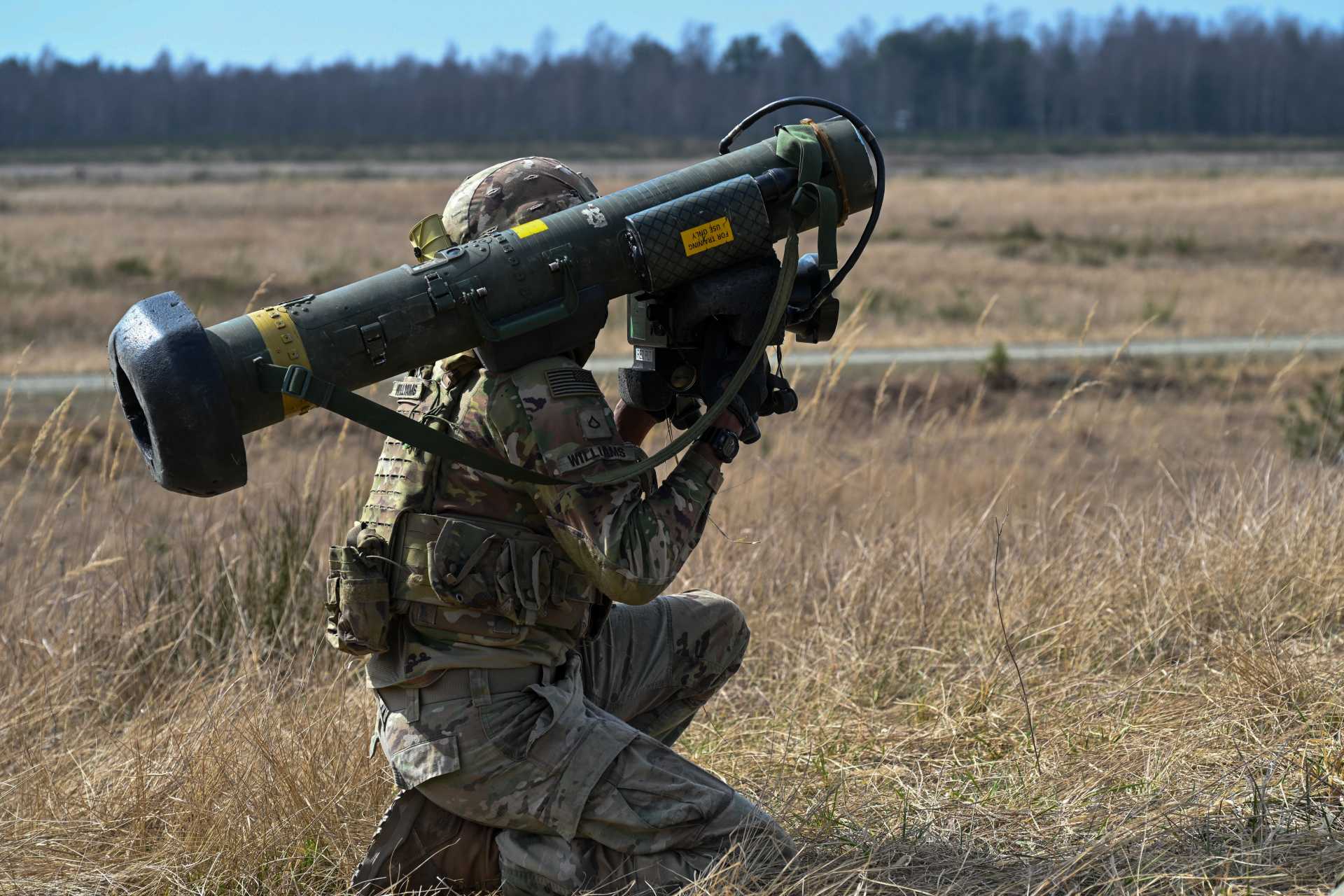
- Details
- Written by: Administrator
- Category: Defence & Security Industry Technology
- Hits: 7044
According to information published by Lockheed Martin on July 16, 2025, the company has initiated a large-scale modernization of its Javelin anti-tank missile production line to respond to escalating global demand and to ensure continuous delivery to U.S. and allied armed forces. The Javelin Joint Venture (JJV), formed by Lockheed Martin and Raytheon, currently produces approximately 2,400 Javelin missiles per year. That figure is set to increase to 3,960 annually by late 2026. This 65 percent production boost is driving an ambitious transformation of Lockheed Martin’s facilities, manufacturing technologies, and quality control systems to achieve a new level of industrial agility, cyber-compliance, and operational efficiency.
Follow Army Recognition on Google News at this link
A U.S. soldier from 4th Squadron 2nd Cavalry Regiment prepares to fire a Javelin missile during live fire training at Grafenwoehr Training Area in Germany on March 23, 2025. (Picture source: U.S. DoD)
The Javelin, formally designated FGM-148, is a man-portable, fire-and-forget anti-tank guided missile system. It entered service with the U.S. Army in the mid-1990s to replace the M47 Dragon system and has since become one of the most effective and widely fielded infantry-operated ATGMs in the world. The system comprises a reusable Command Launch Unit (CLU) with integrated thermal imaging and target acquisition capabilities, and a missile tube that delivers a tandem-shaped charge warhead capable of penetrating advanced reactive and composite armor. The Javelin can engage targets at ranges exceeding 4,000 meters in its latest variants and operates in two attack modes: direct attack for bunkers and fortifications, and top-attack for armored vehicles, exploiting their most vulnerable point.
Javelin’s battlefield performance reached global prominence during the ongoing conflict in Ukraine, where it has played a decisive role in shaping ground engagements. Supplied in large numbers by the United States and NATO allies since early 2022, the Javelin missile system has been deployed extensively by Ukrainian infantry and territorial defense units to repel Russian armored thrusts. During the initial phases of the conflict, Javelins were used with great tactical effectiveness against advancing Russian columns in both rural and urban terrain. Videos and combat reports documented successful engagements against main battle tanks, armored personnel carriers, and fortified positions, often with a single missile resulting in complete vehicle destruction. The missile’s ease of use, minimal training requirements, and fire-and-forget guidance allowed small Ukrainian teams to strike armor and relocate quickly, avoiding return fire.
The combat data collected from Ukraine also validated the Javelin’s resilience in austere conditions, its effectiveness against Russian active protection systems (APS), and its ability to maintain a high operational tempo over extended periods. In many cases, Javelin missiles were launched from concealed positions such as tree lines or building interiors, with the top-attack mode enabling devastating strikes on tank turrets and engine decks. Its proven battlefield lethality has since triggered a wave of renewed interest from European and Indo-Pacific partners, particularly those bordering Russia or facing potential high-intensity conflict scenarios.
To meet this surge in demand, Lockheed Martin is implementing advanced manufacturing upgrades across its Troy (Alabama), Ocala (Florida), and Huntsville (Alabama) facilities. In May 2025, the first newly designed continuity test station was commissioned in Pike County, replacing aging test systems and delivering higher accuracy in validating missile subsystem connectivity. These stations are fully cyber-compliant and designed to support scalable production while minimizing test station downtime. One significant innovation includes a station capable of testing four Javelin seekers simultaneously—four times the current throughput—boosting both speed and reliability.
Simultaneously, the introduction of SystemLink, a digital data automation and analysis platform, is driving real-time decision-making on the production line, allowing for more responsive quality control and process optimization. Lockheed Martin is also standardizing software architecture across all production centers, simplifying maintenance, enhancing technician training, and reducing troubleshooting time.
By late 2026, Lockheed Martin will have deployed 14 new cyber-compliant test stations in Troy, eight in Ocala, and two in Huntsville, all of which will support Quality Assurance Lot Validation Testing (QALVT) and advanced engineering evaluations. These systems will not only speed up production and reduce lead times but will also ensure high fidelity in performance testing, environmental resilience, and functional verification.
The modernization effort includes close collaboration with suppliers to expand their capacity and integrate next-generation manufacturing processes, ensuring the full supply chain is aligned with the ramp-up goals. The modular, replicable nature of the new test systems also lays the groundwork for future international co-production. This would enable allied countries to participate directly in Javelin manufacturing under strict cybersecurity and export control regulations, creating new defense-industrial partnerships and enhancing global readiness.
Lockheed Martin’s investment in Javelin anti-tank missile modernization represents not only a response to current demand but a forward-looking commitment to sustain one of the most combat-proven and strategically critical anti-armor weapons of the 21st century. The Javelin continues to play a vital role in reinforcing deterrence and enabling asymmetric anti-armor warfare, particularly for nations preparing for high-threat scenarios in Europe, Asia, and beyond.
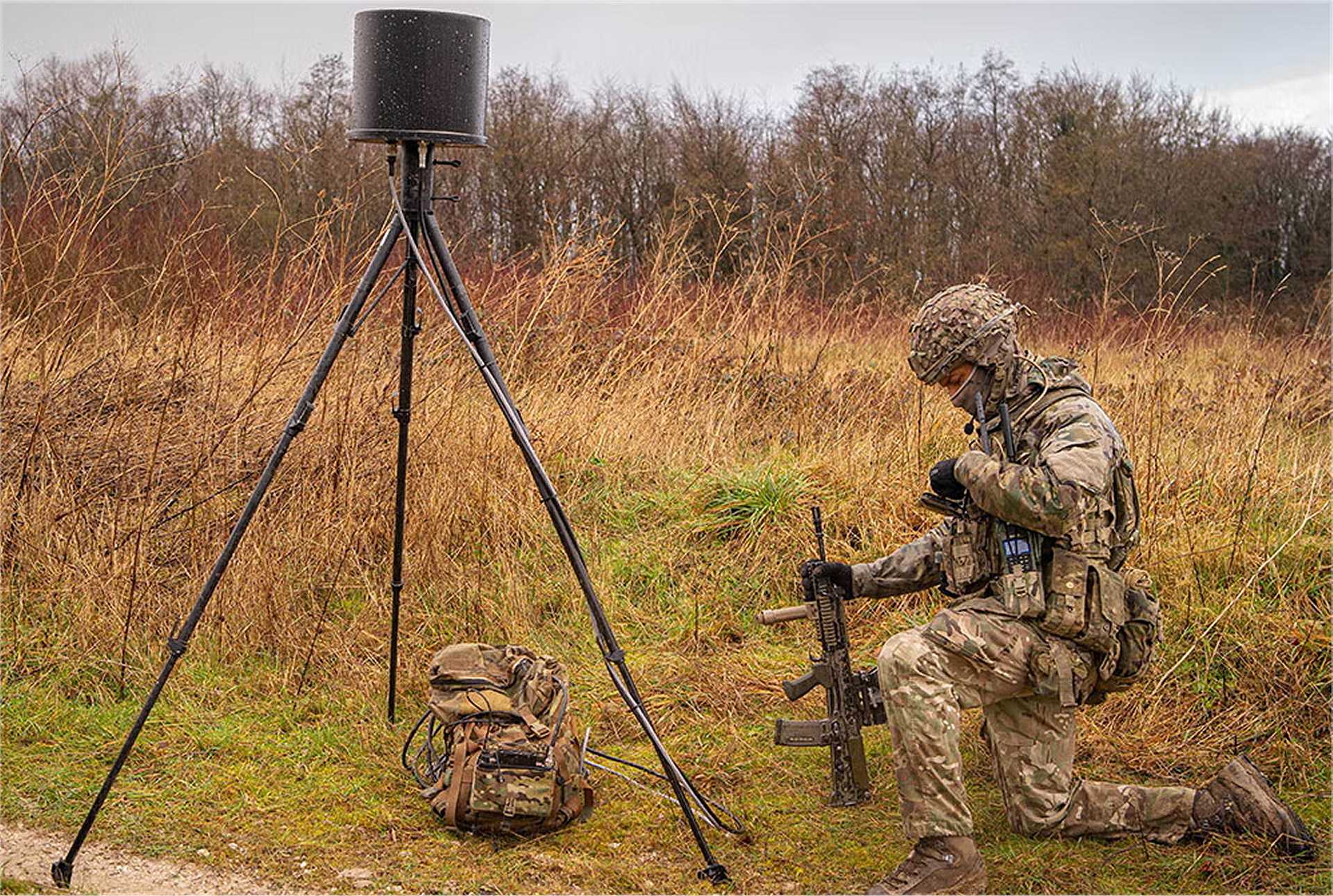
- Details
- Written by: Administrator
- Category: Defence & Security Industry Technology
- Hits: 2879
According to information published by the U.S. Company L3Harris on July 15, 2025, during the joint British-American VANAHEIM exercise held at the Hohenfels Training Area in Germany, British Army personnel tested L3Harris’ advanced Counter-small Unmanned Aerial System (CUAS) technology, CORVUS-RAVEN, in live operational scenarios. The exercise, orchestrated by the British Army’s RAPSTONE Task Force, allowed L3Harris to deliver hands-on access of the system to frontline troops, collecting real-time feedback critical to the system’s ongoing development.
Follow Army Recognition on Google News at this link
U.S. company L3Harris equipped British soldiers with its CORVUS-RAVEN counter-small Unmanned Aerial System (UAS) during the VANAHEIM exercise, demonstrating its passive signal detection, enhanced situational awareness, and jamming defeat capabilities. (Picture source: L3Harris)
The British Army’s RAPSTONE Task Force is a specialist formation created under the UK’s Future Soldier transformation programme. It serves as the Army’s primary experimentation and innovation unit, focused on accelerating the testing and integration of advanced battlefield technologies. RAPSTONE’s mandate is to identify, evaluate, and operationalise cutting-edge solutions that enhance combat effectiveness, survivability, and situational awareness for deployed forces. The task force acts as a direct interface between the military user community and industry, ensuring that new capabilities such as CORVUS-RAVEN are shaped by operational need and frontline user experience.
VANAHEIM is a pivotal, forward-looking CUAS experimentation campaign involving both UK and US forces, designed to identify and refine next-generation CUAS solutions tailored for tactical units. The exercise addresses the rapidly growing threat posed by Class 1 small drones, which have seen increasing use in current global conflict zones. With the British Army emphasizing the need for systems that are soldier-portable, intuitive to operate, and compatible with existing battlefield networks, CORVUS-RAVEN emerged as a key asset for evaluation.
The CORVUS-RAVEN CUAS (Counter-small Unmanned Aerial System) suite offers a fully integrated counter-drone solution combining passive signal detection at ranges of up to four kilometers, real-time situational awareness, and an onboard jamming system. One of its defining strengths is the inclusion of the Individual CORVUS Node (ICN), a miniaturized, software-defined electronic warfare system capable of rapidly switching between detection and disruption modes. The system seamlessly interfaces with common battle management applications such as the Android Tactical Assault Kit (ATAK), empowering dismounted troops with a mobile, intuitive command and control interface.
For the purposes of VANAHEIM, L3Harris deployed CORVUS-RAVEN in two distinct configurations: a mounted version integrated onto a British Army Coyote tactical support vehicle and a wearable, dismounted variant optimized for foot patrols. British soldiers engaged with both formats across a series of dynamic, threat-representative scenarios designed to mimic real-world drone incursions. Feedback from these operational trials is now being used by L3Harris engineers to adapt and refine the system for future combat integration.
L3Harris' participation in VANAHEIM underscores the critical need for agile, soldier-centric CUAS technologies that can evolve alongside the expanding drone threat landscape. The demonstration further strengthens UK-US defense industrial cooperation and reinforces L3Harris’ position as a leader in battlefield electronic warfare and drone countermeasures. As small UAS threats continue to proliferate across both state and non-state actors, systems like CORVUS-RAVEN are poised to become indispensable tools in the modern soldier’s electronic arsenal.
The urgent relevance of CUAS capabilities is being shaped daily by the evolving battlefield dynamics in Ukraine. In this high-intensity conflict, small drones are now a ubiquitous feature across both Russian and Ukrainian forces. These systems are being employed for reconnaissance, artillery spotting, psychological warfare, and increasingly as loitering munitions or improvised explosive devices. Their affordability, accessibility, and ease of use have redefined tactical-level engagements, rendering traditional force protection measures insufficient. The war has highlighted a critical vulnerability: without real-time drone detection and mitigation capabilities, even well-equipped ground forces are at elevated risk. The Ukrainian experience demonstrates that success on the battlefield now often hinges on a force’s ability to locate, track, and neutralize enemy drones before they can act.
With drone warfare evolving at an unprecedented pace, the integration of advanced CUAS technologies has moved from a peripheral consideration to an operational necessity. The CORVUS-RAVEN system’s inclusion in VANAHEIM reflects a broader shift in British and allied defense thinking, acknowledging that future conflicts will be shaped as much by electronic dominance and counter-autonomy as by firepower and maneuver.
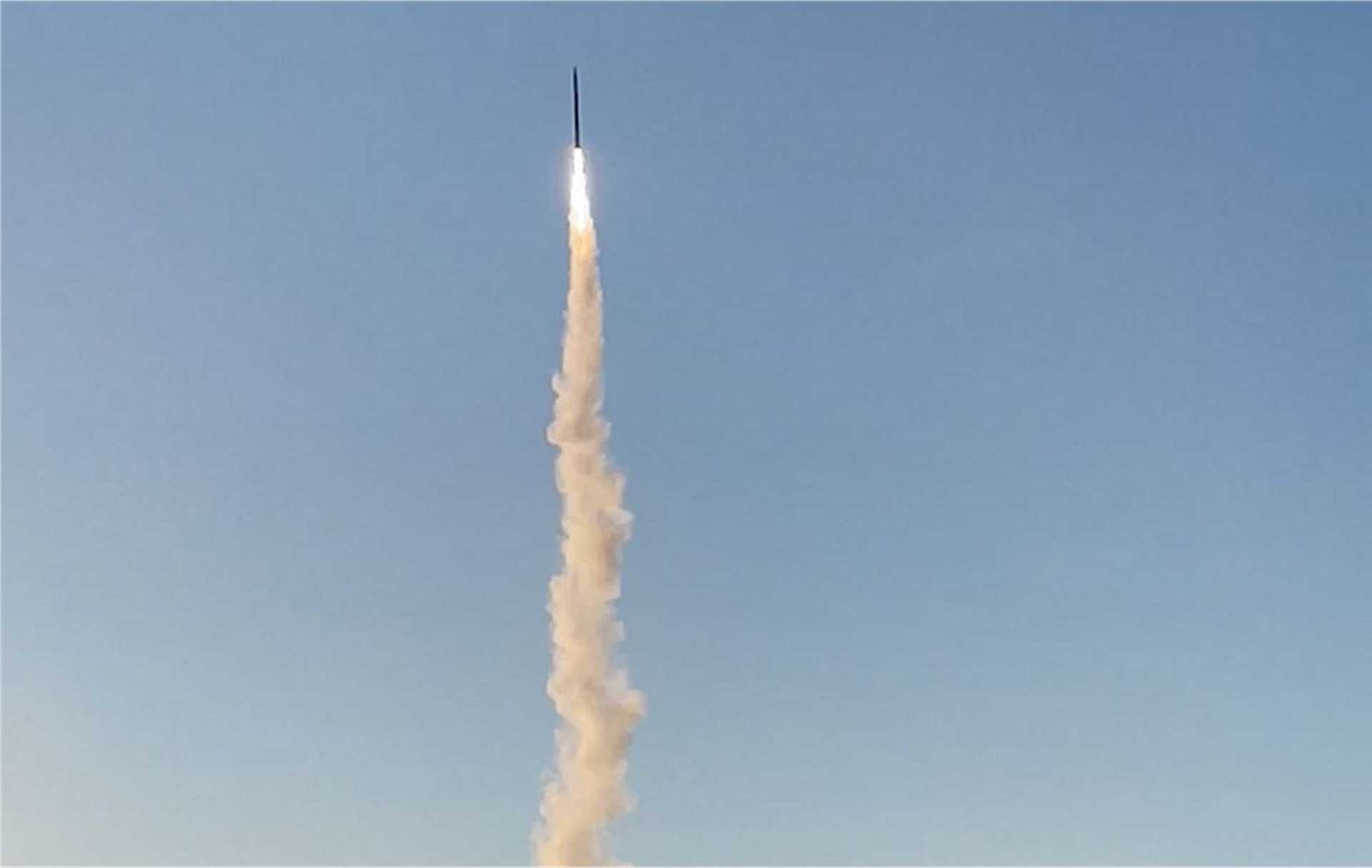
- Details
- Written by: Administrator
- Category: Defence & Security Industry Technology
- Hits: 5822
The development of the U.S. Army’s Next Generation Short-Range Interceptor (NGSRI) marks a significant technological shift in mobile short-range air defense, offering performance and capabilities far surpassing those of the legacy FIM-92 Stinger MANPADS portable air defense missile system. As part of the Maneuver Short-Range Air Defense (M-SHORAD) Increment 3 modernization initiative, the NGSRI is being designed to counter a broad range of advanced aerial threats, including rotary-wing aircraft, drones, cruise missiles, and short-range hypersonic munitions. With integrated enhancements in speed, range, seeker performance, and propulsion, the NGSRI is poised to become a core component of the future U.S. Army's layered air defense strategy.
Follow Army Recognition on Google News at this link
U.S. Raytheon’s new Next-Generation Short-Range Interceptor NGSRI completes a successful ballistic missile flight demonstration in June 2025. (Picture source: Raytheon)
The FIM-92 Stinger is a man-portable, infrared-guided surface-to-air missile that has served as the backbone of the U.S. Army's short-range air defense since its introduction in 1981. Developed by General Dynamics and later manufactured by Raytheon, the Stinger quickly became an iconic battlefield system, widely deployed by U.S. forces and over 30 allied nations. It has been used extensively in multiple conflicts, from the Cold War era through the Global War on Terror, to counter low-flying helicopters and fixed-wing aircraft. Though lightweight and highly portable, the Stinger is constrained by limited range, speed, and vulnerability to modern countermeasures, making it less suitable for today’s threat environment. The NGSRI program was initiated to provide a replacement missile capable of defeating more advanced and agile threats in increasingly complex operational domains.
Developed by Raytheon as a future replacement for the Stinger MANPADS (Man-Portable Air-Defense Systems), the Next Generation Short-Range Interceptor is a new class of surface-to-air missile designed to deliver high-speed, extended-range precision engagements against modern air threats. Measuring under 1.5 meters in length, the NGSRI accelerates beyond Mach 3 within seconds of launch, providing an immediate and powerful engagement envelope for rapidly emerging threats. Its propulsion system, based on Highly Loaded Grain (HLG) solid propellant technology, delivers a sustained and more intense energy output than conventional motors. This advanced rocket motor allows the missile to achieve intercept ranges of up to 9 kilometers, well above the Stinger’s maximum range of just under 4.8 kilometers. The missile’s precision flight and terminal accuracy are sustained across this range, making it a critical asset for mobile formations requiring fast-reaction air defense.
On June 5, 2025, Raytheon, a business unit of RTX, and Northrop Grumman announced the successful completion of four flight-ready tests of the HLG-powered rocket motor for the NGSRI, conducted as part of the U.S. Army’s system maturation program. These tests validated the motor’s ability to produce longer-duration thrust and greater kinetic energy, thereby enhancing the interceptor’s reach and reliability under high-G maneuvering and short time-to-target conditions. The adoption of HLG propellant technology represents a key innovation in the missile’s ability to counter increasingly complex threats, including cruise missiles and emerging hypersonic systems operating at low altitudes.
Earlier this year, on February 18, 2025, Raytheon confirmed that it had successfully completed ten critical subsystem demonstrations for the NGSRI program. These demonstrations included evaluations of the missile’s seeker, warhead, rocket motor, and command launch assembly (CLA), all of which are essential to meet the U.S. Army’s performance and range specifications. The advanced seeker, featuring multi-mode sensing capabilities, exceeded the detection and acquisition range of the legacy Stinger seeker during both laboratory and outdoor testing. It is designed to maintain target lock in contested electromagnetic environments, offering resilience against jamming and decoys.
The flight-ready rocket motor validated in those tests confirmed its ability to deliver consistent thrust across extended flight paths, while the CLA demonstrated superior detection and target identification capability in operationally realistic, low-visibility environments. Arena tests of the warhead showed precise and repeatable lethality across a range of aerial targets, including small UAVs and maneuvering aircraft, marking a significant increase in terminal effectiveness over previous-generation systems.
Raytheon officials described these subsystem tests as a decisive step in advancing the missile toward operational maturity. Tom Laliberty, president of Land & Air Defense Systems at Raytheon, stated, “These successful subsystem demonstrations are a crucial step in meeting the U.S. Army’s range and performance requirements for this transformational short-range air defense capability. We are confident in our ability to rapidly deliver the Army an affordable, low-risk, highly producible NGSRI solution.”
The missile’s physical compatibility with existing U.S. Army systems offers a major advantage in deployment flexibility. The NGSRI is designed to integrate seamlessly into the Stinger Vehicle Universal Launcher and man-portable fire units, allowing it to be fielded rapidly without reconfiguring launch platforms or fire control systems. This backward compatibility, combined with improved performance, makes the NGSRI a force multiplier within the Army’s current and future mobile air defense formations.
Additionally, the upgraded M-SHORAD configuration will remove the need for Hellfire missile integration, allowing the vehicle to double its short-range missile loadout from four to eight interceptors. This change simplifies logistics, reduces crew workload, and dramatically increases the volume of fire available to counter massed aerial attacks, such as drone swarms or coordinated missile salvos.
The NGSRI’s digital architecture supports software-defined functionality, enabling continuous upgrades and threat-specific mission tailoring. This makes the interceptor not only relevant for today’s threat environment, but also adaptable to tomorrow’s rapidly evolving battlefield challenges. With down-selection between competing designs from Raytheon and Lockheed Martin expected in the near term, the U.S. Army is targeting a decision on low-rate initial production by FY2027, with fielding planned shortly thereafter.
In sum, the NGSRI delivers a generational leap in air defense capability, surpassing the FIM-92 Stinger in every measurable category, from seeker fidelity and range to speed and integration flexibility. It provides the U.S. Army with a highly responsive, mobile, and scalable solution to counter the full spectrum of low-altitude aerial threats in peer and near-peer conflict scenarios. Army Recognition will continue to follow the NGSRI’s progress as it transitions from prototype testing to frontline deployment, ensuring readers are informed on one of the most significant air defense developments of the decade.
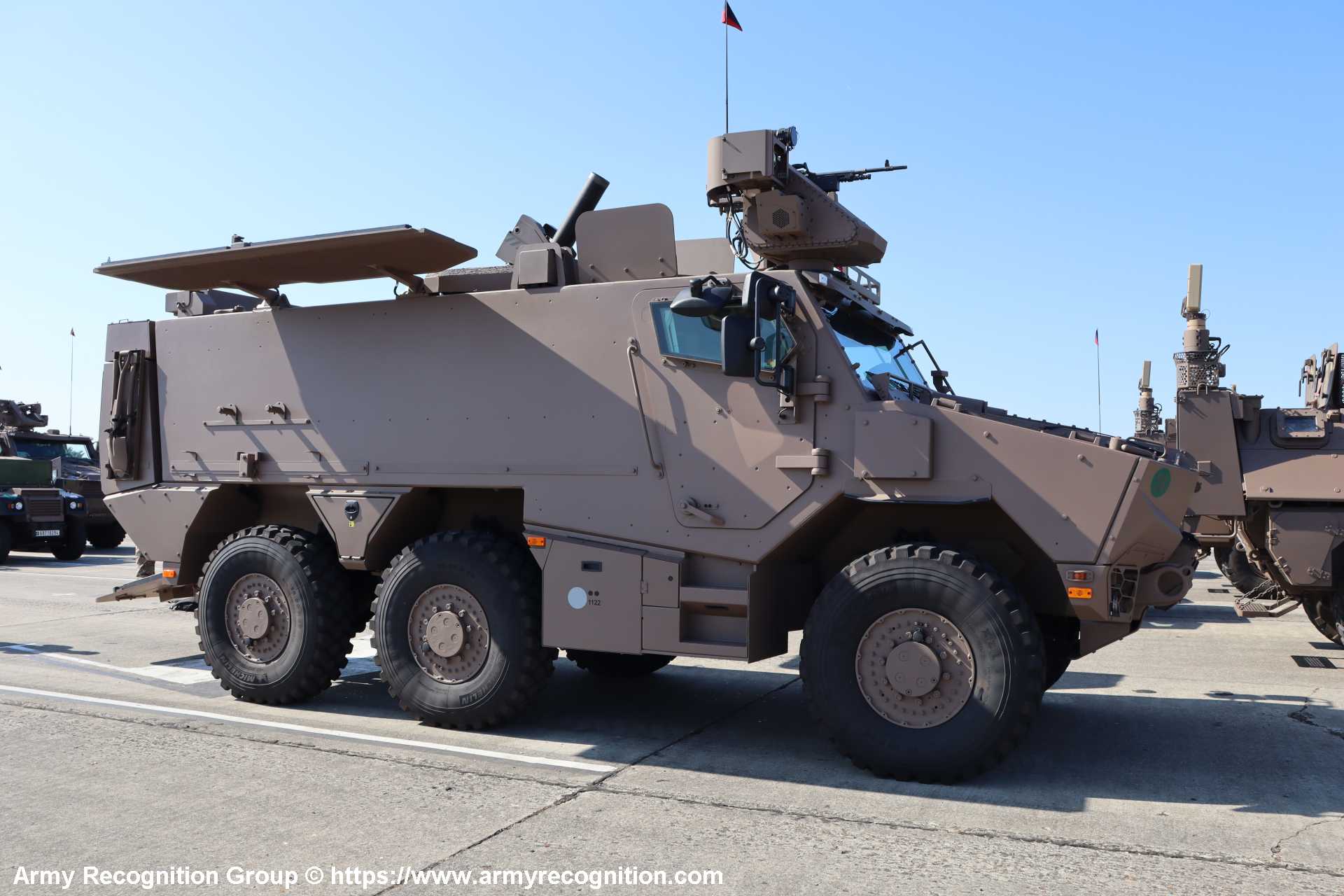
- Details
- Written by: Administrator
- Category: Defence & Security Industry Technology
- Hits: 4348
During the 2025 Bastille Day military parade rehearsal in Paris, the French Army publicly presented its new Griffon MEPAC (Mortier Embarqué Pour l’Appui au Contact - Mortar Carrier for Fire Support) for the first time, a 120mm self-propelled mortar system mounted on the Griffon 6x6 armored vehicle chassis. This marks a major advancement in the operational capability of French artillery units, as it replaces the older MO-120-RT towed mortar with a modern, protected, and mobile fire support system integrated into the SCORPION digital battlefield ecosystem.
Follow Army Recognition on Google News at this link
The Griffon MEPAC is a new French self-propelled mortar carrier vehicle that integrates a 120mm rifled mortar system into a Griffon 6x6 armored vehicle. (Picture source: Army Recognition Group)
The Griffon MEPAC 120mm self-propelled mortar carrier represents a significant evolution in artillery indirect fire support capabilities for the French Army. It retains the firepower of the 120mm MO-120-RT rifled mortar but incorporates it into a fully armored and mobile platform, drastically improving mobility, responsiveness, and crew protection. This transformation enables mortar crews to conduct fire missions rapidly and redeploy immediately after firing, a critical advantage in modern high-intensity conflict zones where mobility and survivability are essential.
One of the primary advantages of the Griffon MEPAC over the previous towed version is its shoot-and-scoot capability. With the MO-120-RT, mortar teams had to rely on external vehicles for towing and were required to set up the system manually in open terrain, leaving crews exposed to enemy fire and significantly increasing deployment time. The MEPAC eliminates these vulnerabilities by integrating the mortar within the Griffon's armored hull, allowing firing operations to be conducted entirely under armor. This not only accelerates response times but also drastically enhances survivability against counter-battery fire and aerial threats.
Protection is another decisive improvement. The Griffon MEPAC provides full ballistic and mine protection compliant with NATO STANAG Level 4 standards. In contrast, MO-120-RT crews operated with minimal protection, making them highly vulnerable during fire missions. The armored environment of the MEPAC ensures crew safety while operating in contested environments, especially under drone surveillance or during artillery duels.
Automation plays a central role in the improved performance of the Griffon MEPAC. The vehicle is equipped with a Thales-designed automatic loading and aiming system, enabling higher rates of fire with reduced crew fatigue. Unlike the manual processes of the MO-120-RT, the automated systems onboard the MEPAC allow for sustained fire support with faster target engagement, improving mission effectiveness and precision.
The integration of the Griffon MEPAC within the SCORPION program brings another layer of operational advantage. The system is fully connected to the SICS (Système d’Information du Combat SCORPION) digital command network, ensuring seamless data exchange with forward observers, reconnaissance drones, and other combat platforms. This enhances situational awareness and shortens the sensor-to-shooter loop, enabling highly coordinated and synchronized fire missions. It also ensures full interoperability with other SCORPION-equipped vehicles such as the Jaguar and standard Griffon troop carriers, further reinforcing combined arms capabilities.
In terms of firepower, the 120mm mortar mounted on the Griffon MEPAC delivers indirect fire at ranges exceeding 13 kilometers, with the capacity to fire both conventional and smart munitions. The system can sustain a firing rate of up to 10 rounds per minute, depending on the type of ammunition and mission requirements. This level of fire support significantly increases the lethality and tactical flexibility of infantry units, especially in decentralized or expeditionary operations.
Logistically, the Griffon MEPAC also streamlines mortar operations. Onboard storage for ammunition reduces dependency on external resupply under fire, and the reduction in crew size due to automation allows for more efficient vehicle operation. All these factors combine to deliver a system that is faster to deploy, more lethal in execution, and significantly safer for the crew.
The unveiling of the French Army Griffon MEPAC 120mm self-propelled mortar carrier vehicle at the Bastille Day rehearsal is a visible demonstration of France’s continued investment in high-tech, combat-ready ground platforms. It underscores the country’s commitment to replacing legacy systems with modern, networked, and protected solutions capable of operating in tomorrow’s battlefields. As the French Army progresses with the SCORPION modernization effort, the Griffon MEPAC stands out as a key capability that aligns with new doctrines of high mobility, digital integration, and armored survivability. Its deployment marks a major leap in battlefield effectiveness and reinforces France’s position as a leader in next-generation land combat systems.
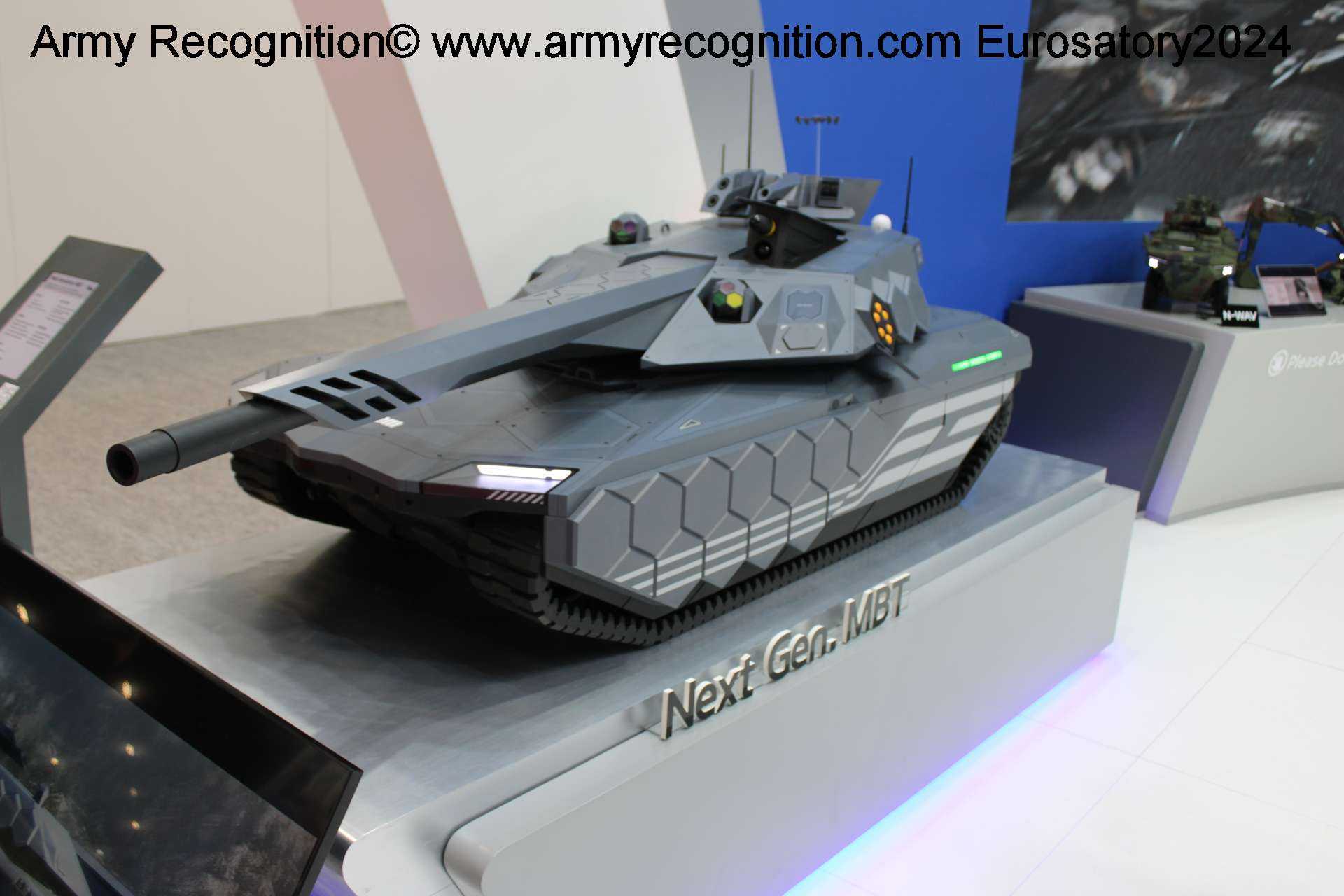
- Details
- Written by: Administrator
- Category: Defence & Security Industry Technology
- Hits: 6787
According to information published by the mason_8718 X account on July 14, 2025, the South Korean Company Hyundai Rotem confirmed that the new 130 mm main gun for the K3 next-generation main battle tank has been successfully tested, marking a major step forward in the tank’s firepower capabilities. The South Korean defense manufacturer also reported that the development of next-generation armor for the K3 is progressing smoothly, and entirely new propulsion systems and active protection systems (APS) are currently under development.
Follow Army Recognition on Google News at this link
Scale model showing a possible design concept of South Korea’s future K3 main battle tank equipped with a newly tested 130mm main gun. (Picture source: Army Recognition Group)
The new generation of South Korean K3 tank will feature a further evolution of the high-density, lightweight composite armor that enabled the K2 Black Panther to be several tons lighter than other 3.5-generation MBTs (Main Battle Tanks). Hyundai Rotem emphasized that there are no plans to accelerate production, as the program remains in a deliberate development phase.
The successful testing of the 130 mm gun represents a significant milestone for the K3 program, as it positions South Korea at the forefront of advanced MBT armament development. Compared to the current 120 mm smoothbore guns in widespread use, the 130 mm caliber is expected to deliver superior armor-piercing performance, extended range, and higher muzzle energy, allowing the K3 to engage future threats effectively. This gun is likely to be paired with a new-generation fire control system and integrated combat suite to maximize lethality and accuracy in high-intensity operations
In terms of protection, Hyundai Rotem revealed that the K3 will incorporate cutting-edge armor technologies surpassing those used in the K2 Black Panther. The new armor reportedly solves longstanding space and weight issues while delivering improved defensive performance. The K2’s armor was already considered advanced due to its use of high-density composite materials and modular armor blocks. The K3 takes this foundation further with new materials and design optimizations, possibly including nano-ceramics, advanced laminates, and embedded reactive or electromagnetic layers. This evolution allows the K3 to remain lightweight without compromising survivability against kinetic or shaped charge threats.
The propulsion system under development is also set to be a major leap forward. While detailed specifications have not yet been disclosed, sources suggest that Hyundai Rotem is working on a next-generation powerpack that could feature improved thermal efficiency, increased power-to-weight ratio, and possibly hybrid-electric components for silent mobility and reduced infrared signature. A new transmission and upgraded suspension will likely accompany this engine to support enhanced maneuverability across various terrains.
For active defense, the K3 will be equipped with a fully redesigned active protection system. Although Hyundai Rotem has not provided technical specifications, this APS is expected to feature multi-layered countermeasures including radar-guided hard-kill interceptors, soft-kill jammers, and AI-based threat detection. This would place the K3 in direct competition with other next-gen MBTs such as Germany's KF51 Panther and future variants of the U.S. AbramsX.
Despite these advancements, Hyundai Rotem has made it clear that the K3 program is not being rushed. The company is prioritizing thorough research, testing, and validation at each phase of development. This deliberate approach is intended to ensure the final platform delivers unmatched performance and reliability, in line with the Republic of Korea Army's future operational requirements.
Meanwhile, production operations at Hyundai Rotem's tank manufacturing facility remain focused on fulfilling ongoing export commitments. Workers continue to operate in rotating shifts to produce K2 tanks for Poland, in line with a multi-year defense agreement signed between the two governments. This production tempo has remained stable over the past three years, showcasing Hyundai Rotem’s ability to maintain a steady supply line while concurrently developing next-generation systems.
It was also clarified that the image shared alongside the recent update does not represent the final configuration of the K3. The actual appearance, modular subsystems, and integrated features are still undergoing revisions as engineers fine-tune the tank’s architecture.
With its powerful 130 mm gun, advanced protection, and forward-looking mobility systems, the K3 is shaping up to be one of the most capable MBTs on the horizon. As Hyundai Rotem continues development at a measured pace, the international defense community will be closely watching the emergence of this high-tech armored platform designed for future conflicts.
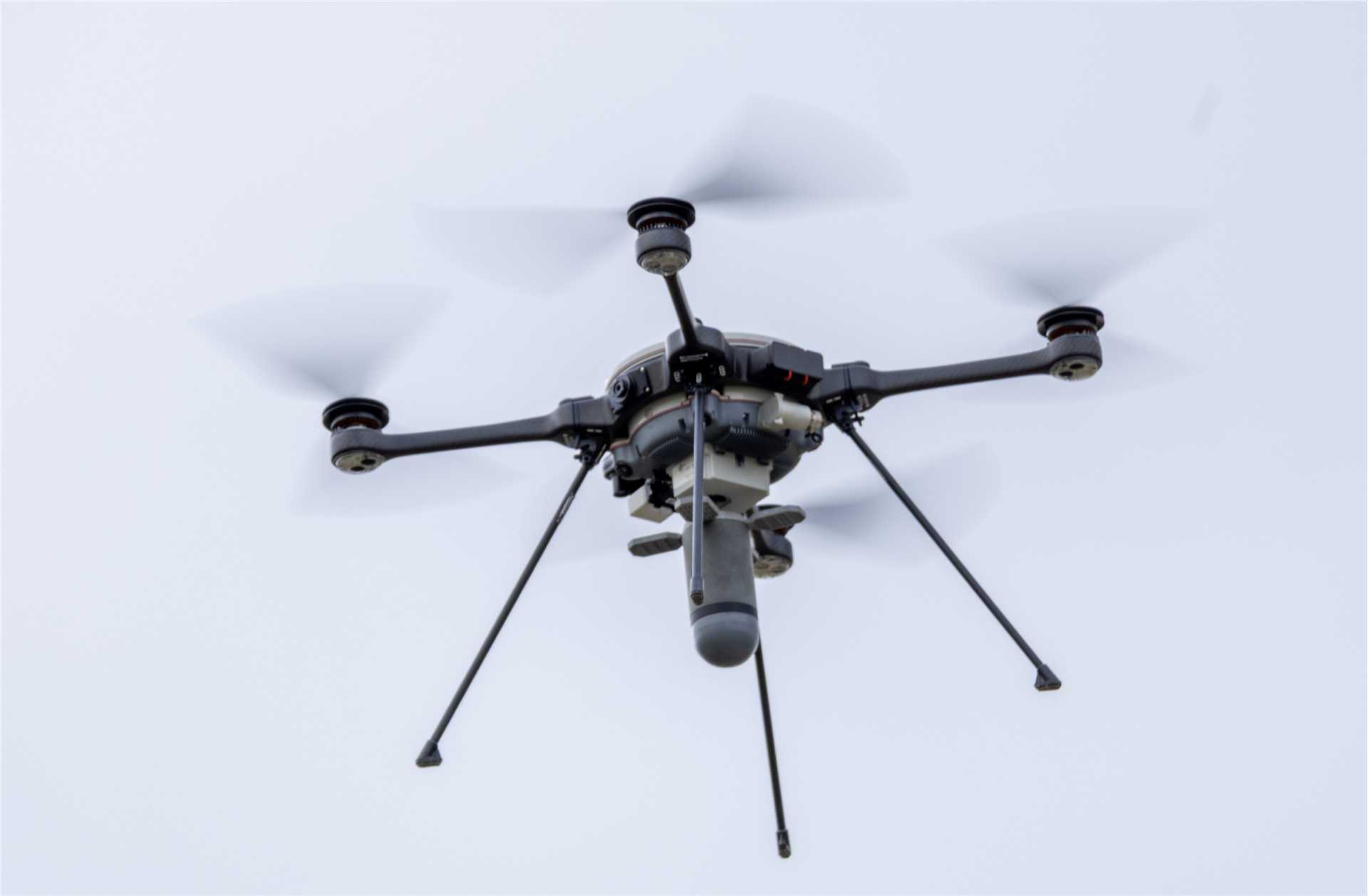
- Details
- Written by: Administrator
- Category: Defence & Security Industry Technology
- Hits: 3509
According to information published by the U.S. Department of Defense on July 9, 2025, the United States Marine Corps has conducted a historic live-fire demonstration at Camp Lejeune involving the R80D SkyRaider unmanned aircraft system (UAS) deploying a Mjölnir lethal payload. The test marks the first time a program-of-record UAS has delivered a live munition during a Marine Corps exercise, signaling a critical leap forward in the Corps’ drive to weaponize tactical drone platforms and reshape the modern battlefield.
Follow Army Recognition on Google News at this link
An R80D SkyRaider small unmanned aircraft system carries a Mjolnir munition during a combined arms live fire exercise performed by U.S. Marines at Camp Lejeune North Carolina, on July 3, 2025, demonstrating the use of aerial drones for precision strike against designated targets. (Picture source: U.S. DoD)
The R80D SkyRaider is a vertical takeoff and landing quadcopter developed by Teledyne FLIR and primarily used for intelligence, surveillance, and reconnaissance. It features modular payload capability, autonomous flight systems, encrypted communications, and ruggedized construction for field deployment in austere or GPS-denied environments. While originally intended as a sensor platform, the SkyRaider's flexible payload architecture has enabled its evolution into a lethal platform with the integration of compact munitions like the Mjölnir, giving small units precision-strike capability in complex terrain.
The decision to integrate armed drones into frontline Marine Corps units has been heavily influenced by the operational realities witnessed in the Russia-Ukraine conflict. Over the course of that war, both Ukrainian and Russian forces have demonstrated how small, inexpensive unmanned aerial systems can produce outsized battlefield effects. Commercial and military-grade drones have been used extensively for real-time targeting, surveillance, and direct strikes using improvised and precision-guided munitions. These drone operations have disabled armored vehicles, neutralized artillery, and executed targeted strikes against command positions with remarkable precision. Their use has also proven decisive in urban environments and trench warfare, where conventional weapons face limited maneuverability and greater risk of collateral damage.
Drawing from these real-world examples, the U.S. Marine Corps is accelerating the integration of lethal small UAS (Unmanned Aerial System) into its distributed operations model. The recent demonstration involved the SkyRaider and the Neros Archer drones working in coordination with traditional fire support assets, including 81mm mortars and the Javelin missile system, in a simulated company-level assault. The successful drop of the Mjölnir munition by the SkyRaider, followed by layered indirect fires, represents a strategic shift in how Marine infantry formations apply precision fires independently in austere environments.
The Mjölnir munition used in this test is a compact, precision-guided explosive device roughly the size of a soda can, engineered to deliver lethal effects with minimal risk to surrounding personnel or infrastructure. It carries a 500-gram explosive charge surrounded by ball bearings and can be configured for either point detonation or aerial burst, depending on the tactical requirement. Its most advanced feature is a LiDAR-based proximity sensing system that enhances its detonation timing and effectiveness.
LiDAR, which stands for Light Detection and Ranging, uses laser pulses to measure distances and build a precise model of the surrounding environment. When integrated into the Mjölnir, this technology enables the munition to assess its altitude and the contour of the terrain below in real-time as it falls toward the target. Based on this data, it calculates the optimal detonation point. For anti-personnel missions, the munition can detonate in mid-air to disperse its payload in a horizontal fragmentation pattern, maximizing area effects. For direct strikes on hardened or concealed targets, it can trigger upon contact to concentrate explosive energy downward. This level of controlled lethality is particularly valuable in urban combat, close-quarters engagements, or when operating near friendly forces or civilians.
The concept of pairing the SkyRaider with the Mjölnir munition originated during a School of Infantry Summit attended by Maj. Gen. Anthony Henderson, Commanding General of Training Command. Inspired by the technology’s potential, Maj. Jessica Del Castillo, Commanding Officer of the Small Unmanned Aircraft School (SUAS) at the Advanced Infantry Training Battalion (AITB), proposed the live munition integration as a tactical innovation. Her proposal was immediately endorsed by Henderson, who directed AITB to execute a live demonstration within sixty days. The result was a successful real-world test that has now opened the door to broader experimentation and possible fielding across infantry battalions.
From a tactical perspective, the Mjölnir munition enhances the firepower of dismounted units by enabling them to engage targets that were previously unreachable without artillery or air support. It gives Marines the ability to eliminate snipers, disable light vehicles, or destroy enemy strongpoints with speed and accuracy. The drone-based delivery method ensures low-signature engagement, minimal logistical footprint, and enhanced survivability for operators who can remain under cover during the strike.
This new capability aligns with the Marine Corps’ Force Design 2030 vision, which emphasizes mobility, distributed operations, and scalable lethality. As the service adapts to modern peer-threat environments, such as those witnessed in Ukraine, the use of smart munitions delivered by small drones will become a cornerstone of how Marines fight and win in future conflicts. The successful demonstration of the SkyRaider-Mjölnir pairing is not just a technological milestone, but a clear indication that the battlefield of tomorrow will be increasingly autonomous, networked, and precise.
- Technology: Turkish Arpan 155 8x8 howitzer conducts live firing test competing with modern artillery systems
- Exclusive: Chinese Army demonstrates PCL-181 155mm howitzer precision strike capability in high-altitude mountains
- Technology: Rheinmetall from Germany introduces new Protected military truck TGS-Mil with modular armor
- Technology: France's ARQUUS develops new autonomous anti-tank robotic system with Akeron missile